|  Home  |   About us  |   Programs & Projects  |   Calendar  |   Birding  |   Blog  |   Get Involved  |

Monday, April 9, 2012

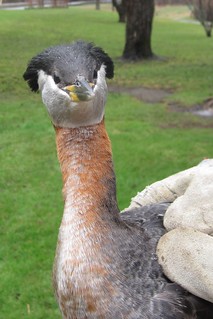
Crash Landing of a Grebe


When the phone rings at North Branch Nature Center, we never know quite what we'll hear when we pick up. Today, we were surprised when a caller told us about a duck that was stuck in a puddle on the sidewalk in downtown Montpelier! The bird turned out to be a Red-necked Grebe.

Grebes are similar in appearance to ducks, but come from a very different lineage. Like loons, grebes eat fish by diving underwater. They've evolved nicely to this lifestyle, with their legs attached towards the back of their bodies (like the motor on the back of a boat). They have lobed toes, which allow their feet to act as flippers and propel them through the water. As a consequence of their anatomy which is so well adapted to life in the water, they are unable to take off from a solid surface.

Red-necked Grebes spend the winter along the Atlantic and Pacific coasts, and each spring they migrate at night to central and western Canada to breed. From above, a wet parking lot can look a lot like a big lake. Street lights can cause further confusion for birds, causing them to crash-land and become stranded on asphalt. In December, more than 4,000 Eared Grebes were grounded in a Wal-Mart parking lot in Utah, a quarter of which didn’t survive.


The Red-necked Grebe that crash-landed in Montpelier has an injured leg and was transported to a waterfowl rehabilitator this afternoon. If the leg does not heal, the grebe will be unable to hunt for fish and will not be rereleased into the wild. We hope this will not be the case, and that the bird will heal quickly so it can continue its northward migration. Traveling hundreds of miles each year is an inherently dangerous task for birds and other migratory animals and this incident demonstrates the added hazards that are created in a human-altered landscape.

Thursday, April 5, 2012

One Teacher, One School, One Community


I love my job. I get to be outside wandering through streams and navigating forests with some of the most incredible human beings,..children. I can not tell you how much I learn from my young friends in a simple blog post. I have learned patience, compassion, self efficacy, resilency, and the process of healing.  For the last 7 months I have been working with a teacher and her class of brilliant and loving kindergarteners at Moretown Elementary School. I thought I was just inspiring teachers and their students to learn outdoors. Instead, I have been taught one the most powerful lessons of my teaching career. Please read the story below, written by Pam Dow of Moretown Elementary.


Our school year started like none other.  Just two days before our scheduled opening, parts of our village and town were ravished by tropical storm Irene.  The opening of school had to be delayed.  Children and families spent the first days after the flooding wrapping their heads around the magnitude of the disaster that destroyed their homes and town.   Quickly it became neighbors helping neighbors, strangers helping strangers, Moretown helping Moretown.  Although many of our material possessions were destroyed by the flooding, our sense of community was just beginning to emerge.
Many children’s homes were flooded and their prized possessions were gone or covered in a thick, gooey muck that was left behind after the waters receded.  The school suffered damage as well, and as staff went about helping families clean out their homes, a professional cleaning crew set to work on the school; ripping up all flooring, scrubbing and sanitizing anything salvageable that came into contact with the contaminated waters. 
Although crews worked hard for many days, our school building was still not safe for students.  Many of our school children were experiencing the most tragic event of their lives, watching their homes and town be destroyed.  They saw the sides of the main street piled with debris-residents’ belongings and the guts of their homes, not salvageable due to the wrath of Irene. 
Moretown children needed normalcy. They needed something they knew and loved, which was why the staff knew school must go on.  We began our school year with a series of fieldtrips to destinations across Vermont.  Destinations that welcomed us with open arms and kindness.  After several days of fieldtrips, we began school in tents set up on our baseball field.  With surprising ease, children and adults adapted to our tent school.  Teacher’s taught, children learned.  I think we all grasped at this sense of normalcy, this idea of routine…school.  We were together as a class, a school, and a community and for a few hours we could focus on something other than the destruction of our homes and town. 
When the time came to return to our classrooms, it was a celebration.  Kindergartners were excited to begin a new program, a Nature Adventure Program, which connected students with the forest behind our school.  For three hours each week, we have had the distinct pleasure of working with Amy Butler from the North Branch Nature Center.  It quickly became apparent that this program was vital to the health and well being of our children.
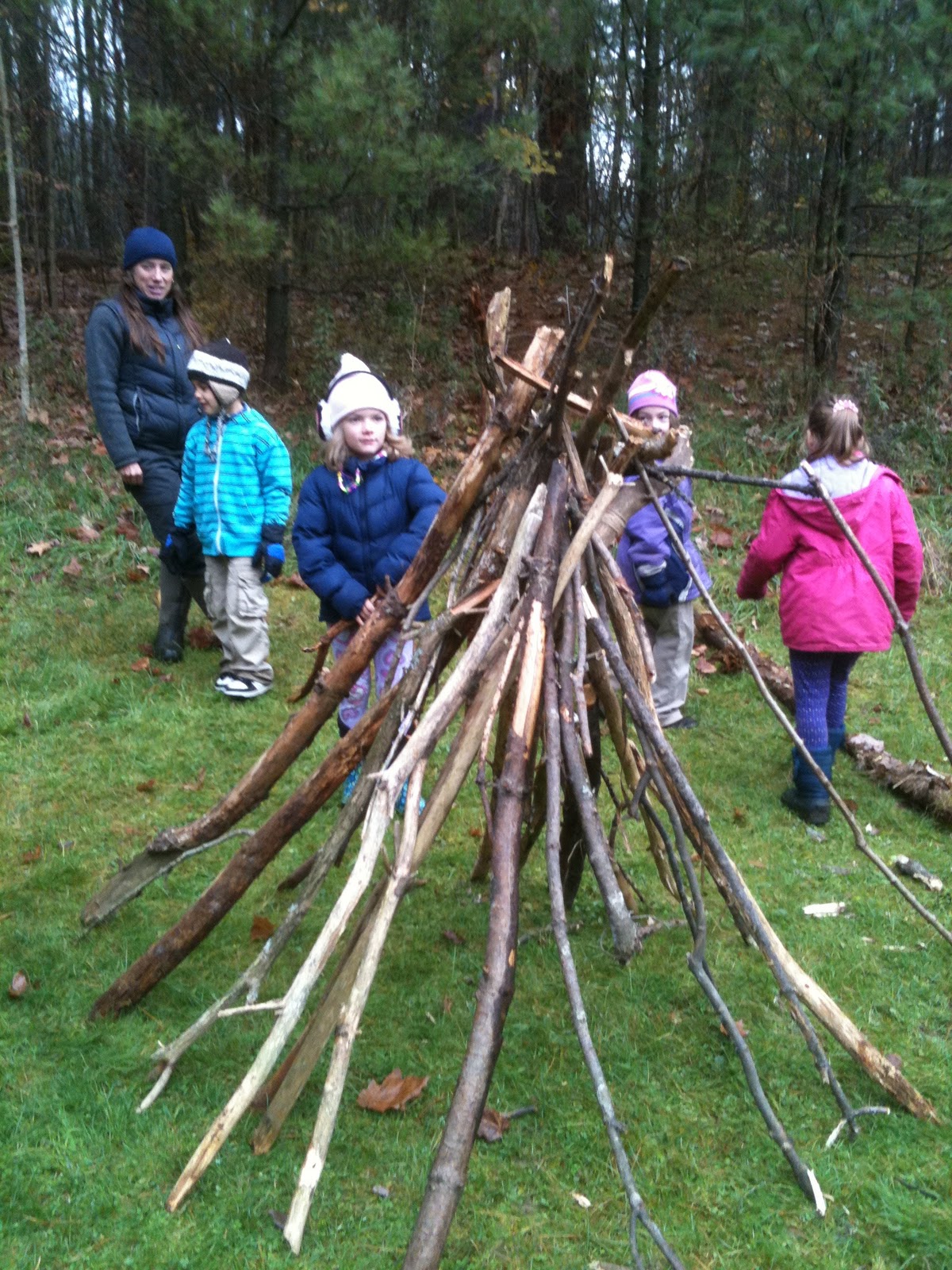
 I have watched as children eagerly wait for Wednesday mornings to arrive so they can go out into the woods behind our school to explore, build, and connect with the natural world around them.  The timing of this program was perfect; these children were living out the realities of a natural disaster but were able to escape into the woods for solace each week.  This group of five and six year olds quickly took to building…building with sticks and stones, leaves and natural materials.  They built and built, from small mouse houses to “sewers” (large holes at the base of trees) that they dug with sticks.  The building continued all fall and winter and now into spring.
The sticks and stones and their actions represent much more than children exploring in the woods. These children have been putting actions behind their emotions.  They are mimicking the actions of the adults around them, they are rebuilding.  As these children watched their town slowly being rebuilt, they, too, rebuilt their sense of normalcy, rebuilt their sense of safety, while rebuilding their homes in the woods.      
Five and six year old children love to build; building in the woods, however, took on a whole new meaning.  This group of children used its time in the forest to heal, to make sense of the devastation that took over their lives.    Through their experiences, these children are becoming leaders, eager to assist their friends up a steep hill or share their knowledge of the natural world with others.  These children have been given the gift of the forest this year.  It was just what they needed as they experienced the rebuilding of their town and so many lives.    
This year it was the flood. Next year, however, it could be Mom and Dad’s divorce, a car accident, the death of a loved one.  I have come to realize that our natural world is a place for healing.   Time spent outside is time spent learning about life, about our sense of community.  Children need to be given this gift each and every school year.  


Friday, March 9, 2012

5 Ways to Make it Better


You've the read the statistics about children's disconnect from nature and community. What's the latest news now? 6.5 hours a day of screen time for the average American child? Or is it 8 hours? Diminishing unstructured play time for kids, less leisure time for adults, and more time on the job. National Park visitation has dropped and childhood obesity is booming. Children can identify more video games and commercialized plastic products than they can recall a common bird song or verbalize the difference between a sugar maple and a white pine. Access to wildpsaces is vanishing and "stranger danger" has crippled free roaming in our neighborhoods. 20 years ago when I began working with children outside none of these statistics were being talked about. Many of them hadn't even come to be. We were still trying to protect whales and save the rainforest. The fabric of our own New England landscape hadn't yet been inundated with HD TV, Xbox, cell phones, high speed Internet, ipods,and the list goes on with the support of a crumbling economy.
Now, I feel like I am trying to save my own species, the human one, and the whole of childhood. Quick, let me teach you how to play and be outdoors! But, let's not continue to dive into the why and what might happen if we don't,...rather let's look at how we can make a change. I strongly believe change starts at home, in our schools and in our communities (yeah Vermont!). I'd like to share just 5 ways to make it happen on your doorstep. This is a top 5 list not to ignore.

#1 -  Nature is contagious. If you want to instill a love of the outdoors in your children, you as a busy adult need to get outside as well. Be a model for your kids. They are watching you and listening to you. Get dirty, wear mud boots and rain pants. Jump in snowbanks and catch a frog. Make going for walks in the forest or near a pond a weekly family activity. Playing is contagious and an incredible stress reliever,...especially outside. Take the time, we have more than we realize.

Time to engage


#2 - Have a "Bag-of-tricks". Children love using tools. Hand lenses, a small hand trowel for digging, a flashlight for dark crevices, string, cups for filling and dumping, pencils and paper. All of these can make a morning walk turn into an all day exploration. Don't forget a beginner field guide as well. Keep your "bag-of tricks" at the back door. A snack and a water bottle brings the bag up to a new level. Don't leave home without it!

#3 - Open a Nature Museum. Your children will fill their pockets with things they have found outside. Rocks, feathers, leaves, shells, sticks, and yes, even handfuls of dirt. Make a space for your children's treasures in your home. Let nature come inside and be part of a museum and an ongoing learning opportunity. Set a place at the dinner table for nature.

#4 - Look for Natural Play Spaces. Children love to create their own play spaces outdoors. Look for the nooks and crannies in a hedgerow, under the drooping boughs of a fir tree, or next to a large boulder. Nature provides it's own playground with a much bigger opportunity for making it your own. The kids will tell you where the best places are, it's part of their biology. Follow them!

A child's special place

#5- Find your Local Nature Hot Spots. Most communities in Vermont have a public park or recreation field. Find out where they are and then follow the suggestions above! Did you know the city of Montpelier has miles of trails starting at Hubbard Park and going all the way to East Montpelier? Town forests are open to the public for exploring and taking care of. Know where your rivers are and what we've named them. Become a steward of a green space or a watershed in your town.

It's meant to be simple and straight forward. It's just 5 ways. Get out there and make it better for our children and for yourself.  Nature is waiting,....

Waiting for nature to soak in


Saturday, February 25, 2012

Deciphering Ducks

As the days grow steadily longer, spring is fast approaching and signs of spring are upon us.  But before the leaves burst out and the colorful songbirds arrive in droves, a great migration of waterfowl is about to take place.  Most of these plump-bodied water birds have their sights set far north of Vermont, but stop briefly in our ponds and puddles on their journey.  Over two dozen species may pass through each spring, some colorful and some drab, but how do you tell them all apart?

For anyone who has painstakingly searched for warblers as they dart around in treetops, watching waterfowl will be a nice reprieve from the aches and pains of warbler neck (the syndrome that comes about from craning your neck upwards in order to look vertically for warblers above).  Waterfowl tend to be sedentary, sitting still in the open water allowing for prolonged observation.  They tend to be large, and have distinctive patterns that help identify them.  But with many species, distinguishing them can be difficult.  

One of the first steps towards deciphering ducks is to have the proper equipment.  Binoculars are a must, but they will only allow you to see waterfowl that are nearby.  A spotting scope can be an invaluable aide in identifying ducks even at great distances.  The next step is to learn the most common ducks.  The best way to spot other rarer species is to know that what you are looking at is not a Mallard!  Can you tell which of the ducks below is a female Mallard?

To learn more about ducks and how to tell them apart, join us for the Better Birding Series on Monday, March 5 (program details below)
 
Better Birding Series: Deciphering Ducks
Monday, March 5, 6:30 p.m.@ First Baptist Church of Montpelier
Fee: $10
In time for the spring waterfowl migration, you'll get ducky. Think of this lecture as a "Duckumentary." You'll learn a simple approach to watching waterfowl and how to distinguish species in flight or when they're just sitting there in front of you. Featuring guest lecturer Larry Clarfeld of NBNC.

Tuesday, February 14, 2012

All Day Outside

Exploring a winter creek
It's another beautiful Monday in Vermont and 30 first grade students are getting ready for a day in Hubbard Park. Each backpack carries a lunch, a water bottle, and a hand crafted mini sled. Every hand, head, foot, and mind is properly prepared for the day ahead. And, yes,...it's February. The outside temperature has climbed to 28 degrees and students are carrying thermometers and a plethora of questions that were generated during morning meeting.

Thermometers in action
How cold is it outside? What is the temperature of the river? Can penguins survive in Hubbard Park? Penguins as we know, do not live in Vermont. But to these first graders at Union Elementary, it is a hot topic because they have been studying penguins through a new math curriculum. Along with penguin math, the students have also been discussing properties of matter and force and motion. What better learning scenario than a day outside in winter? They will encounter a river, a pond, and a mysterious creek moving under ice. A half inch of fresh snow and a layer of hard packed snow turned ice, adds another medium to study. Icicles, frozen puddles, and melting snow under a February sun. We have found the ultimate science laboratory outdoors in the capitol city!

Taking the temperature of the North Branch River

Custom made sled for Piggy
 The concepts of  force and motion is easy enough to experience first hand by sliding bodies down an incline. But, why not construct your own mini-sled with cardboard, plastic, paper, popsicle sticks, and duct tape? Now that's a motivational button for learning! Build your own sled for your favorite small animal or cartoon character. After a few test runs on a carefully groomed surface, children were reconstructing their sleds with more duct tape and objects found close by.
"Hey Amy! I'm gonna tape my water bottle to this sled! Then watch out for how fast it's gonna be!"
Now that's force and motion, first grade style.

Mini sled with jet propellers and a plow
   The day sailed on in a mixture of sun, laughter, snow, idea sharing, questions, tons of observations, and new conclusions. Slow learning is good learning, for it allows for assimilation. This ECO day was planned so that children could move in between "science stations" which offered different degrees of stimuli and multiple ways to be a participant. It may not look slow with all these excited bodies scurrying about, but really,.. it is. All these outdoor provisions that helped to create a day of learning ultimately guided every child to follow their own interests and needs through inquiry based learning. In the end, children experience independence, self organization, participation, and empowerment.

That's 10 am to 2:45pm. No need to go back into the school building today.
We closed our day by having a  sharing circle on the snow covered lawn of Kellogg Hubbard Library.
" What were you most thankful for today?" the teachers asked. Here is what the children shared:

"I am thankful for,....my mini sled because it went fast, the birds singing, being outside, the frozen water that I broke, the fire because it got me warm, my mom, my dad, my teacher, penguins, my friends, nature, the earth and,...I'm just thankful for the whole day!"

All day. Outside. Something to be truly thankful for.

The community is our classroom

Thursday, February 2, 2012

Vermont Team Competes in Superbowl… of Birding

Sunrise off Cape Ann

The skies were clear and the weather warm for the Superbowl this past weekend, only it was birds flying instead of footballs. From 5:00 a.m. to 5:00 p.m. teams of birdwatchers looked high and low for as many different types (or species) of birds as they could find along the Massachusetts coast. For the fourth year, a team of adults and youths from Vermont participated, sponsored by the North Branch Nature Center of Montpelier.

The night before the competition, the team (called the North Branch Noddies) carefully planned their route for the following day. In addition to being experts of the local birdlife, teams must devise clever strategies to ensure they are in the right places at the right times to see the most birds. Each species is assigned a point-value based on the how difficult it is to find (1 point being easiest and 5 points being hardest). So, while a chickadee is worth just one point, a Snowy Owl is worth three, and a Townsend’s Warbler is worth five points.

The Team gazes upwards at a
Townsend's Warbler

Alarm clocks rang at 4:00 a.m. on the morning of the competition, and by 5:00 the team was poised and ready at their secret owl spot. By 5:15 a.m. they had their first two points, for a Eastern Screech-Owl calling in the distance. Scouring the rocky shoreline of Cape Ann, the Noddies continued to rack up points through the morning hours. Many species of birds that breed in the arctic spend the winter months off the New England coast, which for them, is considered “south for the winter”. The obligate trip to the fish pier added several rare species of gulls as they fought over fish scraps on the docks. A pair of Peregrine Falcons watched from afar, perched atop the distant church steeple.

The mild weather certainly played a role in the birdlife encountered. Lakes and ponds with open water meant an abundance of waterfowl that typically vacate in winter, such as Northern Pintails, Ruddy Ducks, and American Coots. Even some insectivores were toughing it out on the coast this winter including a Gray Catbird and a rare vagrant Townsend's Warbler, seen gleaning insects from the needles of a tall spruce tree.

Sunset from Plum Island, after
12 hours of birding

Slowly working their way north, by late afternoon the Noddies had reached Plum Island, considered one of the finest birding locales in New England. Here, on the rolling sand dunes and extensive marshes, the Noddies would complete their quest. From a single spot along the main road, two Snowy Owls could be seen sitting upon the barren, snowless landscape. A flock of hundreds of shorebirds chased the breaking waves along the beach. And as the sky became infused with pink and purple at dusk, a Short-eared Owl could be seen cruising the fields, hunting under the shadows of the setting sun. After twelve hours of birdwatching, the Noddies raced to the finish line with a total of 66 species and 124 points.

The Noddies will be competing in the World Series of Birding this May, email Larry for more information.

If a Child Picks Up a Stick in the Forest,....


 What happens if a child picks up a stick in the forest? It's not a question of if, because they do and they will! When a child does pick one up, what does that stick become? Working with school teachers, this is one of the first concerns of being outside with a classroom of curious children. Do we let them play with sticks? And what does it look, feel, and sound like if 20 children are wielding sticks in the forest? Laying down a rule of "no picking up sticks" is like taking your students to the top of a fresh snowy hill with sleds scattered about and telling them they can't go sledding. What would the point be?
Here is where we break down the barrier of "no sticks" and begin to observe and experience the benefits of allowing children to physically, socially, and emotionally construct their world through stick play.

First, what if we asked the children what they thought? So, we did. In morning meeting we asked students "How would you use sticks in the forest?" The children's reaction was immediate. Hands were raised and bodies were wriggling with ideas and prior knowledge.
We can: build a fort, build a fairy house, build a house to sleep in, make a really big pile, build a fire, make a trap, build a wall to protect us, make a store and sell things,......
Wow. That's a lot of ideas! Notice the use of the word build. Children building things with objects found in their immediate environment is as natural as them learning to walk. Providing space and time to build outdoors expands the experience into a new realm. With more space, it allows for more movement, which creates more language use, and in the end, deeper cognitive development.
The next question we pose to the class is, "How will we do all that building and be safe near our friends?" I ask the children to raise a hand if they have ever been hurt by a stick before. All the children's hands go up. They have all had direct experience with this! The children share with a neighbor and the stories begin to pour out. (Children LOVE and need to share their personal stories. Especially when it connects to the topic at hand. Giving them a chance to share with other classmates strengthens the classroom learning culture and is powerfully inclusive) After a couple minutes of sharing we begin to make our Safe with Sticks list. In all 10 classrooms, the children agreed that sticks are not weapons and we don't hit with sticks. I never had to prompt these two ideas and it was always the first or second rule created by the children! Inevitably, a child grabs the perfectly styled stick and points it at a friend. "Bang! I got you!"
With a simple reminder we're redirected and back to our work.
" Hey friends, remember, we are in a Peace Zone. Let's keep working on that awesome shelter you started building last week!" It has become such regular part of the routine that I know hear children reminding each other of our rules. They are now in charge of their learning and their creations.
I hear children using phrases such as "bubble space" and "safety circle" when moving a stick bigger than themselves. I am also witnessing balance, coordination, development of gross motor skills, and cooperation as three children move a very large branch to add to a debris hut.
Our Safe with Sticks rules are made and students are imagining what they can do with sticks. Now the possibilities grow as the children navigate the landscape of the forest with building plans in mind. With a supportive adult to child ratio and room to roam, here are some examples of what has happened!


Class Stick Sculpture


How does it look?
Building a firewood shed!

Using a saw to cut the perfect length!

The outcomes of all this stick building? Here are just a few,.....developing spatial awareness, decision making, strengthening social and physical skills, building positive interaction and communication skills, learning problem solving strategies, appreciating what your body can do, and for some children it gives them an opportunity to develop control over their behavior and improve concentration by moving, manipulating, and orchestrating objects they have found in nature.
What if a child picks up a stick in the forest?
I guess I would be more concerned if they didn't.


A debris shelter in Hubbard Park built by 1st graders