|  Home  |   About us  |   Programs & Projects  |   Calendar  |   Birding  |   Blog  |   Get Involved  |

Showing posts with label public school. Show all posts

Thursday, February 2, 2012

If a Child Picks Up a Stick in the Forest,....


 What happens if a child picks up a stick in the forest? It's not a question of if, because they do and they will! When a child does pick one up, what does that stick become? Working with school teachers, this is one of the first concerns of being outside with a classroom of curious children. Do we let them play with sticks? And what does it look, feel, and sound like if 20 children are wielding sticks in the forest? Laying down a rule of "no picking up sticks" is like taking your students to the top of a fresh snowy hill with sleds scattered about and telling them they can't go sledding. What would the point be?
Here is where we break down the barrier of "no sticks" and begin to observe and experience the benefits of allowing children to physically, socially, and emotionally construct their world through stick play.

First, what if we asked the children what they thought? So, we did. In morning meeting we asked students "How would you use sticks in the forest?" The children's reaction was immediate. Hands were raised and bodies were wriggling with ideas and prior knowledge.
We can: build a fort, build a fairy house, build a house to sleep in, make a really big pile, build a fire, make a trap, build a wall to protect us, make a store and sell things,......
Wow. That's a lot of ideas! Notice the use of the word build. Children building things with objects found in their immediate environment is as natural as them learning to walk. Providing space and time to build outdoors expands the experience into a new realm. With more space, it allows for more movement, which creates more language use, and in the end, deeper cognitive development.
The next question we pose to the class is, "How will we do all that building and be safe near our friends?" I ask the children to raise a hand if they have ever been hurt by a stick before. All the children's hands go up. They have all had direct experience with this! The children share with a neighbor and the stories begin to pour out. (Children LOVE and need to share their personal stories. Especially when it connects to the topic at hand. Giving them a chance to share with other classmates strengthens the classroom learning culture and is powerfully inclusive) After a couple minutes of sharing we begin to make our Safe with Sticks list. In all 10 classrooms, the children agreed that sticks are not weapons and we don't hit with sticks. I never had to prompt these two ideas and it was always the first or second rule created by the children! Inevitably, a child grabs the perfectly styled stick and points it at a friend. "Bang! I got you!"
With a simple reminder we're redirected and back to our work.
" Hey friends, remember, we are in a Peace Zone. Let's keep working on that awesome shelter you started building last week!" It has become such regular part of the routine that I know hear children reminding each other of our rules. They are now in charge of their learning and their creations.
I hear children using phrases such as "bubble space" and "safety circle" when moving a stick bigger than themselves. I am also witnessing balance, coordination, development of gross motor skills, and cooperation as three children move a very large branch to add to a debris hut.
Our Safe with Sticks rules are made and students are imagining what they can do with sticks. Now the possibilities grow as the children navigate the landscape of the forest with building plans in mind. With a supportive adult to child ratio and room to roam, here are some examples of what has happened!
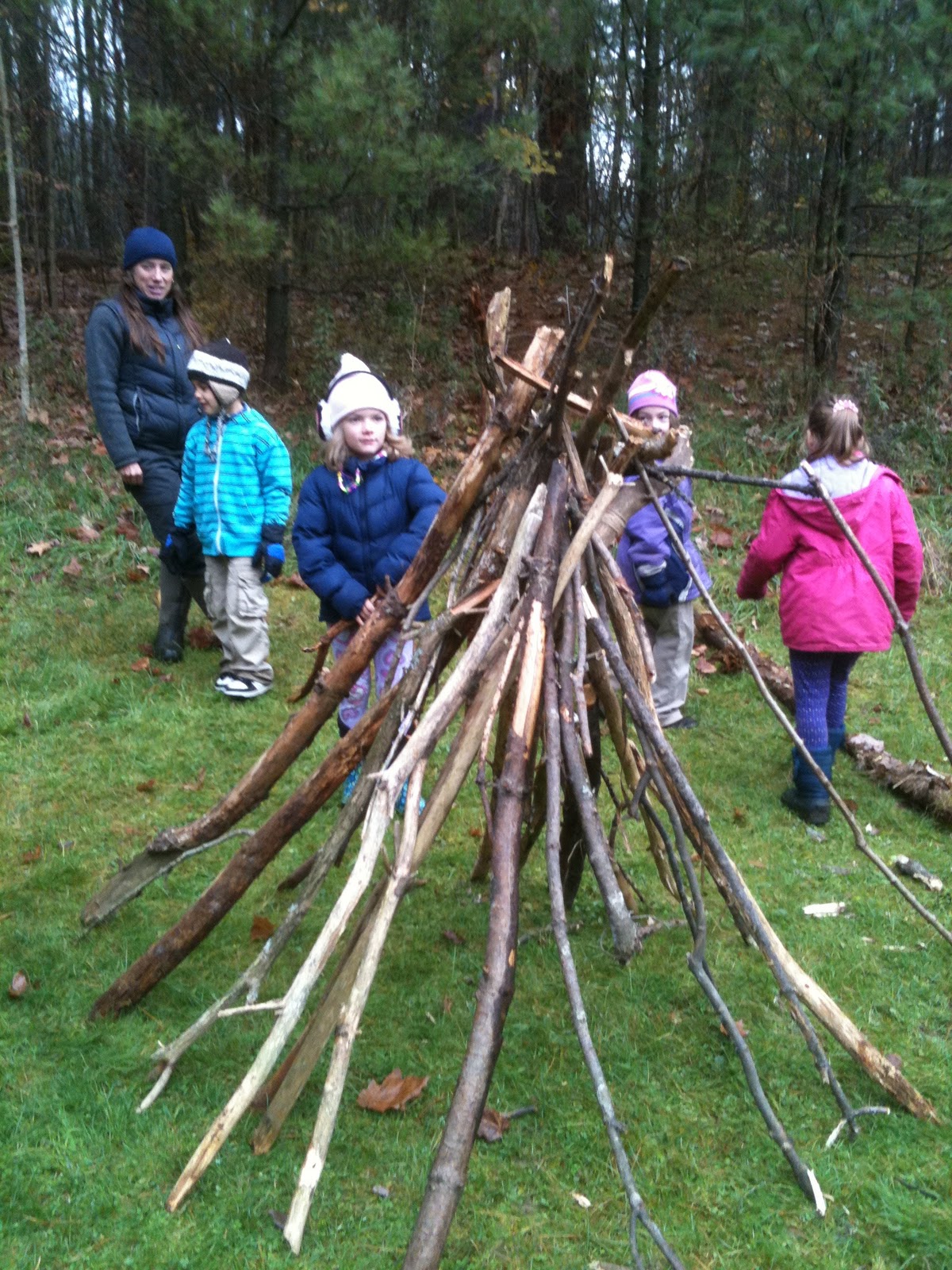

Class Stick Sculpture


How does it look?
Building a firewood shed!

Using a saw to cut the perfect length!

The outcomes of all this stick building? Here are just a few,.....developing spatial awareness, decision making, strengthening social and physical skills, building positive interaction and communication skills, learning problem solving strategies, appreciating what your body can do, and for some children it gives them an opportunity to develop control over their behavior and improve concentration by moving, manipulating, and orchestrating objects they have found in nature.
What if a child picks up a stick in the forest?
I guess I would be more concerned if they didn't.


A debris shelter in Hubbard Park built by 1st graders

Friday, January 27, 2012

Frank the River Otter and 12 Kindergartners

Frank in  the classroom 
Who's your favorite river otter? FRANK!
Why do all these Vermont kindergartners love this member of the weasel family so much? Is it his extreme cute face and soft thick brown fur? How about those webbed toes and beady black eyes. And yes, he does have ears! "But,... they're so small! Can Frank hear okay?" the children wonder.
The ooo's and aww's fill the classroom when Frank makes an appearance. No student ever wants to see him go. They have even written him Valentines and "we miss you" notes.
So lets go back to the question, why do small children almost immediately experience empathy with Lontra canadensis? Children love animals, especially ones that have similar characteristics to their own. Children are natural caretakers of living things when adults model this behavior. I also believe it has to do strongly with children's innate connection to play and the river otters as well.

It is a brisk winter morning and a 12 kindergartners are eager for their ECO (Educating Children Outdoors) day. The school children burst out the back door and scamper up a snow covered hill. It doesn't take long for one adventurous being to figure out if you lay down on you belly, head pointed down hill, give a little push with your arms, you'll be sliding with increasing speed to a certain destination.
 As a teacher and a naturalist, I capitalize on the moment for extended learning during play.
12 young river otters
"Hey! You all remind me of my favorite Vermont weasel!"
'"What's a weasel?" a child shouts as they slide away from me. I reach in my back pack and ready at hand is a mammal guide and a photo of a river otter. Children gather round in between sliding to glance at pictures and make comments. Here we are creating a culture of questioning and learning through exploratory play.
It doesn't take long for the children to create a river at the bottom of their slide, scraps of cloth turn into fish. A den is being dug in the hillside with fast hands turned paws. With a little help from the "adult otters", we learn that by clasping your feet together behind you, your legs turn into a powerful otter tail perfect for steering and propelling forward. I mention to my friends that a coyote may be interested in their small fish cache.
"A coyote? Where?" the children become increasingly concerned, their eyes darting across the landscape. Some stand up on two webbed feet and sniff the air. These kindergartners immediately come up with a system to watch over cached fish and a warning system for an incoming coyote. Hmmmm,... all of sudden these children are the wisest humans I know. They work together as a family to protect what they have. These children are totally engaged. Mind, body, and heart.

The scenario of river otter play continues and I make the very adult comment that we should move on to the  next part of our morning. A small river otter turns to me and barks, " No way! We're gonna slide all day! Plus, we're such good hunters, we already got all of our fish for snack!"
Slide on river otters! Slide on!


A 6 year old masters the river otter slide


Inspired research and writing


Tuesday, January 17, 2012

ECO - Educating Children Outdoors

The ECO program at North Branch Nature Center is a new project that helps reconnect children with the natural world and foster stewardship in their communities.  Through collaboration with public schools, preschools, and daycare facilities, ECO helps to open the doors to the joy of learning outside in all kinds of weather. By using city parks, public lands, and other local green spaces ECO engages children in the natural inquiry based learning of their surrounding environment. Through this type of active learning, children gain a healthy respect for nature and for one another. ECO provides an opportunity for teachers and students to apply integrated academic curricula beyond the classroom to the outdoors for exploration, experimentation, creativity, and personal growth.

 Now in its second year, ECO is working with 10 area school teachers on a weekly and biweekly basis to get their students outside and immersed in the natural world. ECO is not a field trip or a one hour visit to a forest. The students participating in ECO spend 2 ½ to 4 hours exploring a forest, playing games, learning woodcraft skills, journaling, and sharing in a community circle. These experiences happen continously throughout the school year. Rain, shine, and snow are welcomed weather features on any ECO day at public school. Schools have gathered all the needed equipment for their students to be dry and warm for engaged learning outdoors. There’s no such thing as bad weather, just bad clothing!
Not surprising, these days are some children’s favorite day of the week. Singing a song about rain, using ropes to climb a hill, making debris huts, following squirrel tracks in the snow, and boiling water in a Kelly Kettle for tea are all some things a child may experience on an ECO day. Inevitably, with more time spent outside moving and engaging in the natural world, each child develops a sense of themselves and their place in the world. By helping to foster a relationship with nature at an early age, children are given the chance to have a multi-sensory experience that will help them to retain knowledge in a more effective and meaningful way. This old Chinese proverb gives clarity to the purpose of ECO and the ongoing journey of life long learning for all human beings:
Tell me, I forget.
Show me, I remember.
Involve me, I understand. 


If you are interested in learning more about ECO and how to get involved, please contact amy@northbranchnaturecenter.org