|  Home  |   About us  |   Programs & Projects  |   Calendar  |   Birding  |   Blog  |   Get Involved  |

Showing posts with label learning through play. Show all posts

Wednesday, November 27, 2013

Learning beyond the classroom...in a bakery!

The Forest Schoolers had been showing real interest in baking and cooking projects, both real and imaginary, at the Nature Center.  They have made mud pies in our "Mud Kitchen," and savored homemade sumac lemonade and applesauce, and bread cooked over an open fire.  In order to enrich their learning and offer a different perspective on food preparation, a field trip to La Brioche bakery in Montpelier was organized.  The learning opportunities abounded, as did the sugar! 
During a tour of the kitchen, students watched an
industrial bread-rolling machine in action. 
What awe and amazement!

Chef Kat shows us how to pipe frosting onto a cupcake. 
We each practiced frosting cupcakes and decorated
Butterfly and Turkey cupcakes with candies and pretzels. 

That's one cute turkey!
Here we are, with all of our decorated cupcakes! 


 The students were really grateful for their experience at La Brioche.  It will be interesting to see how this learning opportunity extends into our interests at Forest School.  What do you think we should bake?


Wednesday, May 29, 2013

Build an Adventure in Your Forest

This spring students at East Montpelier Elementary School launched the beginning of our most popular ECO lesson to date.  These kindergarten and first graders at EMES were really looking to put their big creative energy to use. We presented the students with a wide variety of tools and inclusions. If you had ropes, buckets, carabiners, and a pulley what could you do? These students jumped in with ideas and focus that turned into The ECO Carnival. Ropes were soon being weaved between trees and buckets hung from various heights. By paying a carnival designer an American Beech leaf,  you could choose from a selection of forest grown games.  Your prize for landing a snowball in a moving bucket? Two large White Pine branches decorated with green twine. A trophy of sorts!
In another, much quieter area of the forest, students pounded charcoal and elderberries in The Pencil Store. Other children silently carved red osier and striped maple branches into pencils with a tool of choice, the Lancashire Potato Peeler.  Paper and journals were brought out of backpacks and soon students were writing letters and secret messages with their new handcrafted pencils with elderberry ink. Deliveries were made by messengers throughout the forest.  Who wants to buy a pencil at The Pencil Store?
 

The Pencil Store is open!


Making charcoal ink
 
Composing a letter
 
 Thanks to the children at EMES we have been wrapping our year in area schools by offering the children “workshop time” in the forest during ECO. We can easily align all the learning that was happening with our new Common Core and Next Generation Science Standards. Force and motion being a very popular one!
Although, that’s not what the teachers were noticing first about their students highly focused participation during these workshop times. The option of choice, self discovery, innovation, trial and error, communication and cooperation with peers,…the list goes on.  Many amazing and creative ideas and projects have sprouted up from this time. A life size Bald Eagle nest, obstacle courses made from willow whips, a chairlift for mice, rope swings, kid sized zip lines and you can’t have a workshop without being properly fed. Dandelion Pancakes anyone?

Dandelion Blossoms for Cooking
Ken makes the best pancakes EVER!
 
Around the fire, we are cooking and relaxing.


Friday, February 15, 2013

Why I build fires.

Each day we meet for Forest School, we make a fire.  It is a warm and welcoming ritual in the snowy, deep winter of central Vermont.  


But I have to admit, I wasn't always so keen on having a fire.  The pre-fire logistics of gathering kindling, requesting firewood donations from parents, checking the weather forecasts for wind and snow and rain all seemed too daunting.  Plus, with my poor circulation, the thought of having to take off my expedition-style mountaineering mittens to start a fire seemed worse than sitting for a few hours without a fire!  I would relegate the fire responsibility to my co-leader and supervise free play and tell stories instead. 

But earlier this week, when my co-teacher offered to join the group for free play, I somewhat ambivalently accepted the role of "Fire Tender."  It was a relatively warm day for mid-February (mid-20 degrees F) and Zach had already started the fire.  All I had to do was add more wood and stir the coals when the fire started to dwindle.  The crackling fire and the sounds of children laughing and shouting in play was comforting and I found a pleasant rhythm to my task.  I came to appreciate that task of tending fire really requires one to cultivate tenderness - attentive, patient, alert and observant.  In essence, being with the fire was quite similar to how I strive to be with my students.  The hour of tending fire passed surprisingly quickly, interspersed by visits from children to warm their hands, dry their mittens and share an interesting observation, and there was a welcoming fire for our end of the day Thanksgiving circle and closing rituals.  

This afternoon was a pivotal moment for me.  I used to skeptically approach fires as something too "crunchy" for me and a practice that was too time consuming to meld with my teaching style.  But I have really come to appreciate the immeasurable value of teaching with a fire.  

After going over some basic safety expectations with your fire guests, the fire is an amazing management tool.   The students naturally gravitate towards it, they are focused and thoughtful around it.  We eat lunch around it, share stories while gazing into its depths, and have it as a gathering point to return to after play and exploration.  

There are countless science lessons that flow from it. Hello, states of matter!  Not to mention cooking, change over time, social studies, tool use, and the list goes on.  It is fun to see what these kindergarten and first grade students know about fire and what preconceptions they have about how things burn and what the difference is between steam and smoke.  I am lucky enough to have colleagues with myriads of experience teaching with fire and who have created lessons involving safe practices with fire.

Plus, the very act of gathering around a fire is powerful and is something that has been practiced for centuries. In a culture that is ever-more focused on deriving pleasure from staring at screens, there is something peacefully rejuvenating that happens when you're staring into a fire with beloved students and colleagues. 


Thursday, February 7, 2013

Fiber fun with Forest School


When the late January chills dip into the single digits, the Forest Schoolers spend a little less time in the forests and fields and spend a little more time indoors exploring other crafts and projects. We are in the midst of a fiber unit right now, and we have experimented with lots of fiber crafts over the past few weeks.  On the first day of our unit, we felt the fiber, examined it under magnifying lenses, and picked through Alpaca fiber which was donated by Melissa and Chris Pierce at North Branch Alpaca Farm. What a mess we made! 


 A guest speaker showed us how to use a drum carder.  We used the clean, long pieces of fiber to card into rovings.  


These rovings can be used for many things, including pretend beards,
 

 and they can be spun into yarn.


On another day, we made beautiful needle-felted works of art from colorful, dyed rovings!


Most recently, we used yarn to weave little bags.  We started with these items:


  and we practiced weaving with our families 
We ate our lunches by the fire and read one of many fiber-themed books, A New Coat for Anna, by Harriet Ziefert. 

 
Afterwards, we explored a frozen swamp and found some incredible ice formations! 


The day ended by listening to the gentle swishing of ice along the river bank.  It was a surprsing, unexpected sound and a lovely way to end an enriching day. 


Thursday, January 24, 2013

Forest School, in the winter


Forest School looks and feels much different in the middle of January than it did in early September.  For one, snow coating the landscape provides opportunities for tranquil sights.  And with the chilly temperatures, frozen water balloons with food coloring make beautiful frozen globes throughout the day.

 These globes were mysterious, magical-looking and provided fodder for lots of imaginary play.  In this game of "Coyotes and Voles," the colored spheres became imaginary vole food!  The children in the middle of the circle were in their vole den and the people on the outside sphere were the coyotes, waiting to "eat" them, by tagging them, of course, as they were trying to scrounge for food.  It's amazing how something as simple as frozen colored water can spur creativity and naturalist knowledge in kindergarteners and first graders.


After an extensive game session, we visited the Christmas tree maze that was being set up for the Ice on Fire festival this weekend.  We were lucky enough to see a Red Tailed Hawk circling above, too!


This is Christmas tree maze from afar.  Community members drop their Christmas trees at the North Branch Nature Center and talented Americorps volunteers set up the aromatic maze for children and adults, alike, to enjoy leading up to the Ice on Fire festival.  


We tucked into the barn for a snack and our morning circle before heading out to our base camp.  On our way, we searched for Nature's Paintbrushes and used them to create patterns and write in the snow.   Hello, literacy!  


On our way to base camp...


Sliding down the hill at our base camp.  Despite the cold temperatures, the children walked, played, slid, imagined and stayed warm and engaged during our 5 hour outing.  Let's see what next week's temperatures bring!


Thursday, February 2, 2012

If a Child Picks Up a Stick in the Forest,....


 What happens if a child picks up a stick in the forest? It's not a question of if, because they do and they will! When a child does pick one up, what does that stick become? Working with school teachers, this is one of the first concerns of being outside with a classroom of curious children. Do we let them play with sticks? And what does it look, feel, and sound like if 20 children are wielding sticks in the forest? Laying down a rule of "no picking up sticks" is like taking your students to the top of a fresh snowy hill with sleds scattered about and telling them they can't go sledding. What would the point be?
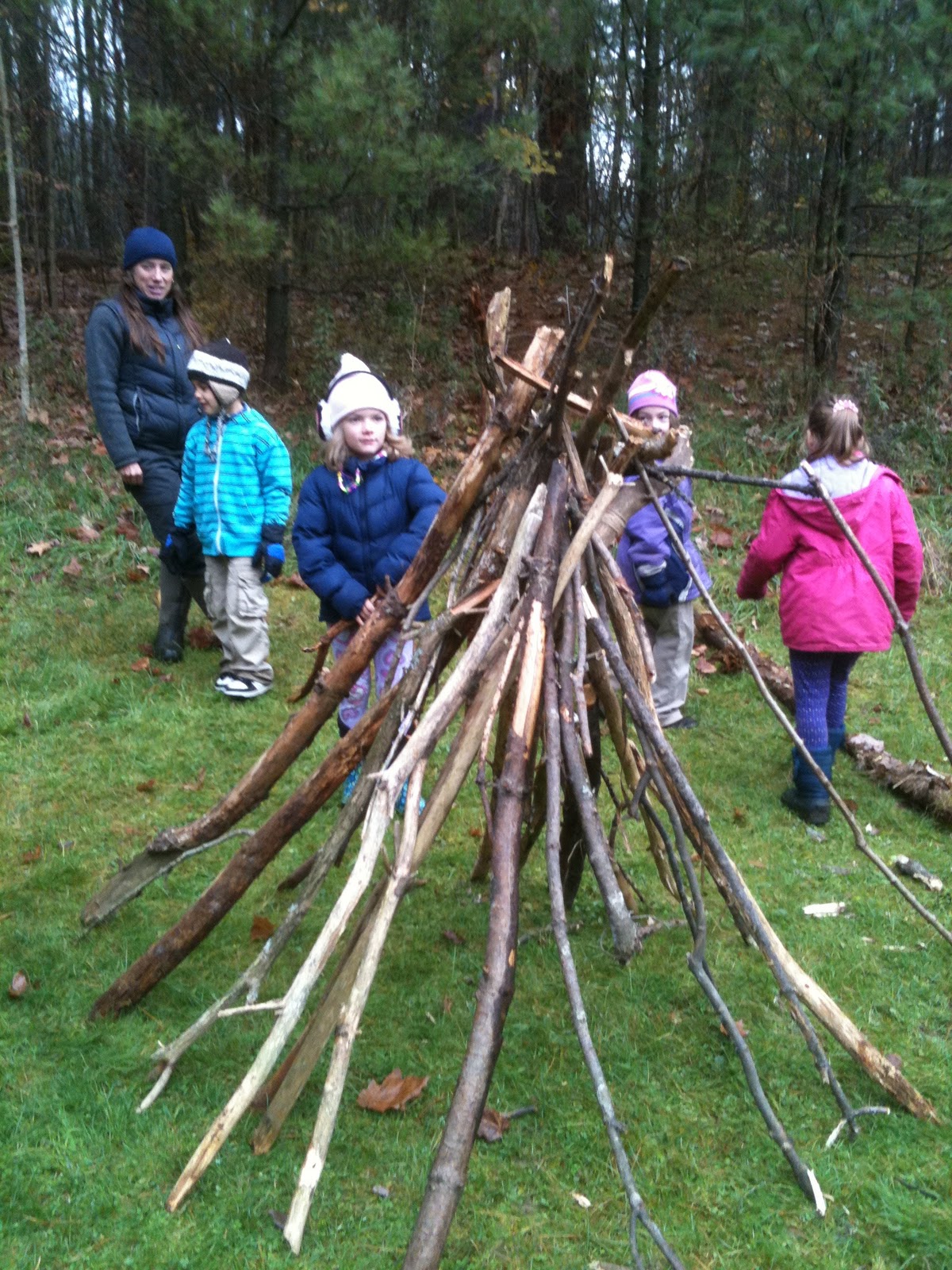
Here is where we break down the barrier of "no sticks" and begin to observe and experience the benefits of allowing children to physically, socially, and emotionally construct their world through stick play.

First, what if we asked the children what they thought? So, we did. In morning meeting we asked students "How would you use sticks in the forest?" The children's reaction was immediate. Hands were raised and bodies were wriggling with ideas and prior knowledge.
We can: build a fort, build a fairy house, build a house to sleep in, make a really big pile, build a fire, make a trap, build a wall to protect us, make a store and sell things,......
Wow. That's a lot of ideas! Notice the use of the word build. Children building things with objects found in their immediate environment is as natural as them learning to walk. Providing space and time to build outdoors expands the experience into a new realm. With more space, it allows for more movement, which creates more language use, and in the end, deeper cognitive development.
The next question we pose to the class is, "How will we do all that building and be safe near our friends?" I ask the children to raise a hand if they have ever been hurt by a stick before. All the children's hands go up. They have all had direct experience with this! The children share with a neighbor and the stories begin to pour out. (Children LOVE and need to share their personal stories. Especially when it connects to the topic at hand. Giving them a chance to share with other classmates strengthens the classroom learning culture and is powerfully inclusive) After a couple minutes of sharing we begin to make our Safe with Sticks list. In all 10 classrooms, the children agreed that sticks are not weapons and we don't hit with sticks. I never had to prompt these two ideas and it was always the first or second rule created by the children! Inevitably, a child grabs the perfectly styled stick and points it at a friend. "Bang! I got you!"
With a simple reminder we're redirected and back to our work.
" Hey friends, remember, we are in a Peace Zone. Let's keep working on that awesome shelter you started building last week!" It has become such regular part of the routine that I know hear children reminding each other of our rules. They are now in charge of their learning and their creations.
I hear children using phrases such as "bubble space" and "safety circle" when moving a stick bigger than themselves. I am also witnessing balance, coordination, development of gross motor skills, and cooperation as three children move a very large branch to add to a debris hut.
Our Safe with Sticks rules are made and students are imagining what they can do with sticks. Now the possibilities grow as the children navigate the landscape of the forest with building plans in mind. With a supportive adult to child ratio and room to roam, here are some examples of what has happened!


Class Stick Sculpture


How does it look?
Building a firewood shed!

Using a saw to cut the perfect length!

The outcomes of all this stick building? Here are just a few,.....developing spatial awareness, decision making, strengthening social and physical skills, building positive interaction and communication skills, learning problem solving strategies, appreciating what your body can do, and for some children it gives them an opportunity to develop control over their behavior and improve concentration by moving, manipulating, and orchestrating objects they have found in nature.
What if a child picks up a stick in the forest?
I guess I would be more concerned if they didn't.


A debris shelter in Hubbard Park built by 1st graders

Friday, January 27, 2012

Frank the River Otter and 12 Kindergartners

Frank in  the classroom 
Who's your favorite river otter? FRANK!
Why do all these Vermont kindergartners love this member of the weasel family so much? Is it his extreme cute face and soft thick brown fur? How about those webbed toes and beady black eyes. And yes, he does have ears! "But,... they're so small! Can Frank hear okay?" the children wonder.
The ooo's and aww's fill the classroom when Frank makes an appearance. No student ever wants to see him go. They have even written him Valentines and "we miss you" notes.
So lets go back to the question, why do small children almost immediately experience empathy with Lontra canadensis? Children love animals, especially ones that have similar characteristics to their own. Children are natural caretakers of living things when adults model this behavior. I also believe it has to do strongly with children's innate connection to play and the river otters as well.

It is a brisk winter morning and a 12 kindergartners are eager for their ECO (Educating Children Outdoors) day. The school children burst out the back door and scamper up a snow covered hill. It doesn't take long for one adventurous being to figure out if you lay down on you belly, head pointed down hill, give a little push with your arms, you'll be sliding with increasing speed to a certain destination.
 As a teacher and a naturalist, I capitalize on the moment for extended learning during play.
12 young river otters
"Hey! You all remind me of my favorite Vermont weasel!"
'"What's a weasel?" a child shouts as they slide away from me. I reach in my back pack and ready at hand is a mammal guide and a photo of a river otter. Children gather round in between sliding to glance at pictures and make comments. Here we are creating a culture of questioning and learning through exploratory play.
It doesn't take long for the children to create a river at the bottom of their slide, scraps of cloth turn into fish. A den is being dug in the hillside with fast hands turned paws. With a little help from the "adult otters", we learn that by clasping your feet together behind you, your legs turn into a powerful otter tail perfect for steering and propelling forward. I mention to my friends that a coyote may be interested in their small fish cache.
"A coyote? Where?" the children become increasingly concerned, their eyes darting across the landscape. Some stand up on two webbed feet and sniff the air. These kindergartners immediately come up with a system to watch over cached fish and a warning system for an incoming coyote. Hmmmm,... all of sudden these children are the wisest humans I know. They work together as a family to protect what they have. These children are totally engaged. Mind, body, and heart.

The scenario of river otter play continues and I make the very adult comment that we should move on to the  next part of our morning. A small river otter turns to me and barks, " No way! We're gonna slide all day! Plus, we're such good hunters, we already got all of our fish for snack!"
Slide on river otters! Slide on!


A 6 year old masters the river otter slide


Inspired research and writing