|  Home  |   About us  |   Programs & Projects  |   Calendar  |   Birding  |   Blog  |   Get Involved  |

Showing posts with label children. Show all posts

Friday, February 15, 2013

Why I build fires.

Each day we meet for Forest School, we make a fire.  It is a warm and welcoming ritual in the snowy, deep winter of central Vermont.  


But I have to admit, I wasn't always so keen on having a fire.  The pre-fire logistics of gathering kindling, requesting firewood donations from parents, checking the weather forecasts for wind and snow and rain all seemed too daunting.  Plus, with my poor circulation, the thought of having to take off my expedition-style mountaineering mittens to start a fire seemed worse than sitting for a few hours without a fire!  I would relegate the fire responsibility to my co-leader and supervise free play and tell stories instead. 

But earlier this week, when my co-teacher offered to join the group for free play, I somewhat ambivalently accepted the role of "Fire Tender."  It was a relatively warm day for mid-February (mid-20 degrees F) and Zach had already started the fire.  All I had to do was add more wood and stir the coals when the fire started to dwindle.  The crackling fire and the sounds of children laughing and shouting in play was comforting and I found a pleasant rhythm to my task.  I came to appreciate that task of tending fire really requires one to cultivate tenderness - attentive, patient, alert and observant.  In essence, being with the fire was quite similar to how I strive to be with my students.  The hour of tending fire passed surprisingly quickly, interspersed by visits from children to warm their hands, dry their mittens and share an interesting observation, and there was a welcoming fire for our end of the day Thanksgiving circle and closing rituals.  

This afternoon was a pivotal moment for me.  I used to skeptically approach fires as something too "crunchy" for me and a practice that was too time consuming to meld with my teaching style.  But I have really come to appreciate the immeasurable value of teaching with a fire.  

After going over some basic safety expectations with your fire guests, the fire is an amazing management tool.   The students naturally gravitate towards it, they are focused and thoughtful around it.  We eat lunch around it, share stories while gazing into its depths, and have it as a gathering point to return to after play and exploration.  

There are countless science lessons that flow from it. Hello, states of matter!  Not to mention cooking, change over time, social studies, tool use, and the list goes on.  It is fun to see what these kindergarten and first grade students know about fire and what preconceptions they have about how things burn and what the difference is between steam and smoke.  I am lucky enough to have colleagues with myriads of experience teaching with fire and who have created lessons involving safe practices with fire.

Plus, the very act of gathering around a fire is powerful and is something that has been practiced for centuries. In a culture that is ever-more focused on deriving pleasure from staring at screens, there is something peacefully rejuvenating that happens when you're staring into a fire with beloved students and colleagues. 


Thursday, February 7, 2013

Fiber fun with Forest School


When the late January chills dip into the single digits, the Forest Schoolers spend a little less time in the forests and fields and spend a little more time indoors exploring other crafts and projects. We are in the midst of a fiber unit right now, and we have experimented with lots of fiber crafts over the past few weeks.  On the first day of our unit, we felt the fiber, examined it under magnifying lenses, and picked through Alpaca fiber which was donated by Melissa and Chris Pierce at North Branch Alpaca Farm. What a mess we made! 


 A guest speaker showed us how to use a drum carder.  We used the clean, long pieces of fiber to card into rovings.  


These rovings can be used for many things, including pretend beards,
 

 and they can be spun into yarn.


On another day, we made beautiful needle-felted works of art from colorful, dyed rovings!


Most recently, we used yarn to weave little bags.  We started with these items:


  and we practiced weaving with our families 
We ate our lunches by the fire and read one of many fiber-themed books, A New Coat for Anna, by Harriet Ziefert. 

 
Afterwards, we explored a frozen swamp and found some incredible ice formations! 


The day ended by listening to the gentle swishing of ice along the river bank.  It was a surprsing, unexpected sound and a lovely way to end an enriching day. 


Thursday, December 20, 2012

Whittling with Kids

The Forest School students have had a super fun time honing their whittling skills this fall using potato peelers.  As soon as the single-pivot potato peelers were introduced, these kindergarten and first graders enthusiastically took to experimenting with whittling:

 
They made crafts, like this God's eye in a homemade frame:
 
 
With so many beautiful goods created over the course of a few weeks, everyone wanted to create a store to sell their wares!  A name was voted on, which was the "Fire Whittlers" and friends and family were invited to shop during the last Forest School session before the holiday break.  Here are the students making price tags for their goods:

 
When the parents arrived, they were instructed how to "Fox-walk" up to our basecamp:


Here are our guests arriving through the forest: 

 
One vendor selling a fishing pole:

 
We finished off the afternoon with a Thanksgiving circle, where parents, grandparents, students, North Branch staff and friends shared one thing that they were thankful for.  It was a beautiful afternoon with lots of wonderful learning that took place!

Community Mapping in Montpelier

Did you know Montpelier, VT, has four churches within three blocks?  Or that there are three dentists in less than a half-mile?  The second graders at Union Elementary made these discoveries, plus many more, as they mapped their route from school to Hubbard Park.  Map-making is a vital tool in helping children to get to know their community and these 50 students put their classroom-based learning into use as they mapped their mile-long trip from U.E.S. to the city park. 

The objectives of this activity was for students to spend time getting to know more about their community and to support the learning happening in the classroom.  The second grade is currently amidst a mapping unit, so the students put their knowledge of orientation, scale, keys, and landmarks to use.  During their two and a half-hour ECO sessions, four second grade classes added landmarks and points of interest to a simple sketch map that their ECO teacher drew up before class.  In teams of two, children drew and wrote details on their map so that someone who had never walked the route before could find their way from the school to the park.  Teachers and parent volunteers guided the discovery, but it was largely student driven.

The snowy weather added for an extra challenge for keeping their map dry, but students were upbeat and curious about their surroundings.


Although these students live in the town and have walked this route many times, they were making discoveries about the town that they had never appreciated before and asking questions.  One student asked, "What's a chiropractor?"  Another student wanted to know what the Rotary club was and why they gave the library benches.  One class had just begun a poetry unit, and so they were asked to record poetic words about the weather, sights in town, and experiences up in the park. 

The teachers were very pleased with their students work.  This activity acted as an informal assessment of what the students had been learning about maps in the classroom.  "I can honestly say that I'm speechless about how well this activity corresponds with the classroom learning," remarked one teacher.  "It is great to see what the students have been learning put into practice." 

Thursday, February 2, 2012

If a Child Picks Up a Stick in the Forest,....


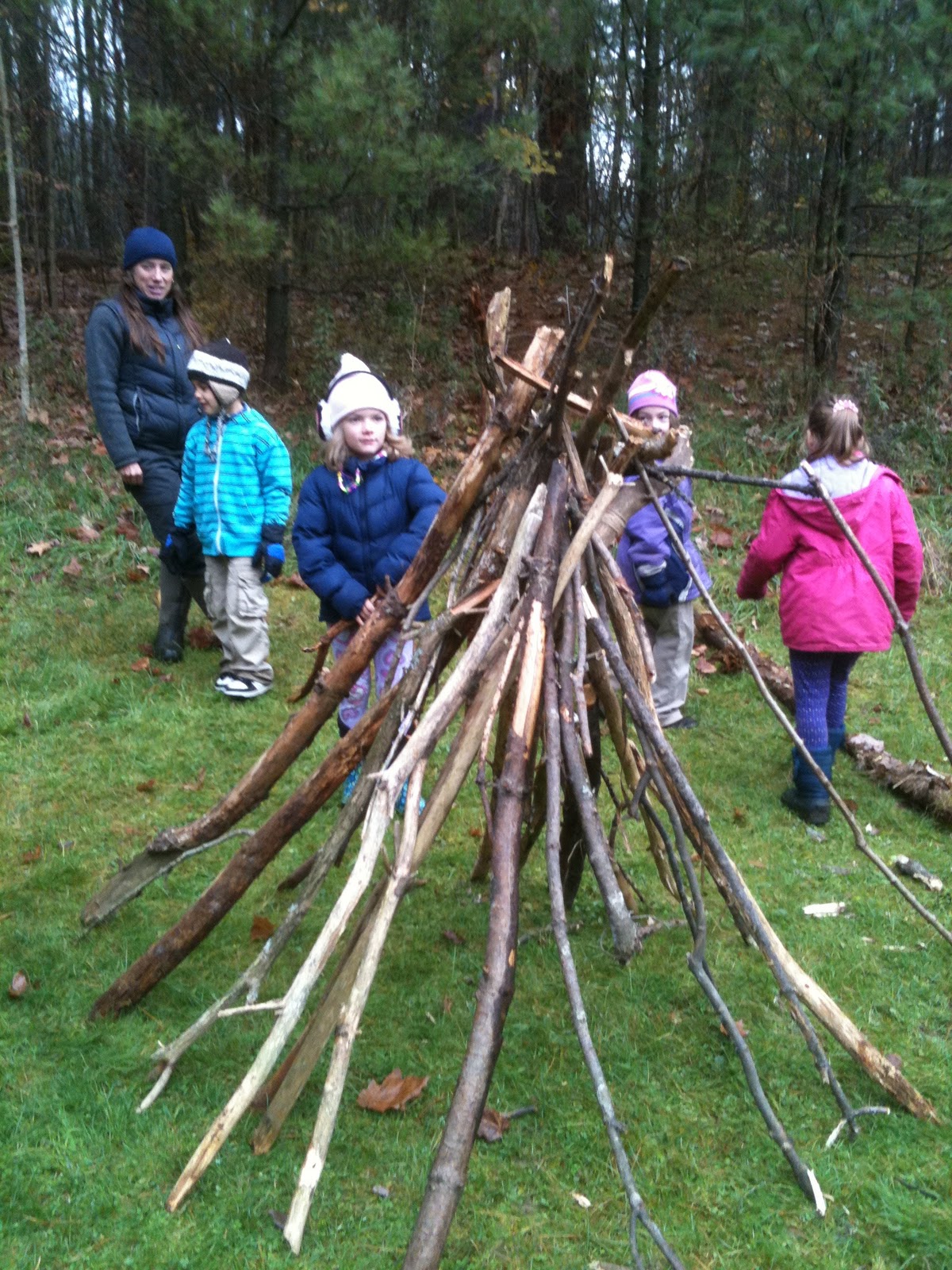
 What happens if a child picks up a stick in the forest? It's not a question of if, because they do and they will! When a child does pick one up, what does that stick become? Working with school teachers, this is one of the first concerns of being outside with a classroom of curious children. Do we let them play with sticks? And what does it look, feel, and sound like if 20 children are wielding sticks in the forest? Laying down a rule of "no picking up sticks" is like taking your students to the top of a fresh snowy hill with sleds scattered about and telling them they can't go sledding. What would the point be?
Here is where we break down the barrier of "no sticks" and begin to observe and experience the benefits of allowing children to physically, socially, and emotionally construct their world through stick play.

First, what if we asked the children what they thought? So, we did. In morning meeting we asked students "How would you use sticks in the forest?" The children's reaction was immediate. Hands were raised and bodies were wriggling with ideas and prior knowledge.
We can: build a fort, build a fairy house, build a house to sleep in, make a really big pile, build a fire, make a trap, build a wall to protect us, make a store and sell things,......
Wow. That's a lot of ideas! Notice the use of the word build. Children building things with objects found in their immediate environment is as natural as them learning to walk. Providing space and time to build outdoors expands the experience into a new realm. With more space, it allows for more movement, which creates more language use, and in the end, deeper cognitive development.
The next question we pose to the class is, "How will we do all that building and be safe near our friends?" I ask the children to raise a hand if they have ever been hurt by a stick before. All the children's hands go up. They have all had direct experience with this! The children share with a neighbor and the stories begin to pour out. (Children LOVE and need to share their personal stories. Especially when it connects to the topic at hand. Giving them a chance to share with other classmates strengthens the classroom learning culture and is powerfully inclusive) After a couple minutes of sharing we begin to make our Safe with Sticks list. In all 10 classrooms, the children agreed that sticks are not weapons and we don't hit with sticks. I never had to prompt these two ideas and it was always the first or second rule created by the children! Inevitably, a child grabs the perfectly styled stick and points it at a friend. "Bang! I got you!"
With a simple reminder we're redirected and back to our work.
" Hey friends, remember, we are in a Peace Zone. Let's keep working on that awesome shelter you started building last week!" It has become such regular part of the routine that I know hear children reminding each other of our rules. They are now in charge of their learning and their creations.
I hear children using phrases such as "bubble space" and "safety circle" when moving a stick bigger than themselves. I am also witnessing balance, coordination, development of gross motor skills, and cooperation as three children move a very large branch to add to a debris hut.
Our Safe with Sticks rules are made and students are imagining what they can do with sticks. Now the possibilities grow as the children navigate the landscape of the forest with building plans in mind. With a supportive adult to child ratio and room to roam, here are some examples of what has happened!


Class Stick Sculpture


How does it look?
Building a firewood shed!

Using a saw to cut the perfect length!

The outcomes of all this stick building? Here are just a few,.....developing spatial awareness, decision making, strengthening social and physical skills, building positive interaction and communication skills, learning problem solving strategies, appreciating what your body can do, and for some children it gives them an opportunity to develop control over their behavior and improve concentration by moving, manipulating, and orchestrating objects they have found in nature.
What if a child picks up a stick in the forest?
I guess I would be more concerned if they didn't.


A debris shelter in Hubbard Park built by 1st graders

Tuesday, January 17, 2012

ECO - Educating Children Outdoors

The ECO program at North Branch Nature Center is a new project that helps reconnect children with the natural world and foster stewardship in their communities.  Through collaboration with public schools, preschools, and daycare facilities, ECO helps to open the doors to the joy of learning outside in all kinds of weather. By using city parks, public lands, and other local green spaces ECO engages children in the natural inquiry based learning of their surrounding environment. Through this type of active learning, children gain a healthy respect for nature and for one another. ECO provides an opportunity for teachers and students to apply integrated academic curricula beyond the classroom to the outdoors for exploration, experimentation, creativity, and personal growth.

 Now in its second year, ECO is working with 10 area school teachers on a weekly and biweekly basis to get their students outside and immersed in the natural world. ECO is not a field trip or a one hour visit to a forest. The students participating in ECO spend 2 ½ to 4 hours exploring a forest, playing games, learning woodcraft skills, journaling, and sharing in a community circle. These experiences happen continously throughout the school year. Rain, shine, and snow are welcomed weather features on any ECO day at public school. Schools have gathered all the needed equipment for their students to be dry and warm for engaged learning outdoors. There’s no such thing as bad weather, just bad clothing!
Not surprising, these days are some children’s favorite day of the week. Singing a song about rain, using ropes to climb a hill, making debris huts, following squirrel tracks in the snow, and boiling water in a Kelly Kettle for tea are all some things a child may experience on an ECO day. Inevitably, with more time spent outside moving and engaging in the natural world, each child develops a sense of themselves and their place in the world. By helping to foster a relationship with nature at an early age, children are given the chance to have a multi-sensory experience that will help them to retain knowledge in a more effective and meaningful way. This old Chinese proverb gives clarity to the purpose of ECO and the ongoing journey of life long learning for all human beings:
Tell me, I forget.
Show me, I remember.
Involve me, I understand. 


If you are interested in learning more about ECO and how to get involved, please contact amy@northbranchnaturecenter.org