|  Home  |   About us  |   Programs & Projects  |   Calendar  |   Birding  |   Blog  |   Get Involved  |

Showing posts with label outdoor play. Show all posts

Friday, November 1, 2013

Loose parts magic

I've been looking for ways to enhance my students creativity and problem-solving skills in my outdoor-based preschool and kindergarden.  In my research amongst other blogs and educators, the hot way to do just that is through loose parts play.  Having collections of random objects, such as buckets, sticks, kitchen utensils, bowls, balls of different sizes, and planks and rounds of wood can be engineered and imagined into so many different things! 

I have to admit, I've used loose parts in the past.  I would meticulousely arrange them into little stations before the children arrived with my pre-determined ways that the children would use the objects.  There might be a music station, with an arrangement of buckets, bowls and utensils for banging, a building station with sticks, and a rolling station with balls of various sizes and halved PVC pipes.  But the children had little attention to give the parts and would wander between stations, and often resort to playing tag games. 


So I decided to change my tune.  I put out only one or two collections of loose parts materials, along with an art or craft project, to welcome the children as they arrived.  I also made clear that any of the materials at the side of the barn were available.  To my surprise, the ways that the children used the materials skyrocketed!  Here, two children making a delicious concoction in the "kitchen." 

Meanwhile, another two arrange wooden rounds and planks into their own obstacle course.   
 Just a few moments later, they shift their attention to building a tower. 
 They keep adding to it, and it's almost double the height of this child!
The preschoolers decided to use some planks and the picnic table as a makeshift slide. 
 With a little redirection, the used the plank of wood as a ramp for other objects, like this wooden round:
 a ping-pong ball,
 wooden block shapes
and round silver balls.  So much ingenuity!  And focus, too - look at the girl in the racoon mask, raptly watching the whole time.

Monday, October 14, 2013

Becoming bears

Front Cover
 In preschool, the best way to learn about something is to pretend to be it.  The changing leaves and the slight crispness to the air are a sign for bears to begin their hibernation process, so we became bears for the day!

First, we met the North Branch Nature Center's taxidermied black bear.  People got to touch the bear's fur, examine it's claws and ask questions about why the bear was there and why it wasn't moving anymore. 

Then, we played in a bear den (a big blue tarp in an outside corner of the barn) and learned to waddle like bears.  We sniffed apple slices with our dry "people noses" and then smelled them with dampened "bear noses."  Everyone agreed that the apples smelled even better with wet bear noses!

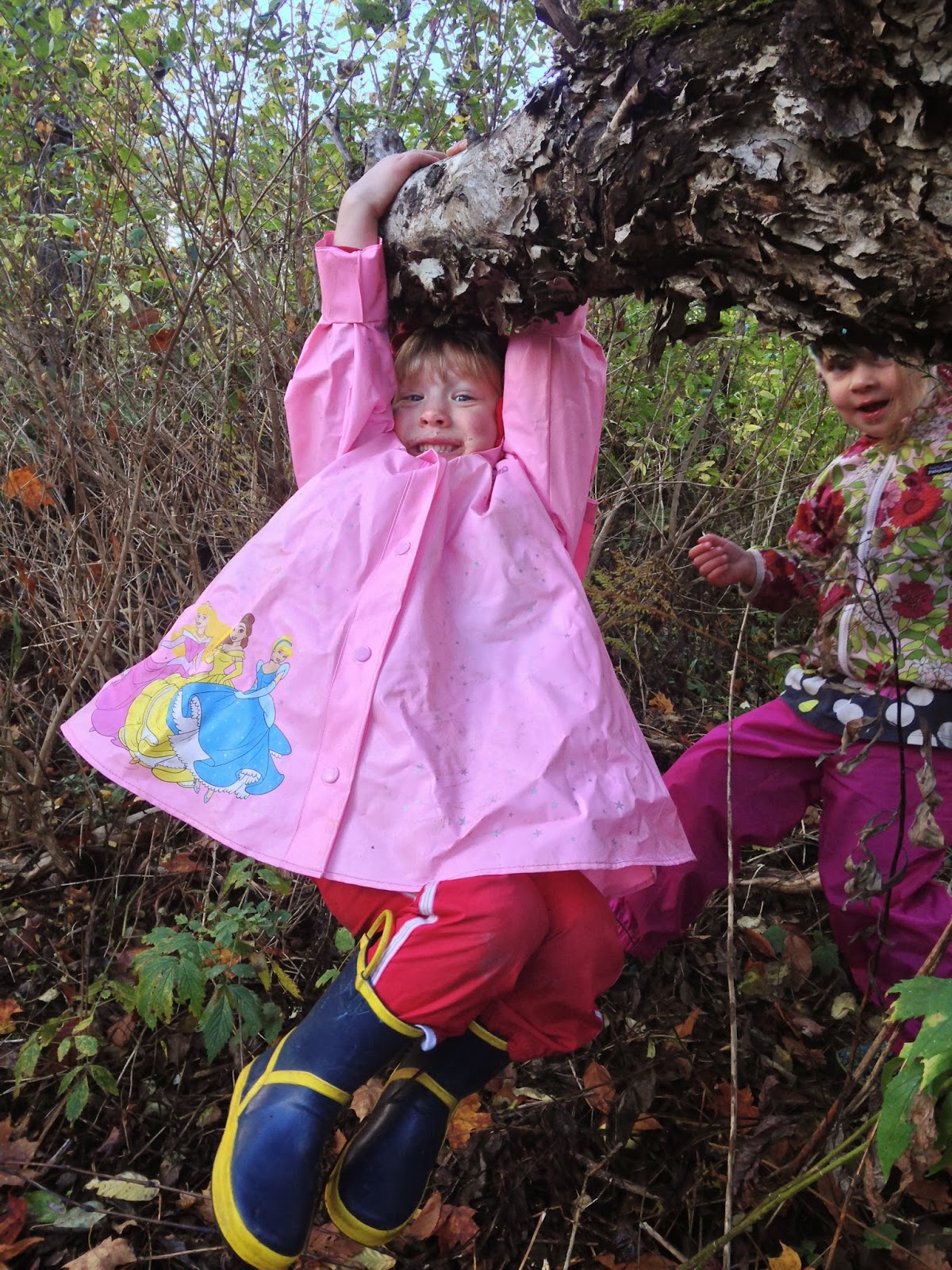
At deer camp during snack, we read Jim Arnosky's Every Autumn Comes the Bear.  We talked about what bears need to survive in winter.  One thing they have to do is eat, often apples or nuts or berries.  We visited an apple tree and practiced our bear climbing skills.

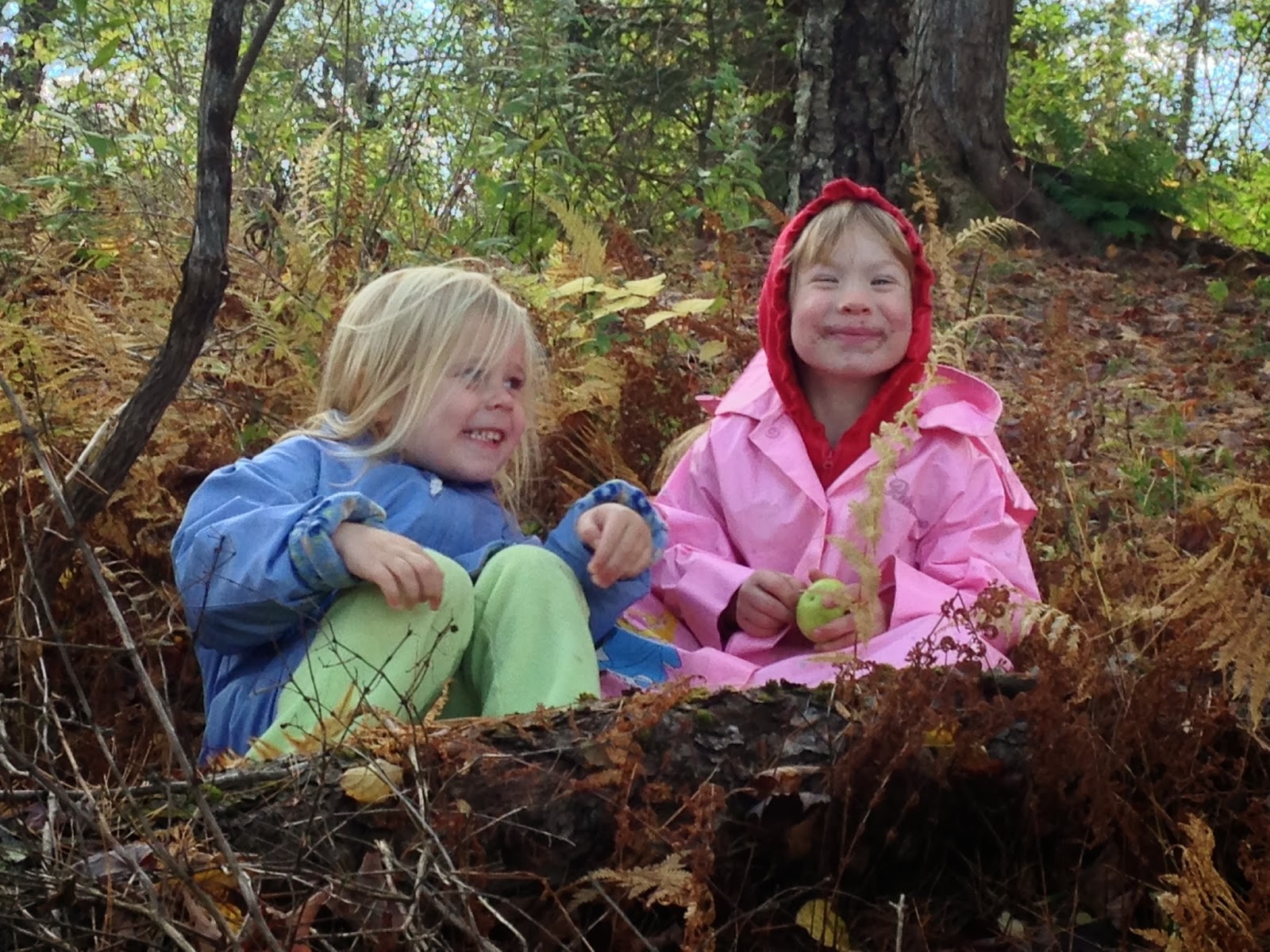
We ate some apples like bears...
 We observed the grasses and spent some quiet time during a break from our bear-play...
And we talked about bear dens and where they spend the winter.  Two girls made the connection that some animals make nests that are like dens.  Here they are trying out one of the nests they found in the forest!
What fun it can be to pretend to be animals!

Tuesday, September 17, 2013

Building our play-spaces

 The Forest Preschoolers are active, imaginative, and LOVE to build.  They love to create their worlds, and will craft pretty much anything they can get their hands on into elaborate scenes.  Much of our mornings focus around building in some form, and pretty much everyone participates. 
Laying out our obstacle course.
Yay for teamwork! Moving a board for a fort's floor.

A salvaged slide makes for the beginnings of a forest playground.

Working on a home-made swing.
Making dock-masks.

Giving the swing a test-run!

Flags for our tipi

Righting our own little tipi.


Building models with kitchen-fresh play-do.
What fun these little ones have while making their world the way they want to see it!

Friday, September 6, 2013

First week of Forest Preschool!

I noticed two major signs of fall this week:  the temps were crisp and cool in the morning, and eager 3, 4, and 5 year olds started their first week of Forest Preschool!  Being outside the whole time, the children used their imaginations and took advantage of the forest to have a grand old time.

Our days always start with "Loose Parts Play."  As Forest Preschool teachers, we embrace the adage, "One man's trash is another man's treasure," and gather old kitchen utensils, sticks, rocks, old pallets, pretty much anything to see how the children will engineer them into new, creative uses and forms. 

Our sound wall.
Sorting, building and categorizing

Once we're out at Deer Camp, we eat snack and listen to a story.  On Thursday, we heard about the Green Man, who liked to leave mysterious pictures in the forest.  Often, these stories will influence our activity for the day. 

Snack and story

Collecting and counting apples for Green Man

Making our own Green Man
Taking a break and playing in the mud


We also looked for deer beds and, of course, had to make our own and sample them:

In the fields behind Deer Camp
Pine needle deer bed


Look!  I found a baby deer!
 A lot of fun can happen in the scope of the three hour morning.  We look forward to many more weeks of adventuring with these energetic explorers!

Tuesday, May 21, 2013

Forest School farm field trip

 
We were lucky enough to visit a Forest Schooler's family's farm today!  Located just up the road from the NBNC, we spent the morning exploring forests, ponds and streams, helping with farm chores and enjoying the humid spring weather (thankfully the thunderstorms held off!)
 
Here are some happy explorers!
 
We found some porquipine quills outside a den.  Did you know porqupines poop on their front stoops?

 
Who knew there was a cave that could fit the whole Forest School, and even some siblings?!
After exploring the forest, we helped with farm chores.  First we scrubbed water buckets for the ducks...
 
Then we collected chicken and duck eggs!

 
Afterwards, we played with the baby goats.


And had a peaceful time observing ducks.

Can you find the toad eggs? 
 
 
Here's a boat, made with woven ferns.

 
What a day it was!  So much fun learning happens at a farm.
 

Wednesday, May 8, 2013

Poems by the river

Poems are big these days.  Montpelier's annual Poem City just wrapped up its amazing score of events, readings and poems in almost every storefront.  Recently, Vermont Public Radio highlighted poetry's ability to help kids learn to read.  (Click here for the full article.)  Poems have an ability to capture simple, sweet moments and complicated emotion in touching ways, and educators are tapping into this writing form with their students. 

We at Forest School are doing just that.  During the past two weeks of near-summer temps and sunshine, we Forest Schoolers have been taken refuge under a shady bridge on the North Branch of the Winooski River (our Nature Center's namesake!).  In between bouts of searching for shimmering rocks and sneaking up on crayfish and wood frogs, we wrote some poems ourselves!  Here are a few of our creations:

River Haiku, by SP
Flowing and growing
Is nice to put your feet in
Ducks love it so much

It's Low, by OS
And on the other side it's high
It's really slow
And its a bit warmer than last time
The sun hits it and it sparkles
It wooshes across to the other side
And the other side is really high
It's sandy and rocky
Can you guess who I am?
The river!

The River, by SP, OS, and LV
Flowing, gurgling and pretty designs
Cool and refreshing
Wooshing and rushing
Home for many creatures
Rippling and rocky, always flowing
It's big and long
It almost never ends
You can't swim in it because it's too cold
Music to my ears
My ducks would love to swim in it
When you step in the sand over and over,
you have to go in the water over and over

(Apologies for the lack of pictures - they'll be coming soon!!)

Wednesday, March 27, 2013

Garden Prep!

Since the beginning of Forest School in September, students have been dreaming about gardening.  What do we plant?  When can we start?  How can we cook what we grow?  Now that it's the end of March, with the snow dripping and warmer breezes blowing, the students are finally starting to prepare for gardening in our little plot in the Community Garden at the North Branch Nature Center!

First, students filled seed flats with soil and planted pepper and tomato seeds. 


Then, they made labels for their seed trays.  This was an excellent time for young writers to practice their literacy skills!


Next, students chose which seeds they would like to grow in their "Dream Garden."  This served as an opportunity to categorize and sort, which are important math concepts for kindergarteners.


Students then wrote and drew in their journals the types of vegetables and flowers they wanted to plant.  (An excellent opportunity for more advanced writers to learn spelling and practice writing.)


After such great garden preparations, we ate lunch by the river and hung out with our friends in the springy sunshine.   What a good, full day it was!


Wednesday, March 20, 2013

Spring is Coming! Using QFT with second graders

Happy First Day of Spring!  Although you might not guess that spring is beginning with the 15" of light snow we received over the past few days, spring is coming.  To celebrate spring's arrival, in two second grade classes at Union Elementary School in Montpelier, we used our senses to find signs of spring in Hubbard Park.  We were helped by the Question Formulating Technique, which was developed by the Right Question Institute.  First students thought of as many questions as they could in 2 minutes about the statement, "Spring is Coming!"  Here were the parameters:

1.  Only ask questions.
2.  Any statement will be turned into a question.
3.  No analysis of questions or answering them.
4.  Write questions as they are stated.  

Here is the list that we generated:


 We walked the mile through town up to our "Base Camp" to investigate signs of spring that are on their wa.  Here are a few students diligently recording their observations at their sit spots.  They found snow melting, warm breezes, soft moss, buds beginning and much more.  Sitting quietly and observing proved fruitful for generating more questions about what's going on in the little microcosm of the sit spot. 


When we returned back to school, we revisited our questions from earlier in the morning.  Can you see the extra questions we asked?  Students focused their questions and were much more specific.  In the early morning, questions were broader, such as, "Do you think it will be warm," and "Why is spring coming?" 

After being outside and everyone sharing the signs of spring that they saw, smelled, heard (lots of birds!) and felt, the questions that the questions generated were more specific and demonstrated higher thought processes.  For example, one student asked, "Why is the grass orangish-brownish after the snow melts?"  Immediately after, another student asked, "Why is grass green in the summer?"  Since we wrote these questions on the flip chart, they will be saved and teachers can return back to discuss and answer these questions!  It's a perfect opportunity for authentic, engaged learning. 

These second graders are savvy researchers, too.  When I asked how they could answer their own questions, one boy stated, "You google it!"  They also knew to look in books, talk to their parents and teachers, ask the librarian for help, and much more.  


Here's something I observed at my sit spot!  It looks like a cross between a frozen inchworm and a tiny birdpoop.  I wonder what it is?  How did it survive the winter?  How did it remain sticking to the stick throughout the winter?  Oh, the questions that arise...