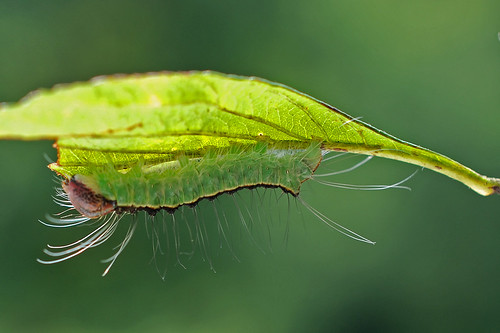
The field at NBNC is beautiful this time of year, full of daisies, vetch, black-eyed susan, milkweed, and so many more. Even the first goldenrods are starting to show their color. But it was a very subtle flower that made my day this wildflower Wednesday. I've probably walked by it 100 times without ever seeing it. The Ragged Fringed Orchid may not be obvious as you walk by, but once you find it among the ferns and grasses, it stands out for its beauty and elegance. The flowers emit a fragrance at night that attracts moths such as sphinx moths and owlets.
Thursday, July 24, 2014
Wednesday, July 23, 2014
Candid Caterpillars

A guest post by Scott Maxham
Last week I was out clearing Japanese knotweed from the riverside. Clearing knotweed can be a daunting task. It takes over large areas and deprives other plants of sunlight. While taking a much needed water break, a few feet away from the knotweed patch, I found a spiky surprise. This black red spotted caterpillar looked a bit menacing with the numerous spikes, but I was feeling adventurous and let him crawl into my hands. This caterpillar seemed ginormous after working with the tiny cecropia caterpillars we have been raising at the Nature Center.
Back at the Center Center Chip and I determined that I found a Mourning Cloak Caterpillar. Chip agreed that it was a big caterpillar and would probably be looking to pupate in the near future. Sure enough the next day we found the mourning cloak hanging upside down from the container it now calls home. If you’re interested you can see the mourning cloak pupae here at the Nature Center in our critter room.
The mourning cloak butterfly is one of the first to be seen in the spring. This is because it overwinters as an adult butterfly and does not migrate. They find safe spots in trees or logs to overwinter. The butterfly hibernates and when spring arrives the mourning cloak is ready to find a mate. The mourning cloak is unique in that it remains an adult butterfly for 10 long months. This is much longer than most butterflies live. Most butterflies will live for about a month. Even the migrating monarch butterfly will live a shorter life, usually around 7 to 8 months.
![]() |
| Photo by Jo Ann Poe-McGavin |
Yesterday Ken was out and about with the “Incredible Insects” summer camp. While they were out looking for bugs, they found a caterpillar that I consider incredible, but prefers to be called “splendid”. Ken and the kids brought back a pair of splendid dagger moth caterpillars! These caterpillars have a bit of fuzz surrounding them and change from green to brown when they are about to molt. They grow up to be stealthy moths that blend in with tree bark.
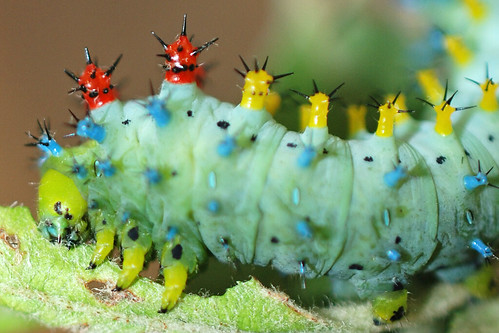
All these caterpillars have been a warm-up for the rapidly approaching Live Caterpillar Day at NBNC. This Saturday, July 26, between 11am and 4pm Sam Jaffe from the Caterpillar Lab will be coming to the Nature Center to show off his wonderful caterpillars. If you can’t make it to caterpillar day or can’t wait until Saturday to see caterpillars you can again stop by the critter room at NBNC. The cecropia caterpillars are plentiful and have grown to be much more colorful. Hope to see you Saturday at Caterpillar Day!
Friday, July 11, 2014
Summer Scientists
Last week campers in grades 5th through 8th joined us for a week of scientific research during NBNC's Summer Scientists camp. We joined a different researcher in the field every day as we learned their methodologies and aided them in their studies.
| Sorting BMIs into ice cube trays |
We began the week by heading to the Dog River with the UVM Watershed Alliance for some water quality testing. After testing for dissolved oxygen, phosphorus, and other chemical and physical properties, we cast our nets for some Benthic Macro Invertebrates (river and lake bottom dwelling bugs). Placing our nets firmly on the bottom of the river, we reached in and began rubbing rocks with our hands on the upstream side of the open nets, hoping to dislodge some critters, which would then be carried by the current into the net. With many pollution sensitive species such as stonefly and dragonfly larvae combined with favorable chemical and physical test results, we concluded that section of the Dog River was indeed healthy. Upon our return to the nature center, we dipped our nets one final time along the bend in the North Branch River before heading home.
![]() |
| Hellgrammite found in North Branch River |
![]() |
| Camper holding a baby wood turtle |
Day 2 was spent wading in the Worcester section of the North Branch River with local wood turtle guru Mark Powell and his turtle dog Gracie. Having been skunked last year, we would have been happy with just one turtle but as luck would have it, we found 3! Gracie the turtle dog sniffed out in the brush one while our keen camper eyes spotted one basking on the bank. After we helped Mark weigh and measure the turtles, we released them back into the water. While bending over to return one of the turtles, a camper discovered our 3rd and smallest turtle of the day. This turtles was less than one year old with its shell only measuring 1 and 3/4 inches!
For our third day, we stayed onsite at NBNC while visiting Chip and Larry at the bird banding station. We caught several birds that had already been banded in years prior and some that had just hatched this year. There were common yellowthroats, song sparrows, chestnut-sided warblers, and house wrens. The highlight though was a species that we had never banded at the nature center... a red-winged blackbird. Although they are a very common species at the nature center, they tend to stick to the fields and cattails.
![]() |
| Female Red-winged Blackbird |
![]() |
| Petting a Common Yellowthroat |
Our week culminated in a full day citizen science adventure in Groton State Forest as we worked to photograph and identify as many species as we possibly could, which we would then add to the Vermont Center for Ecostudies project the VT Atlas of Life. The goal of this project is to catalog every living species in the state. So we photographed and identified everything from slugs to flowers, from birds to newts. No better way to spend a day than exploring the wonderful flora and fauna of Vermont!
![]() |
| Eastern Newt |
![]() |
| We found some Blue-eyed Grass while having lunch atop Owl's Head! |
Saturday, July 5, 2014
Shade for Coffee and a Home for Birds
![]() |
| Chestnut-sided Warbler is one of the migratory species that benefits from bird-friendly coffee |
A guest post by Scott Maxham:
Birds and coffee don’t seem to have
much in common at first thought. Although an early morning birder may beg to
differ as waking up at the crack of dawn can be a bit easier with a quick
caffeine boost. The connection between birds and coffee is deeper than most
realize.
Coffee is a beverage enjoyed by
many, but quite often we don’t think about where it was grown. If we do know
where it was grown it is most likely to romanticize over the warm location and
not how the coffee itself was grown. Unfortunately most coffee plantations
clear cut rainforests to make way for the coffee plants. Habitats are destroyed
and once pristine forests are no longer standing. This is a big deal because
coffee does not require full sun to grow. Interestingly, shade-grown coffee
plants produce higher quality beans than sun grown coffee plants.
| Bird-friendly coffee can help preserve forest trees, providing critical habitat. |
This in turn means that tropical
rainforests don’t need to be cut down. These forests are the overwintering
habitats for many of the birds we enjoy and are happy to have nesting in North
America. Of course, such forests are home to many other plants and animals.
Forests are also great at storing carbon and creating oxygen. Forests prevent
erosion and promote healthy water cycles.
Birds and Beans is a brand of
coffee that aims to support farmers who grow shade-grown coffee. They seek out
these farmers and then sell their coffee to bird-loving coffee drinkers. If you
would like to taste this bird friendly coffee, visit our coffee page.
In an effort to determine the
benefits shade grown coffee, in terms of bird populations, North Branch Nature
Center’s ‘Avian Wonders’ summer camp surveyed the Beidler Family Farm, in
Randolph, to see what birds resided there. Other organic and bird-friendly
farms were surveyed throughout the U.S. and Central America as part of a
project with Birds and Beans… stay tuned for the results!
We encourage you to help the cause
by purchasing Birds and Beans coffee for yourself or another coffee drinking
friend or family member as part of our buyer's club. It is also small and easy change you can make to
protect birds all around the world.
Friday, June 20, 2014
BirdFest 2014!
![]() |
| Learning how we study birds at the banding station |
Earlier this month, over 200 people gathered at North Branch
Nature Center to celebrate birds for our 3rd annual BirdFest. It all
started at 7:00 a.m. with our early-morning bird walk. Participants scoured
treetops and dense shrubs, spying dozens of colorful bird species as they
busily built nests and searched for food. A pair of Black-billed Cuckoos inspired
“ooo’s and aaah’s” as they perched out in the open for all to see. By 8:00
a.m., some of our early morning participants continued to enjoy the sights and
sounds of birds while others made their way to the bird banding station to see
avian research up close.
The bird banding station was busy with activity as a wide
variety of species were captured and studied. Among the highlights was a Pine
Warbler, a species that spends much of its time out of sight in treetops, and a
first for us at the banding station! Other captures included chickadees,
cardinals, a hummingbird, and a Magnolia Warbler!
![]() |
| Chip shows onlookers a Ruby-throated Hummingbird just before release |
The 9:30 a.m. bird walk with Paula Gills crossed paths with
the banding station, where visitors continued to enjoy seeing birds up-close.
And at the same time, a multitude of activities were beginning at BirdFest
central. Kid’s tent; kestrel box building; live raptors; bird carving demo and
workshop… all the action began just before 10:00 a.m.
By 11:00 a.m., early morning bird walk participants were
enjoying talks about Bald Eagles and bird photography, while kids were
excitedly roaming the area around the house as they explored, carved, built and
discovered. By 1:15 p.m. the awards ceremony was underway for our drawing and
photo contest participants. Over 50 species later, and seemingly in the blink
of an eye, BirdFest was done!
![]() |
| Craig and the Red-tailed Hawk |
![]() |
| Arts & crafts at the Kid's Tent |
![]() |
| Remy carving some chickadees |
![]() |
| Building Kestrel Boxes |
Thanks so much to all of our presenters, including Allison
from Birds of Vermont Museum for hosting the carving workshop, Remy Lary for a
great carving demo, Craig from Outreach for Earth Stewardship for the
always-popular live raptor show, John Buck and Tom Berriman for their great
presentations, Paula Gills for leading the mid-morning bird walk, and everyone
else who helped out in so many ways! And of course, thanks to our BirdFest sponsors for their support!
All photos by Eve Bernhard.
Wednesday, June 18, 2014
Wildflower Wednesday #4
Another Wednesday is upon us, so here is another wildflower update from NBNC. All these pictures were taken today!
Galium (also known as bedstraw) flowers are tiny, at less than 5mm. But there are thousands of them in the fields of NBNC. Later in the season, after the flowers are long gone, we sometimes find caterpillars of the Galium Sphinx Moth feeding on green leaves.
Orange Hawkweed is an attractive but non-native wildflower that can be found scattered throughout the fields at NBNC.
Cow Vetch (also sometimes called Purple Vetch) grows throughout the fields at NBNC. We see the Northern Amber Bumblebee (Bombus borealis) visiting the flowers occasionally.
Coming Attractions:
Milkweed is getting close to flowering... I look forward to it blooming every year... it is a pollinator-magnet!
Monday, June 16, 2014
Amphibian Monitoring: 2014 Season Wrap-up
Thousands of tadpoles and salamander larvae are now happily
swimming about vernal pools thanks to the hard work of the dedicated Amphibian Monitoring Program (AMP) volunteers! Over 2 dozen volunteers spent 50 hours
patrolling busy roads and helping amphibians get across safely.
With the coldest March on record, Wood Frog migrations
seemed delayed as the snow slowly melted in early April. But by the end of the
month, things had warmed considerable and the cold winter had no effect on the
timing of Spotted Salamander migration. The ‘big night’ in central Vermont
occurred on Earth Day, April 22, and volunteers were out in force to help them
as they migrated across roads. Vernal pool breeders continued to migrate for
the next several weeks, and we even had volunteers out in early May crossing
Spotted Salamanders in East Montpelier.
Collectively, volunteers monitored 12 road crossings,
documenting 10 species of amphibians. Over 500 individual amphibians were moved
off the road, including an impressive 136 Spotted Salamanders! The rare Jefferson/Blue-spotted
Salamander group was also documented at several locations. Five new crossing
sites were located by volunteers in Randolph, Calais, Elmore, Wolcott, and
Worcester. Additionally, 35 people attended the 3 trainings offered this year
to learn more about amphibian migration and what they could do to help.
While our efforts for the Amphibian Monitoring Program have
wrapped up for the year, there will still be amphibians active on roadways
during rainy nights for the remainder of the ‘warm’ season. Continue to stay
alert for animals on the road and feel free to report your sightings to the Vermont Reptile & Amphibian Atlas.
Thanks to all of the AMP's volunteers and supporters for another productive year!
Subscribe to:
Posts (Atom)