|  Home  |   About us  |   Programs & Projects  |   Calendar  |   Birding  |   Blog  |   Get Involved  |

Thursday, December 20, 2012

Community Mapping in Montpelier

Did you know Montpelier, VT, has four churches within three blocks?  Or that there are three dentists in less than a half-mile?  The second graders at Union Elementary made these discoveries, plus many more, as they mapped their route from school to Hubbard Park.  Map-making is a vital tool in helping children to get to know their community and these 50 students put their classroom-based learning into use as they mapped their mile-long trip from U.E.S. to the city park. 

The objectives of this activity was for students to spend time getting to know more about their community and to support the learning happening in the classroom.  The second grade is currently amidst a mapping unit, so the students put their knowledge of orientation, scale, keys, and landmarks to use.  During their two and a half-hour ECO sessions, four second grade classes added landmarks and points of interest to a simple sketch map that their ECO teacher drew up before class.  In teams of two, children drew and wrote details on their map so that someone who had never walked the route before could find their way from the school to the park.  Teachers and parent volunteers guided the discovery, but it was largely student driven.

The snowy weather added for an extra challenge for keeping their map dry, but students were upbeat and curious about their surroundings.


Although these students live in the town and have walked this route many times, they were making discoveries about the town that they had never appreciated before and asking questions.  One student asked, "What's a chiropractor?"  Another student wanted to know what the Rotary club was and why they gave the library benches.  One class had just begun a poetry unit, and so they were asked to record poetic words about the weather, sights in town, and experiences up in the park. 

The teachers were very pleased with their students work.  This activity acted as an informal assessment of what the students had been learning about maps in the classroom.  "I can honestly say that I'm speechless about how well this activity corresponds with the classroom learning," remarked one teacher.  "It is great to see what the students have been learning put into practice." 

Wednesday, December 19, 2012

Plainfield Christmas Bird Count: Results

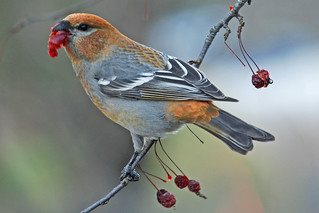
Pine Grosbeak seen in Montpelier during the Plainfield CBC
The 52nd annual Christmas Bird Count took place under sunny skies this past Saturday, as 27 observers scoured the count circle for birds. With another mild month leading up to the count, and no snow cover, we were expecting surprises. We weren’t disappointed.

Highlights included 2 new species to the count: Red-bellied Woodpecker and Swamp Sparrow. Both were seen in East Montpelier during the afternoon. The second ever sighting of Golden Eagle occurred in Barre at the corner of Camire Hill Rd and Camp St. The bird was seen flying north, and was only first seen on the Plainfield CBC last year. Another notable sighting was that of a Winter Wren, seen during the public walk at the North Branch Nature Center, the first CBC sighting in 10 years.

Overall, the total species tally of 42 was slightly above our 20-year average of 40. Three additional “count week” birds were seen (Sharp-shinned Hawk, Cooper’s Hawk, and Belted Kingfisher). With some reports still coming in, we expect the number of birds seen to grow, but so far 3,484 individuals were observed on a very successful CBC.


Canada Goose 210
Mallard 4
Hooded Merganser 2
Common Merganser 1
Ruffed Grouse 6
Wild Turkey 250
Bald Eagle 1
Golden Eagle 1
Sharp-shinned Hawk cw
Cooper's Hawk cw
Northern Goshawk 1
Red-tailed Hawk 4
Herring Gull 2
Rock Pigeon 276
Mourning Dove 140
Barred Owl 1
Belted Kingfisher cw
Red-bellied Woodpecker 1
Downy Woodpecker 29
Hairy Woodpecker 60
Pileated Woodpecker 10
Northern Shrike 2
Blue Jay 126
American Crow 194
Common Raven 66
Black-capped Chickadee 1196
Tufted Titmouse 14
Red-breasted Nuthatch 61
White-breasted Nuthatch 57
Brown Creeper 7
Winter Wren 1
Golden-crowned Kinglet 18
European Starling 186
Bohemian Waxwing  35
American Tree Sparrow 12
Swamp Sparrow 1
Dark-eyed Junco 40
Northern Cardinal 16
Brown-headed Cowbird 35
Pine Grosbeak 70
House Finch 2
Common Redpoll 206
American Goldfinch 56
Evening Grosbeak 32
House Sparrow 52

Tuesday, December 11, 2012

Banding Together: Citizen Science

Iris releases a Cedar Waxwing
On a dark summer's night, just before dawn, bicycles and cars begin to fill the NBNC parking lot. It's a 'banding day,' and volunteers walk the dew-covered fields, opening mist nets and preparing the banding station for a busy morning. For the next six hours, the banding station will catch, measure, tag, and release birds as part of a nationwide study on bird abundance and distribution. Capturing birds allows us to gain insight into their productivity, survival rate, and other demographics invaluable to their conservation. In addition to its conservation value, banding has allowed NBNC to educate about avian research in a way we were never before capable.

Jeanie Williams has volunteered at the station for the past two summers, refining her skills at identifying and measuring birds, removing them from nets, and recording data. Without volunteers like Jeanie, the station could not operate. At the same time, volunteers like Jeanie get to enjoy the unique experience of seeing (and even holding) birds up-close. Many are common, yet seldom-seen residents of NBNC that skulk in dense brush. Only through banding can we see them well and understand their importance at NBNC.

One of the most exciting parts of the morning is when the children arrive. Volunteers have already been banding for three hours, but for the kids of NBNC's summer camp, the day is just beginning. The campers tour the station, learn about why we band birds, and allow birds to perch delicately on their hands before release. 

A banded Chickadee visits the feeder
I recall one day this summer when children arrived to an empty station. We were just beginning our final net check, which would determine if our young visitors got to see any birds. As luck would have it, we caught our very first adult male Indigo Bunting just in time for the campers to see. They bubbled with excitement and awe as they ogled the brilliant, blue bird. And then I heard one of the campers exclaim, "I want to be a bird scientist when I grow up," to which another replied, "no, that's what I want to be!"

Anytime you can advance conservation while educating the public is a chance to double your impact. At NBNC, we call this "citizen science", and we strive to offer such opportunities throughout the year. Visit the citizen science section of our website for a full listing of citizen science programs to join our community of scientist-learners.

Wednesday, December 5, 2012

The Circle of Life: Bobcat at NBNC!

As I explored one of the far, out-of-the-way corners of the Nature Center in late-October, I was saddened to find the carcass of a deer in a small gap between the dense, riverside vegetation.  Any animal-lover would be disappointed to learn of a dead deer, but being a naturalist, I also knew that some good could come from this.  Besides a few nibbles on the ears, the carcass looked (and smelled) fresh and intact.  So I decided to set up a motion-sensing wildlife camera and see what creatures would come to scavenge the meat. The results were astounding:


We have found Bobcat tracks within a half-mile of the Nature Center in the past, but this is the first definitive evidence we've found of this species on the property.  We obtained numerous video clips of the Bobcat feeding on November 4, between 1:45 and 3:00 a.m.  Here is another stunning video of the Bobcat:


The other mammal we caught feeding on the carcass was a Gray Fox.  Unlike the Bobcat, which was only recorded on one evening, the fox's visits were more frequent, being recorded numerous times over the past month.  This is not too surprising, as we have found numerous Gray Fox tracks on the property in past winters.  We even recorded the fox visiting within 2 minutes of the bobcat!  Here is one of the many fox videos:

Friday, November 30, 2012

The Energy of Boys

What could be more fun on a rainy day than getting muddy?
Every Thursday afternoon I watch as the boys filter in one by one for the North Branch Trekkers afterschool program.  The first couple quietly set their packs down, bashfully bid their mothers farewell for the afternoon, and softly take up conversation while fiddling with the contents of their packs.  Two more boys arrive, toss their packs in the pile, and dispassionately wave goodbye to their moms as they jog off to join a game that has just started.  The last boys to arrive don’t even make it to the sign-in table… their packs are cast aside haphazardly in the field as they run full force to join the game that has now reached full tilt, parent left in their wake.  Something magical seems to happen with each arrival.  With each addition the energy of the group seems to grow exponentially.  You can almost see it as it bounces between and touches every boy in the group, pulling them closer together - carrying ideas, challenges, and discoveries with it.  For adolescent boys, this is where real learning takes place. 
The trekkers examine scat to see
which mammal has been here
One of their favorite games to play is a game called “Coyote and Deer”, where the coyotes are working together as a pack to track down the hiding deer.  It is an interesting game to watch them play because watching a group of young boys roaming the woods is much like watching a bachelor herd of young bucks, figuring out how to interact with their environment and each other.  Like young deer sparing with their antlers for the first time, they challenge each other to feats of strength and courage as they chase each other down hillsides and across ravines, using the rough terrain to build coordination and dexterity.  They can also be much like a pack of young coyotes figuring out their individual roles within the pack, learning their strengths and weaknesses as they work together to overcome challenges.

At “Trekkers,” we use the forests, creeks, and fields as tools to help children learn not only about the natural world but about themselves as well.  These are lessons that they will carry with them for the rest of their lives, lessons that we all must learn one way or another.  It is of no small significance that they are learning these lessons in nature.  The young buck may not know it, but those early years of playful exploration help shape him into the regal patriarch of the woods.  Much like the young buck, these boys represent our future.  

Wednesday, November 21, 2012

Pine Grosbeaks Invade!


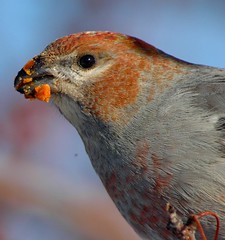
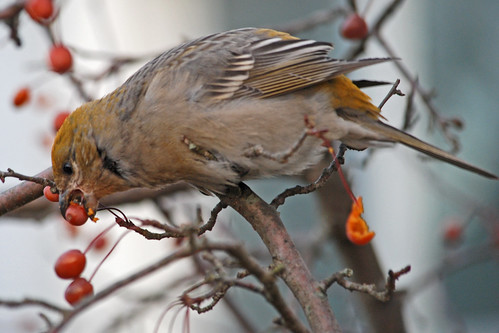
Vermont has been invaded by mysterious flying objects! They’re not aliens, although they might look unfamiliar to many.  They’re Pine Grosbeaks.  These medium-sized, parrot-like birds breed hundreds of miles to our north, and don’t venture south every year.  In fact, over the past two years (2010 & 2011), only four Pine Grosbeak sightings were reported in Vermont eBird.  But in the past two weeks, there have been dozens of sightings in every corner of the state. 

It is thought that Pine Grosbeaks travel south in winters when their favorite food, fruit, is in short supply on their breeding grounds.  They are most easily found in fruiting trees such as ornamental cherry and crabapples.  In addition to their vibrant colors, these birds are easily observed because of their audacity around humans: they will often tolerate our presence, feeding along busy downtown streets.  


If you haven’t seen this bird already this fall, there is a good chance you will.  All sightings can be reported to eBird or directly to the North Branch Nature Center.

Monday, November 12, 2012

Waterfowl: Before the Water Freezes


November is here, and frosty nights are no longer the exception: they’re the norm.  Our lakes and ponds are beginning to freeze, but before their liquid surface disappears, late-migrating waterfowl can still be encountered basically anywhere around central Vermont.  Unusual ducks could be coming soon to a pond near you!

Long after many birds have already left or passed through Vermont on their journey south, some species of waterfowl actually peak in November and our largest water-bodies are revolving doors for ducks and geese this time of year.  Even some mediocre-sized ponds can harbor rarities in November.  Here are some water-birds that are frequently seen this month:

Long-tailed Duck, 11/17/10, Berlin Pond, Berlin, VT

Long-tailed Duck, formally known as Oldquaw, is most numerous in Washington County in the third week of November.  This species is an uncommon but almost-annual visitor to Berlin Pond, and has already been sighted this month on 4 ponds in Washington County (the bigger the pond, the more likely they’ll visit). 

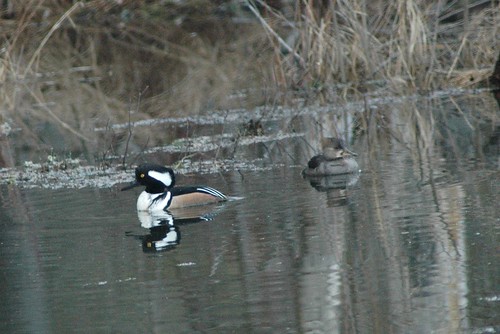
Hooded Merganser pair, 4/12/11, Berlin Pond, Berlin, VT
 
Hooded Merganser is a fairly common breeding species in Vermont, but is most numerous as it migrates through the county this month.  The stunning breeding-plumage of the male can be observed year-round.  Their clean-white hood is erected as they court females on their southward migration.

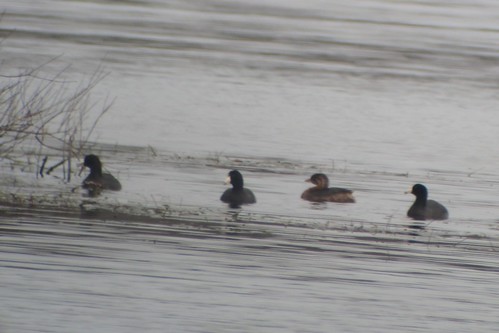
American Coots with Pied-billed Grebe, 11/15/11, Berlin Pond, Berlin, VT

Coot are an unusual visitor that are more closely related to Virginia Rail than to ducks.  While they haven’t been sighted in Washington County yet this fall, they are most likely to occur in November, so keep your eyes peeled for this black-bodied, white-billed bird.

Ring-necked Duck (male), 4/21/11, Berlin Pond, Berlin, VT


Ring-necked Duck reaches its peak in Washington Co. in November, and when viewed well, looks far more like a "ring-billed" than a "ring-necked" duck, which readily distinguishes it from all other ducks.  An uncommon breeder in Vermont, this species is easily observed at Berlin Pond most days in November, as long as there is open water.

Common Goldeneye (male & female), 3/4/12, Shelburne Point, Shelburne, VT

Goldeneye can be found all winter long on Lake Champlain, and until the smaller inland lakes freeze solid, are a good winter potential anywhere in the state from November on.  Keep an eye out for this arctic-breeding species throughout the month.

American Wigeon, 11/7/11, Berlin Pond, Berlin, VT

Always expect the unexpected, as nearly any species of duck that occurs in Vermont could show up in November.  On 11/7 last year, an American Wigeon appeared at Berlin Pond for just a single day, observed and photographed by 2 lucky birders.  This is currently the only fall sighting for this species in Washington County, but that could very well change in the next few weeks.  Keep a close eye on your local pond, because some cool and unique birds are still passing through as winter is hot on our heels!

Text and photos by Larry Clarfeld