|  Home  |   About us  |   Programs & Projects  |   Calendar  |   Birding  |   Blog  |   Get Involved  |

Friday, January 27, 2012

Frank the River Otter and 12 Kindergartners

Frank in  the classroom 
Who's your favorite river otter? FRANK!
Why do all these Vermont kindergartners love this member of the weasel family so much? Is it his extreme cute face and soft thick brown fur? How about those webbed toes and beady black eyes. And yes, he does have ears! "But,... they're so small! Can Frank hear okay?" the children wonder.
The ooo's and aww's fill the classroom when Frank makes an appearance. No student ever wants to see him go. They have even written him Valentines and "we miss you" notes.
So lets go back to the question, why do small children almost immediately experience empathy with Lontra canadensis? Children love animals, especially ones that have similar characteristics to their own. Children are natural caretakers of living things when adults model this behavior. I also believe it has to do strongly with children's innate connection to play and the river otters as well.

It is a brisk winter morning and a 12 kindergartners are eager for their ECO (Educating Children Outdoors) day. The school children burst out the back door and scamper up a snow covered hill. It doesn't take long for one adventurous being to figure out if you lay down on you belly, head pointed down hill, give a little push with your arms, you'll be sliding with increasing speed to a certain destination.
 As a teacher and a naturalist, I capitalize on the moment for extended learning during play.
12 young river otters
"Hey! You all remind me of my favorite Vermont weasel!"
'"What's a weasel?" a child shouts as they slide away from me. I reach in my back pack and ready at hand is a mammal guide and a photo of a river otter. Children gather round in between sliding to glance at pictures and make comments. Here we are creating a culture of questioning and learning through exploratory play.
It doesn't take long for the children to create a river at the bottom of their slide, scraps of cloth turn into fish. A den is being dug in the hillside with fast hands turned paws. With a little help from the "adult otters", we learn that by clasping your feet together behind you, your legs turn into a powerful otter tail perfect for steering and propelling forward. I mention to my friends that a coyote may be interested in their small fish cache.
"A coyote? Where?" the children become increasingly concerned, their eyes darting across the landscape. Some stand up on two webbed feet and sniff the air. These kindergartners immediately come up with a system to watch over cached fish and a warning system for an incoming coyote. Hmmmm,... all of sudden these children are the wisest humans I know. They work together as a family to protect what they have. These children are totally engaged. Mind, body, and heart.

The scenario of river otter play continues and I make the very adult comment that we should move on to the  next part of our morning. A small river otter turns to me and barks, " No way! We're gonna slide all day! Plus, we're such good hunters, we already got all of our fish for snack!"
Slide on river otters! Slide on!


A 6 year old masters the river otter slide


Inspired research and writing


Tuesday, January 24, 2012

Grand Canyon

by Bryan Pfeiffer, reposted with permission

The Naturalist Journeys Lecture Series
Join Bryan Pfeiffer on Friday, January 27, at 7pm for his presentation Into the Canyon, Into the Earth at the Unitarian Church of Montpelier. More info about the Naturalist Journeys Lectures.


I’m up from another hike in the Grand Canyon. No photo, no amount of hyperbole, does it justice. But I’ll try with five images. First is dawn on the South Rim after a snowstorm from our camp on Utah Flats, 1500 feet above the Colorado River on the north side. The second looks north from the Tonto Platform, a shelf of Bright Angel Shale at 3600 feet in elevation. The third is looking west above the Colorado River. Next is Ruth in Seventyfive Mile Canyon, a side slot canyon along our two-week hike. Finally, a Utah Juniper at sunrise on the South Rim. Click on each image for a wider, more satisfying view.


Find this and other stories by Bryan about the Grand Canyon, birds, dragonflies, and other natural history at The Daily Wing. Learn more about the Naturalist Journeys Lectures.

Tuesday, January 17, 2012

ECO - Educating Children Outdoors

The ECO program at North Branch Nature Center is a new project that helps reconnect children with the natural world and foster stewardship in their communities.  Through collaboration with public schools, preschools, and daycare facilities, ECO helps to open the doors to the joy of learning outside in all kinds of weather. By using city parks, public lands, and other local green spaces ECO engages children in the natural inquiry based learning of their surrounding environment. Through this type of active learning, children gain a healthy respect for nature and for one another. ECO provides an opportunity for teachers and students to apply integrated academic curricula beyond the classroom to the outdoors for exploration, experimentation, creativity, and personal growth.

 Now in its second year, ECO is working with 10 area school teachers on a weekly and biweekly basis to get their students outside and immersed in the natural world. ECO is not a field trip or a one hour visit to a forest. The students participating in ECO spend 2 ½ to 4 hours exploring a forest, playing games, learning woodcraft skills, journaling, and sharing in a community circle. These experiences happen continously throughout the school year. Rain, shine, and snow are welcomed weather features on any ECO day at public school. Schools have gathered all the needed equipment for their students to be dry and warm for engaged learning outdoors. There’s no such thing as bad weather, just bad clothing!
Not surprising, these days are some children’s favorite day of the week. Singing a song about rain, using ropes to climb a hill, making debris huts, following squirrel tracks in the snow, and boiling water in a Kelly Kettle for tea are all some things a child may experience on an ECO day. Inevitably, with more time spent outside moving and engaging in the natural world, each child develops a sense of themselves and their place in the world. By helping to foster a relationship with nature at an early age, children are given the chance to have a multi-sensory experience that will help them to retain knowledge in a more effective and meaningful way. This old Chinese proverb gives clarity to the purpose of ECO and the ongoing journey of life long learning for all human beings:
Tell me, I forget.
Show me, I remember.
Involve me, I understand. 


If you are interested in learning more about ECO and how to get involved, please contact amy@northbranchnaturecenter.org

Wednesday, January 11, 2012

Bird Banding at NBNC - 2011 Report


It is said that “a bird in the hand is worth two in the bush,” and this was certainly the case at North Branch Nature Center, where bird banding was formally launched in the summer of 2011. In bird banding, songbirds are captured in mist nets, carefully removed, identified and measured, and "tagged" with a band before being released. Bands look like little metal bracelets the birds wear on their ankles to help identify them if they are recaptured in the future.

Being able to differentiate individual birds allows banders to gain insight into their abundance, productivity, survival rate, and other demographics that would not otherwise be possible. Furthermore, close examination of birds-in-the-hand can reveal anatomical traits that would be indistinguishable through binoculars, such as weight, feather molt, breeding status, and others. Decades of banding has demonstrated this technique to be a safe, cost effective way of learning more about birds, with meaningful insights towards improving avian conservation.


The data collected this year has already shed some light on the birds of NBNC. Of the 32 species of birds that were caught, ten species had individuals that were recaptured, which is a good indication that these species were sticking around, perhaps to breed. One Common Yellowthroat was caught on five separate occasions between June 1 and July 16! It will be especially interesting next year to see how many banded birds return to NBNC after spending the winter in the tropics.

In addition to providing important scientific data, banding has offered a unique way for children and adults at NBNC to connect with birds. Over 75 children and 20 adults attended banding demonstrations, getting an up-close look at how scientists study birds. Some kids even helped release birds, a privilege that has inspired awe, curiosity, and a greater consciousness of how extraordinary birds are.

Download a full copy of this report, including graphs and tables.

Monday, December 19, 2011

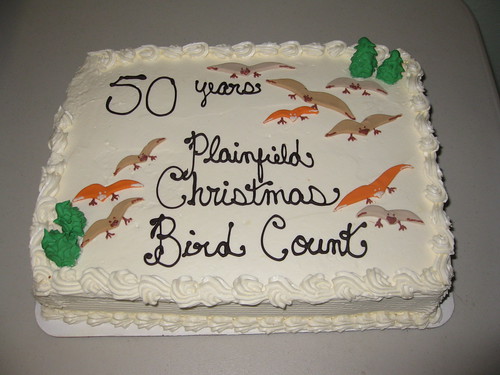
51st Plainfield Christmas Bird Count


“Atypical” would be a good word to describe the 51st Plainfield Christmas Bird Count. Warm temperatures leading up to the count and the absence of snow likely played a role in the birds we encountered. While the number of species seen (37) was higher than average, the total number of individuals was rather low. Many of the “common” birds were sparse, and extremely low counts were reported for many species including chickadees, nuthatches, blue jays, and woodpeckers. With an abundance of open ground and hence plenty of foraging area for birds, it is possible that the usual year-round residents were dispersed across a larger area than normal, rather than being concentrated at feeders.

While most birds were hard to find, some appeared in record numbers. New high counts were set for American Robin and Canada Goose, both of which have likely been taking advantage of the mild weather. Other lingering birds included a White-throated Sparrow and a Red-winged Blackbird, both found visiting feeders during the count day. An immature Herring Gull, the first on the count in 12-years, was also probably taking advantage of the unusually large amount of open water in the count circle.

The crown jewel of this year’s CBC had to be a Golden Eagle observed near Marshfield Mountain. Not only are Golden Eagles rare year-round, they are especially rare outside of fall migration, which typically tapers off in mid-November. This was the first Golden Eagle on the count in its 50-year history.
Preliminary results of the Plainfield CBC are shown below:


Canada Goose 830
Mallard 6
Hooded Merganser 3
Common Merganser 2
Ruffed Grouse 5
Wild Turkey 83
Bald Eagle 1
Red-tailed Hawk cw
Herring Gull 1
Rock Pigeon 77
Mourning Dove 44
Downy Woodpecker 20
Hairy Woodpecker 25
Pileated Woodpecker 2
Blue Jay 54
American Crow 175
Common Raven 14
Black-capped Chickadee 481
Tufted Titmouse 9
Red-breasted Nuthatch 25
White-breasted Nuthatch 23
Brown Creeper 5
Golden-crowned Kinglet 7
American Robin 27
European Starling 207
Cedar Waxwing 32
American Tree Sparrow 17
White-throated Sparrow 1
Dark-eyed Junco 35
Northern Cardinal 9
Red-winged Blackbird 1
Purple Finch 13
House Finch 14
Pine Siskin 61
American Goldfinch 266
Evening Grosbeak 18
House Sparrow 6

Tuesday, December 13, 2011

Vermont Christmas Bird Counts


Birdwatchers across the western hemisphere are filling their feeders and dusting off their binoculars for the 112th annual Christmas Bird Count (CBC). In Vermont, over a dozen counts will take place, with volunteers spreading out across the pre-determined study-area in an effort to census the winter bird population, leaving no chickadee uncounted. Some counts have taken place for decades, allowing scientists to learn how bird populations are changing over time. In fact, the large, long-term dataset created by the CBC is now used by the EPA as one of their major indicators of global climate change.

Last year, over 60,000 people took aprt in 2,160 counts across 31 countries/territories, setting records. The success of the CBC is due in a large part to the masses of volunteers who count birds for the sake of fun, science, and tradition. Most counts conclude with a potluck dinner, with rarities seen throughout the day being kept secret until everyone is gathered together, so they can be properly boasted. Most counts also welcome new participants, so if you’ve never taken part before, make this holiday season your first and come count some birds!

More info about the Christmas Bird Count


2011/12 VERMONT COUNTS:


Barnet
Jan. 1
Contact: Charlie Brown
cbrowne@fairbanksmuseum.org

Bennington
Dec. 28
Contact: Bonnie Dundas
kinglet@sover.net

Brattleboro
Dec. 17
Contact: Al Merritt
chpmnkx@sover.net

Burlington
Dec. 18
Contact: Shirley Johnson
rjsj489@comcast.net
Compiler: Eric Lazarus
ericlazarus@myfairpoint.net

Champlain Islands/St. Albans
Dec. 18
Contact: Liz Alton
redbnuthatch@gmail.com

Ferrisburgh
Dec. 17
Contact: Mike Winslow
mikekira@myfairpoint.net

Hanover-Norwich
Jan. 1
Contact: Daniel Crook
daniel.crook@hitchcock.org

Hinesburg-Huntington
Dec. 31
Contact: Paul Wieczoreck
mgcpw@gmavt.net

Island Pond
Dec. 15
Contact: Jayson Benoit
jayson@northwoodscenter.org

Mad River Valley/Northfield
Dec. 16
Contact Pat Folsom
pfols@gmavt.net

Middlebury
Dec. 18
Contact: Jim Andrews
jandrews@middlebury.edu

Mt. Abraham
Dec. 17
Contact: Randy Durand
durand@gmavt.net

Plainfield
Dec. 17
Contact: Chip Darmstadt
chip@NorthBranchNatureCenter.org

Randolph Area
Dec. 17
Contact: Rick Enser
rickenser@yahoo.com

Rutland
Dec. 31
Contact: Roy Pilcher
shamwariVT@aol.com

Saxton's River
Dec. 17
Contact: Don Clark
sapsbks@sover.net

Springfield
Dec. 18
Contact: Hugh Putnam
putnams@vermontel.net

Winhall/Windham
Dec. 17
Contact: Ruth Stewart
birder_rws@hotmail.com


Woodstock

Dec. 28
Contact: Sally Laughlin
laughlin@sover.net

Monday, December 12, 2011

Antique Bird Names

Ever see a flock of snowflakes fluttering above a snowy field? How about bullbats cruising over dimly-lit city streets? Or, have you ever seen a sparrow hawk perched patiently on a telephone line? Even sharp birders may not recognize some of these as archaic bird names. All languages evolve over time, but it seems that that bird nomenclature has a relatively short half-life. Bird names change for many reasons, but here are a few of our favorite archaic bird names:


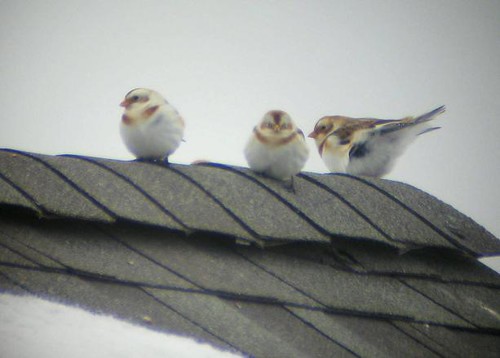
Snowflake – It isn’t too far of a stretch to picture a flock of Snow Buntings over a snowy field and think “snowflakes”. In fact, at the turn of the century this is how Snow Buntings were referred to. When I was first reading through results of the 1906 Christmas Bird Count, I thought the reference to “about a dozen” snowflakes as some kind of old-fashioned birding joke, but in fact, this was an accurate report, given the lingo of the time.

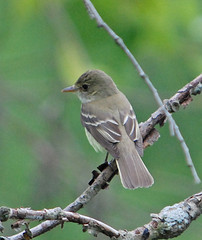
Traill’s Flycatcher – Some of the more exciting name-changing events for birders are when species are split, and one name becomes two. Named after Thomas Stewart Traill, a Scottish professor of medical jurisprudence and promoter of zoology and natural history in the early 1800’s, this nondescript gray-and-white bird became two in 1973. Now known as either Willow or Alder Flycathers, the two species are nearly indistinguishable by sight, but have different songs and habitat preferences. Sometimes, when birders see one of the pair but don’t hear their song, a bird will still be given the ambiguous label of “Traill’s”.

Sparrow Hawk – … is neither a sparrow nor a hawk, so some explanation is warranted! This out-of-date term was used to refer to the American Kestrel, who’s diminutive size derived the “sparrow” part of its name. But the “hawk” part just didn’t fit, as kestrels are a type of falcon, not hawk, and so the name was officially changed in 1973. Many raptors names have similar delineation, and terms such as Fish Hawk, Pigeon Hawk, Marsh Hawk, Duck Hawk, and others still surface from time to time.


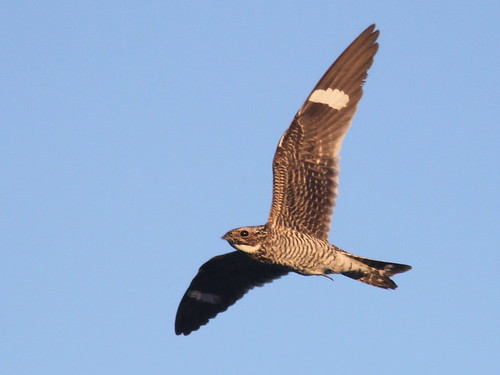
Bullbat – Birds that spend much of their lives near people tend to collect a plethora of pseudonyms, and so it is not surprising that a bird that nests on rooftops would be given a nickname. Even the official name “Common Nighthawk” is a bit of a misnomer, as these birds are neither hawks nor are they strictly nocturnal. Others may know the Common Nighthawk better as a “bullbat”, which is a more fitting term. The birds are erratic and bat-like in flight, and cruise over city streets at dusk, feeding on insects. But anyone who has seen a Nighthawk display during the breeding season knows why they call them "bull". Nighthawks will dive bomb other creatures that wander too close, including people, complimenting their bat-like flight with the attitude of a bull.

What are your favorite Antique Bird Names?