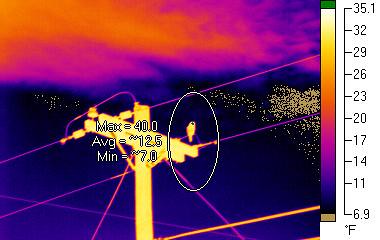
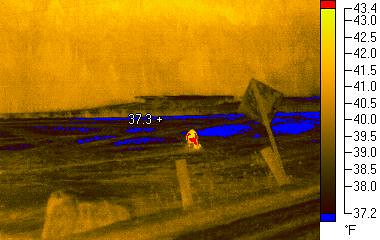
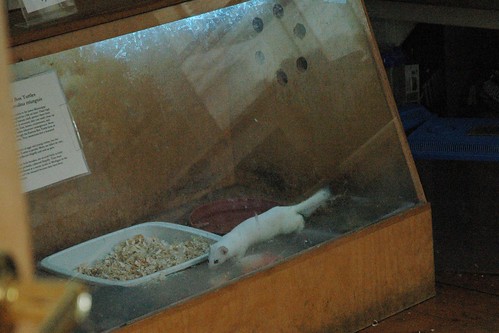
 Recently, when a family in the critter room asked about the “new animal”, we were shocked to find that the ermine had “weaseled” its way into the Box Turtle tank through ventilation holes and was enjoying part of the turtles’ lunch! We caught our uninvited guest in the act, sharing lunch with the turtles, in the picture shown on the right. Thankfully the ermine didn’t harm the turtles in any way and the ventilation holes have since been sealed. But ermine encounters are still quite common in the NBNC building. The bold ermine has even walked right up to people and sniffed their shoes!
As with all old buildings in Vermont, there are plenty of ways for animals to penetrate our walls, and the century-old stone foundation of the Nature Center has allowed in other creatures over the years such as mice and squirrels. Our ermine is likely keeping tabs on other rodent squatters. In the wild, ermines are known for their prowess in capturing prey, and easily invade burrows for mice, voles, and even young rabbits.
The highly active lifestyle of the ermine requires it to consume a large amount of food relative to their size, as much as a quarter to a third of their total body weight daily. Their need for a large volume of prey has made ermine both revered and reviled by people. Outside of the chicken coup the ermine can be a helpful companion in disposing of rodent pests, but inside the chicken coup the ermine can wreak havoc, eating chickens and eggs alike. In New Zealand, ermine were introduced as early as the late 1800’s to help eradicate rabbits, but the plan backfired when they spread throughout the country, decimating flightless and defenseless native bird populations. The introduction of ermine into New Zealand is now considered one of that country’s worst environmental mistakes ever.
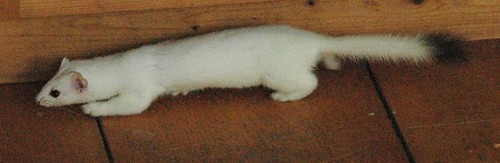
So far, we’ve coexisted quite peacefully with our ermine friend. How long she/he will stick around is anybody’s guess. In spring and summer, his/her fur will turn brown and it will be time to return to the wild. But for now, we’ll enjoy the company of another animal in the building and will always anticipate entering a room, because we never know when those curious black eyes will be looking up at us.

 For twelve consecutive hours, the North Branch Noddies scoured the coast of Essex County, MA, in search of all the birds that they could find in the Superbowl of Birding. This was our third year taking part in the competition and we tallied an impressive 66 species, more than we ever have before!
 Before noon we had already found amazing birds such as the Barrow's Goldeneye at Loblolly Cove, the King Eider (pictured above) at Bass Rocks, and the Common Murre at Eastern Point. Every stop we made throughout the day seemed to add new species to our list. As the sun was setting, with less than 10 minutes left in the competition, a Short-eared Owl flew silently across the sky at Plum Island as our final bird.
 Around our Nature Center we saw a beautiful pattern of small rodent tracks, perhaps belonging to a white footed mouse or deer mouse, making a large figure eight around our white pine trees. The children attending our morning