|  Home  |   About us  |   Programs & Projects  |   Calendar  |   Birding  |   Blog  |   Get Involved  |

Monday, October 14, 2013

Becoming bears

Front Cover
 In preschool, the best way to learn about something is to pretend to be it.  The changing leaves and the slight crispness to the air are a sign for bears to begin their hibernation process, so we became bears for the day!

First, we met the North Branch Nature Center's taxidermied black bear.  People got to touch the bear's fur, examine it's claws and ask questions about why the bear was there and why it wasn't moving anymore. 

Then, we played in a bear den (a big blue tarp in an outside corner of the barn) and learned to waddle like bears.  We sniffed apple slices with our dry "people noses" and then smelled them with dampened "bear noses."  Everyone agreed that the apples smelled even better with wet bear noses!

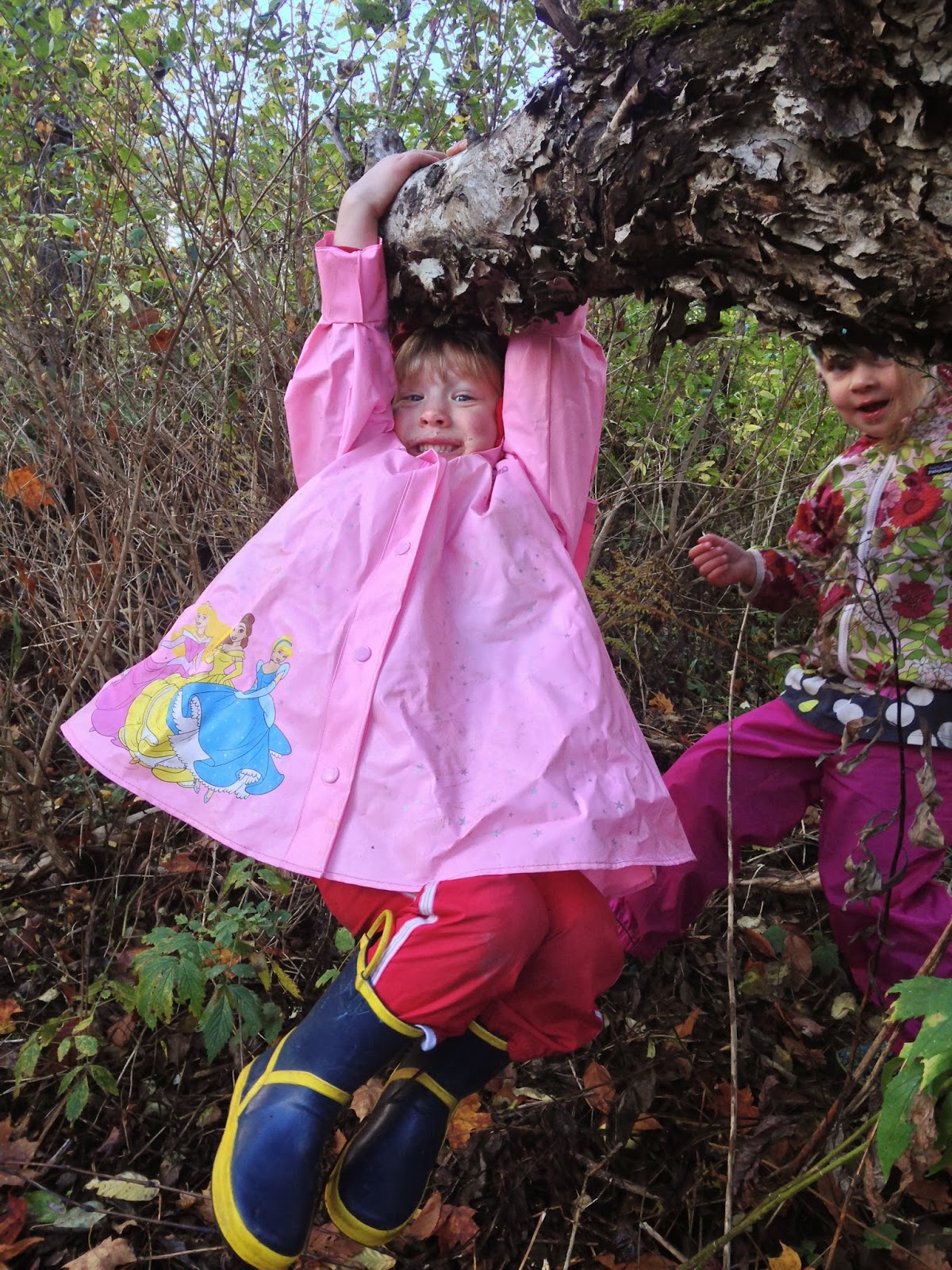
At deer camp during snack, we read Jim Arnosky's Every Autumn Comes the Bear.  We talked about what bears need to survive in winter.  One thing they have to do is eat, often apples or nuts or berries.  We visited an apple tree and practiced our bear climbing skills.

We ate some apples like bears...
 We observed the grasses and spent some quiet time during a break from our bear-play...
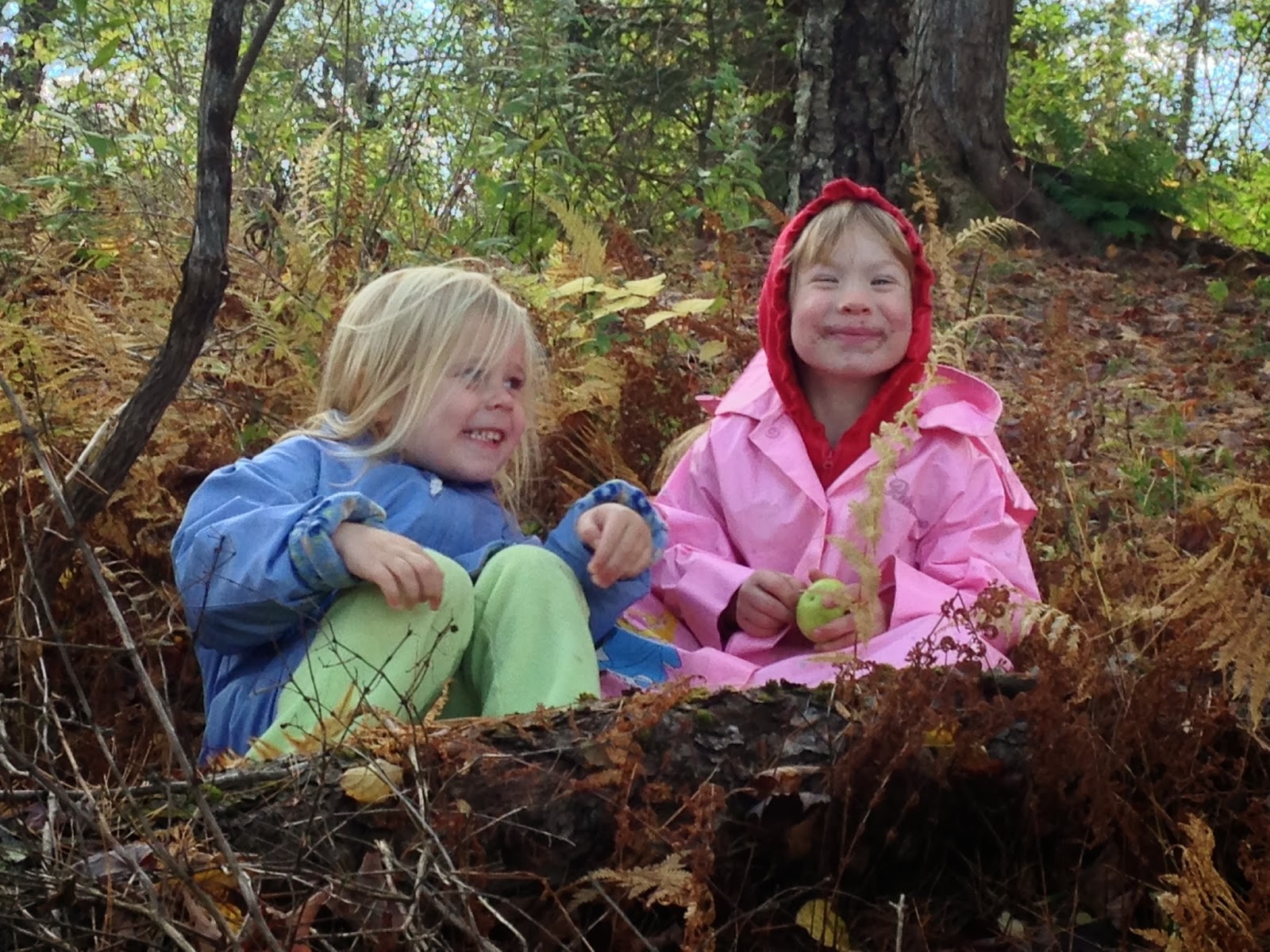
And we talked about bear dens and where they spend the winter.  Two girls made the connection that some animals make nests that are like dens.  Here they are trying out one of the nests they found in the forest!
What fun it can be to pretend to be animals!

Friday, October 11, 2013

Owls, Skunks & Beavers: NBNC at night

Working the night shift at the North Branch Nature Center definitely has its perks. Last night was our inaugural night of saw-whet owl banding and these tiny migratory owls did not disappoint. Soon after sunset we opened two mist nets down by the river and, in the span of 3 hours, we caught 4 of these pint-sized owls. Not bad at all, considering we had no idea if we'd catch any at all or even if they migrate through the area.


Northern Saw-whet Owls nest all over Vermont but migrate through the state in much greater numbers. Drawn in by an audio lure of the male's territorial song, banders catch the curious owls with nets that resemble volleyball nets. After banding each bird with a small aluminum band, observing and taking some measurements to determine age and sex, the owls are released to continue their migration.

Why band migratory Northern Saw-whet Owls? It wasn't until 1906 that scientists even knew that these owls were migratory and today much of their behavior is still a mystery. With banding stations throughout their range, however, scientists can gain insights into the timing of their migration, their migratory routes and overwintering areas, and their population cycles and trends. We are excited to be able to contribute to this effort to better understand this secretive, seldom-seen species. And do I even need to point out that these diminutive owls are certainly among the cutest animals on the planet?!

In between net checks, other creatures of the night kept us entertained. We had the pleasure of listening to Barred Owls in the distance, beavers plunking their tails in the river and even a skunk exploring the perimeter of the barn. Yes, working nights has its benefits!


Why So Many Wooly Bears?


If you find yourself asking this question lately, you are not alone.  This fall it is hard to take a step outside in central Vermont without finding a fuzzy caterpillar underfoot.  Attentive motorists may find themselves swerving to avoid road-crossing caterpillars.  And as the nights become cold, wooly bears are finding their way indoors.  So, why are there so many this year?

In 2006, Sandal Cate (recently retired NBNC educator) posed that question to Dick Dearborn, a retired Maine Forest Service scientist.  That year had been a big one for wooly bears, but it doesn’t rival this year’s numbers.  “Some insects like the Woolly Bear will often have a peak in their population,” said Dearborn, “Woolly Bear numbers increase to a high point about every ten years.”  This pattern, however, is not exact and it can be hard to predict exactly when and why these peaks occur.

Part of why people are seeing so many now has to do with their life cycle.  Wooly Bears are the larval (caterpillar) phase of the Isabella Tiger Moth.  Wooly Bears feed on a wide variety of plants, although are not considered a garden pest, even in years where they are abundant.  The caterpillars overwinter and can often be found wandering in the fall in search of a suitable place to spend the winter months.  Their thick, bristly hair makes them unpalatable to most predators, so they can wander out in the open without fear of being eaten.  They can remain active well into November, so as long as there isn’t snow on the ground, we can expect to continue seeing Wooly Bears as they wander about!

So, watch your step out there… and help a Wooly Bear across the road this fall!

p.s. Here are some unusual looking Wooly Bears that we've found at and around NBNC in the past.


Friday, October 4, 2013

Quiet in the Forest

It's the beginning of all our ECO (Educating Children Outdoors) programs in surrounding schools and the students have fallen back into our outdoor learning routines beautifully. The crisp fall air, the stunning colors of autumn and reuniting with special places in the forest have created unique learning opportunities. This past week children at East Montpelier Elementary silently wandered in the forest looking for their very own special place. This routine serves every child in a different way. Whether its sitting silently and gazing up at the canopy or writing in a journal, students always ask for this time on our ECO days. One East Montpelier teacher was especially inspired at the base of her tree this week. While watching students silently sink into the forest, she wrote this poem:

Flutter

A child sits quietly in the forest.
She lifts up her head gently.
Her gaze is still
and steady.
She watches as an amber leaf
f
 l
   u
    t
      t
        e
          r
          s
from the forest canopy.
She is still. 


Thursday, September 26, 2013

Caterpillars of NBNC (part 4)

Fall may officially be here, but that doesn't mean it's too late to search for insects!  A group of 2nd graders from Barre Town had spectacular success in a quest for bugs at NBNC this past Tuesday, turning up around ten types of caterpillars (along with a host of other amazing insects).  Here were some of the highlights:

We found tons of fuzzy Wooly Bear caterpillars during the morning's foray, but only one Impressed Dagger Moth!

It has been over a year since we've found the Henry's Marsh Moth caterpillar at NBNC, so it was a welcomed sight on Tuesday!  It's amazing what you can find with lots of eyes searching!

The Brown-hooded Owlet was also featured in part 3 of NBNC's caterpillars, but is too beautiful not to mention again!  It is no wonder that this caterpillar is on the cover of the field guide "Caterpillars of Eastern North America."  It was a sure favorite!

The Black Swallowtail is a common species at NBNC, feeding on members of the carrot family.  It was featured in our very first caterpillar post, but we decided to feature it again because of this individual's unusual coloration.  Check out Caterpillars of NBNC part 1 to see what they usually look like here.

The Black Arches caterpillar may have been the day's rarest find.  Some consider the species to be uncommon and this is the first time we've found it at NBNC!


Wednesday, September 25, 2013

Snapping Turtle Hatchlings


The exposed Snapping Turtle nest.

Unexpected discoveries are to be expected when spending time in nature.  You go out looking for one thing and find another.  When I was checking a crayfish trap (which turned out to be empty) just downstream from NBNC last week, I was thrilled to discover a nest of Snapping Turtles in the process of being born.

I first noticed some very fresh looking egg shells at the base of a large dirt pile.  I could tell they were fresh because the leathery shells had not yet curled up as they do when they begin to dry out.  At the top of the dirt pile was a cave-like opening about the size of a slice of bread, inside which eggs and baby turtles were piled and partially buried.  Some had already hatched, others were hatching, and some were still sealed in the ping pong ball sized eggs.  

One of the Snapping Turtles just beginning to emerge.
Hatchling Snapping Turtles are extremely vulnerable and can become a bite-sized snack for a slew of creatures such as raccoons, otters, herons, kingfishers, crows, bullfrogs, bass, snakes, and even other turtles.  Under natural conditions, few nestlings will survive to adulthood, but these conditions were far from natural.  The nest was completely exposed, elevated above the ground on top of the mound of soil, open and exposed to the baseball diamond.  Crows frequent this area, searching for scraps left by people, and would gobble up baby turtles in an instant.  So I decided to excavate the nest and watch over the turtles until they had all hatched.
A hatchling almost out of its shell.
Over the next few days, the baby turtles emerged from their eggs.  They pried through the leathery shells using their egg tooth (the sharp, white tip of their beak), which will disappear as they grow.  Even with my help, most of these turtles will likely become prey for other creatures.  Very few hatchlings make it to adulthood, but those that do have few natural predators and can live for decades.  I wished them luck as I released them into the beaver pond near NBNC.  Hopefully in ten years I will see one of them as an adult, enjoying life along the North Branch of the Winooski River. 

Ready for release at the beaver pond.

Tuesday, September 17, 2013

Building our play-spaces

 The Forest Preschoolers are active, imaginative, and LOVE to build.  They love to create their worlds, and will craft pretty much anything they can get their hands on into elaborate scenes.  Much of our mornings focus around building in some form, and pretty much everyone participates. 
Laying out our obstacle course.
Yay for teamwork! Moving a board for a fort's floor.

A salvaged slide makes for the beginnings of a forest playground.

Working on a home-made swing.
Making dock-masks.

Giving the swing a test-run!

Flags for our tipi

Righting our own little tipi.


Building models with kitchen-fresh play-do.
What fun these little ones have while making their world the way they want to see it!