|  Home  |   About us  |   Programs & Projects  |   Calendar  |   Birding  |   Blog  |   Get Involved  |

Showing posts with label outdoor learning. Show all posts

Friday, November 1, 2013

Loose parts magic

I've been looking for ways to enhance my students creativity and problem-solving skills in my outdoor-based preschool and kindergarden.  In my research amongst other blogs and educators, the hot way to do just that is through loose parts play.  Having collections of random objects, such as buckets, sticks, kitchen utensils, bowls, balls of different sizes, and planks and rounds of wood can be engineered and imagined into so many different things! 

I have to admit, I've used loose parts in the past.  I would meticulousely arrange them into little stations before the children arrived with my pre-determined ways that the children would use the objects.  There might be a music station, with an arrangement of buckets, bowls and utensils for banging, a building station with sticks, and a rolling station with balls of various sizes and halved PVC pipes.  But the children had little attention to give the parts and would wander between stations, and often resort to playing tag games. 


So I decided to change my tune.  I put out only one or two collections of loose parts materials, along with an art or craft project, to welcome the children as they arrived.  I also made clear that any of the materials at the side of the barn were available.  To my surprise, the ways that the children used the materials skyrocketed!  Here, two children making a delicious concoction in the "kitchen." 

Meanwhile, another two arrange wooden rounds and planks into their own obstacle course.   
 Just a few moments later, they shift their attention to building a tower. 
 They keep adding to it, and it's almost double the height of this child!
The preschoolers decided to use some planks and the picnic table as a makeshift slide. 
 With a little redirection, the used the plank of wood as a ramp for other objects, like this wooden round:
 a ping-pong ball,
 wooden block shapes
and round silver balls.  So much ingenuity!  And focus, too - look at the girl in the racoon mask, raptly watching the whole time.

Monday, October 14, 2013

Becoming bears

Front Cover
 In preschool, the best way to learn about something is to pretend to be it.  The changing leaves and the slight crispness to the air are a sign for bears to begin their hibernation process, so we became bears for the day!

First, we met the North Branch Nature Center's taxidermied black bear.  People got to touch the bear's fur, examine it's claws and ask questions about why the bear was there and why it wasn't moving anymore. 

Then, we played in a bear den (a big blue tarp in an outside corner of the barn) and learned to waddle like bears.  We sniffed apple slices with our dry "people noses" and then smelled them with dampened "bear noses."  Everyone agreed that the apples smelled even better with wet bear noses!

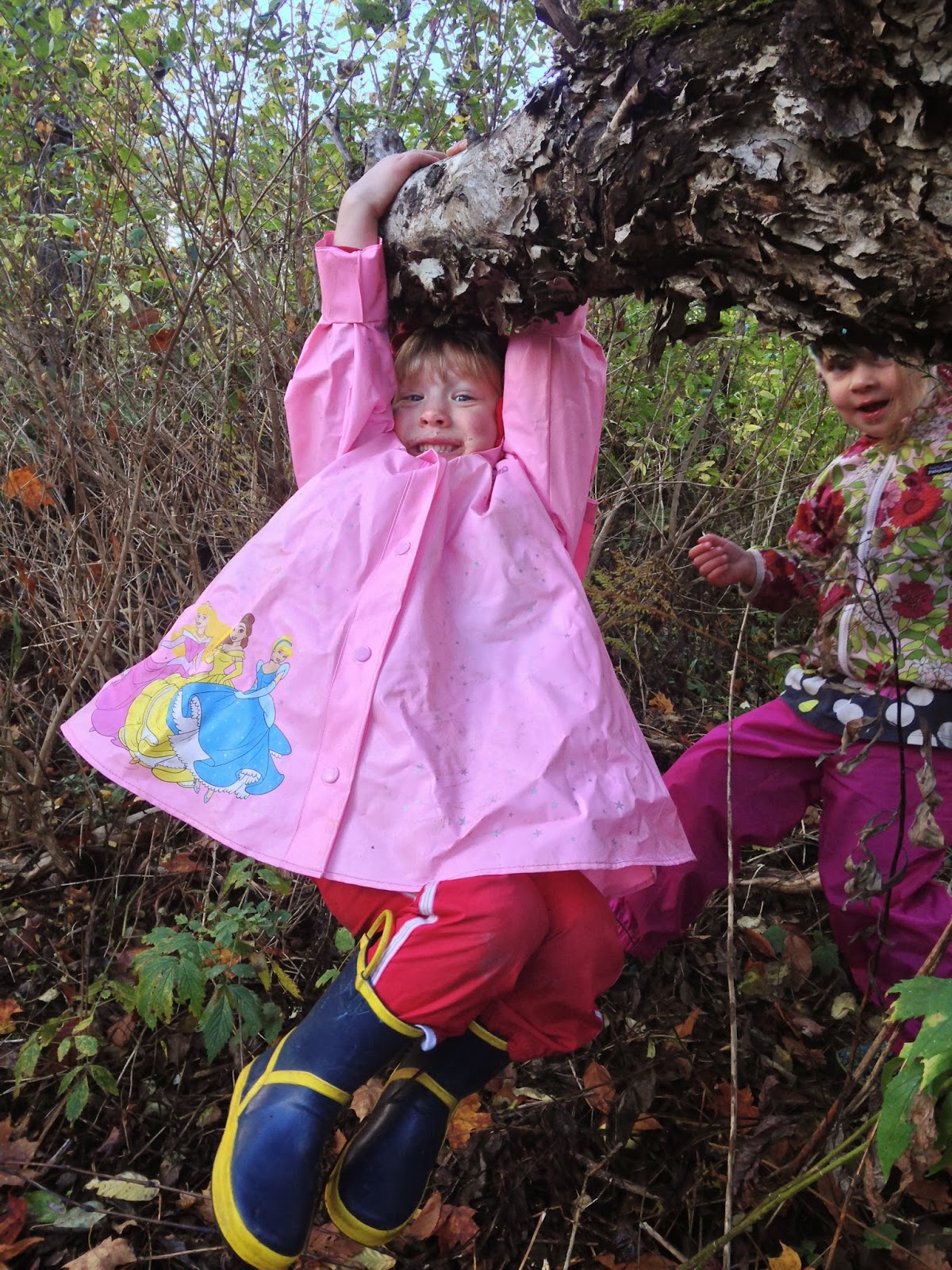
At deer camp during snack, we read Jim Arnosky's Every Autumn Comes the Bear.  We talked about what bears need to survive in winter.  One thing they have to do is eat, often apples or nuts or berries.  We visited an apple tree and practiced our bear climbing skills.

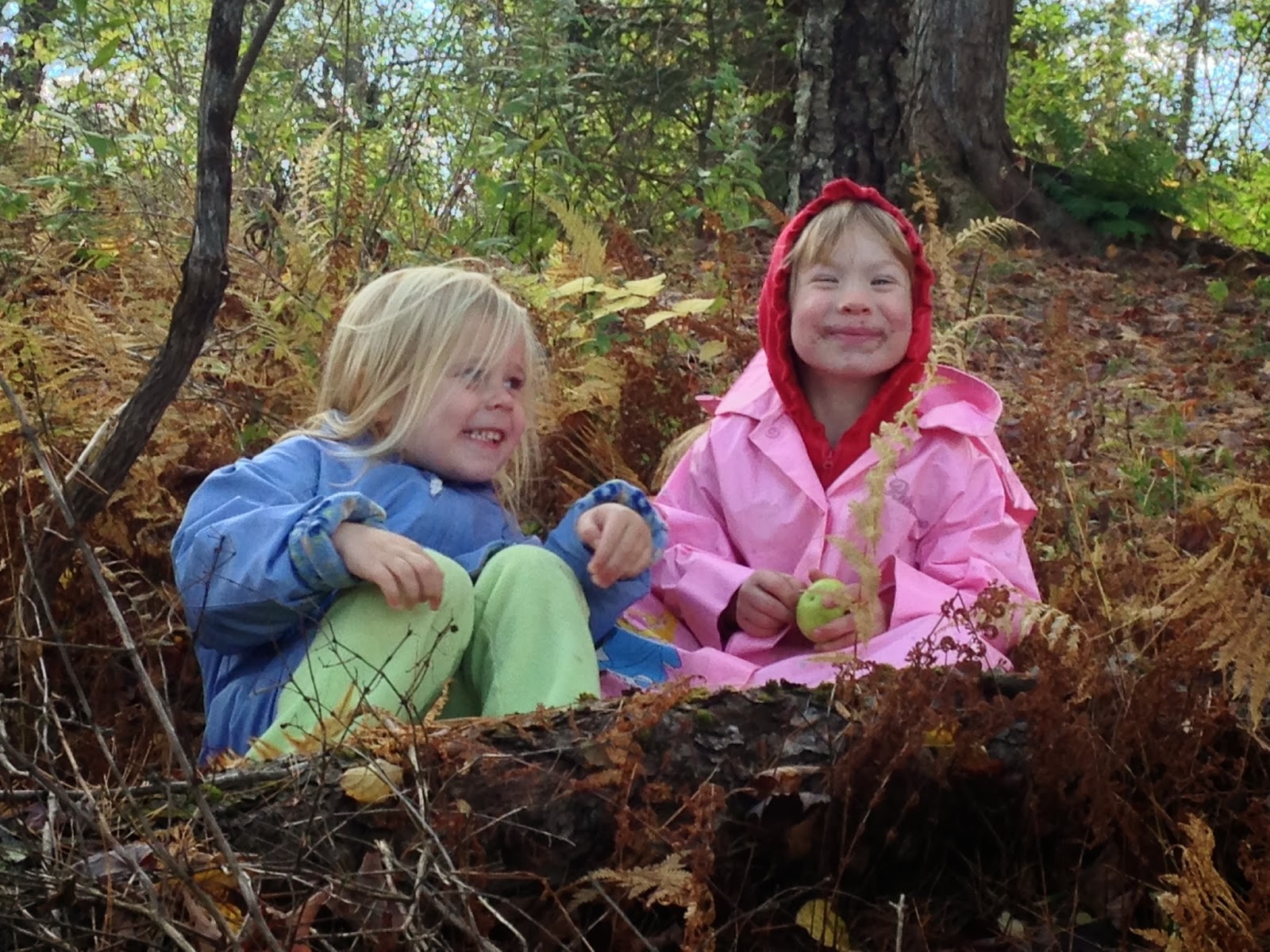
We ate some apples like bears...
 We observed the grasses and spent some quiet time during a break from our bear-play...
And we talked about bear dens and where they spend the winter.  Two girls made the connection that some animals make nests that are like dens.  Here they are trying out one of the nests they found in the forest!
What fun it can be to pretend to be animals!

Tuesday, September 17, 2013

Building our play-spaces

 The Forest Preschoolers are active, imaginative, and LOVE to build.  They love to create their worlds, and will craft pretty much anything they can get their hands on into elaborate scenes.  Much of our mornings focus around building in some form, and pretty much everyone participates. 
Laying out our obstacle course.
Yay for teamwork! Moving a board for a fort's floor.

A salvaged slide makes for the beginnings of a forest playground.

Working on a home-made swing.
Making dock-masks.

Giving the swing a test-run!

Flags for our tipi

Righting our own little tipi.


Building models with kitchen-fresh play-do.
What fun these little ones have while making their world the way they want to see it!

Tuesday, May 21, 2013

Forest School farm field trip

 
We were lucky enough to visit a Forest Schooler's family's farm today!  Located just up the road from the NBNC, we spent the morning exploring forests, ponds and streams, helping with farm chores and enjoying the humid spring weather (thankfully the thunderstorms held off!)
 
Here are some happy explorers!
 
We found some porquipine quills outside a den.  Did you know porqupines poop on their front stoops?

 
Who knew there was a cave that could fit the whole Forest School, and even some siblings?!
After exploring the forest, we helped with farm chores.  First we scrubbed water buckets for the ducks...
 
Then we collected chicken and duck eggs!

 
Afterwards, we played with the baby goats.


And had a peaceful time observing ducks.

Can you find the toad eggs? 
 
 
Here's a boat, made with woven ferns.

 
What a day it was!  So much fun learning happens at a farm.
 

Wednesday, March 20, 2013

Spring is Coming! Using QFT with second graders

Happy First Day of Spring!  Although you might not guess that spring is beginning with the 15" of light snow we received over the past few days, spring is coming.  To celebrate spring's arrival, in two second grade classes at Union Elementary School in Montpelier, we used our senses to find signs of spring in Hubbard Park.  We were helped by the Question Formulating Technique, which was developed by the Right Question Institute.  First students thought of as many questions as they could in 2 minutes about the statement, "Spring is Coming!"  Here were the parameters:

1.  Only ask questions.
2.  Any statement will be turned into a question.
3.  No analysis of questions or answering them.
4.  Write questions as they are stated.  

Here is the list that we generated:


 We walked the mile through town up to our "Base Camp" to investigate signs of spring that are on their wa.  Here are a few students diligently recording their observations at their sit spots.  They found snow melting, warm breezes, soft moss, buds beginning and much more.  Sitting quietly and observing proved fruitful for generating more questions about what's going on in the little microcosm of the sit spot. 


When we returned back to school, we revisited our questions from earlier in the morning.  Can you see the extra questions we asked?  Students focused their questions and were much more specific.  In the early morning, questions were broader, such as, "Do you think it will be warm," and "Why is spring coming?" 

After being outside and everyone sharing the signs of spring that they saw, smelled, heard (lots of birds!) and felt, the questions that the questions generated were more specific and demonstrated higher thought processes.  For example, one student asked, "Why is the grass orangish-brownish after the snow melts?"  Immediately after, another student asked, "Why is grass green in the summer?"  Since we wrote these questions on the flip chart, they will be saved and teachers can return back to discuss and answer these questions!  It's a perfect opportunity for authentic, engaged learning. 

These second graders are savvy researchers, too.  When I asked how they could answer their own questions, one boy stated, "You google it!"  They also knew to look in books, talk to their parents and teachers, ask the librarian for help, and much more.  


Here's something I observed at my sit spot!  It looks like a cross between a frozen inchworm and a tiny birdpoop.  I wonder what it is?  How did it survive the winter?  How did it remain sticking to the stick throughout the winter?  Oh, the questions that arise...

Friday, February 15, 2013

Why I build fires.

Each day we meet for Forest School, we make a fire.  It is a warm and welcoming ritual in the snowy, deep winter of central Vermont.  


But I have to admit, I wasn't always so keen on having a fire.  The pre-fire logistics of gathering kindling, requesting firewood donations from parents, checking the weather forecasts for wind and snow and rain all seemed too daunting.  Plus, with my poor circulation, the thought of having to take off my expedition-style mountaineering mittens to start a fire seemed worse than sitting for a few hours without a fire!  I would relegate the fire responsibility to my co-leader and supervise free play and tell stories instead. 

But earlier this week, when my co-teacher offered to join the group for free play, I somewhat ambivalently accepted the role of "Fire Tender."  It was a relatively warm day for mid-February (mid-20 degrees F) and Zach had already started the fire.  All I had to do was add more wood and stir the coals when the fire started to dwindle.  The crackling fire and the sounds of children laughing and shouting in play was comforting and I found a pleasant rhythm to my task.  I came to appreciate that task of tending fire really requires one to cultivate tenderness - attentive, patient, alert and observant.  In essence, being with the fire was quite similar to how I strive to be with my students.  The hour of tending fire passed surprisingly quickly, interspersed by visits from children to warm their hands, dry their mittens and share an interesting observation, and there was a welcoming fire for our end of the day Thanksgiving circle and closing rituals.  

This afternoon was a pivotal moment for me.  I used to skeptically approach fires as something too "crunchy" for me and a practice that was too time consuming to meld with my teaching style.  But I have really come to appreciate the immeasurable value of teaching with a fire.  

After going over some basic safety expectations with your fire guests, the fire is an amazing management tool.   The students naturally gravitate towards it, they are focused and thoughtful around it.  We eat lunch around it, share stories while gazing into its depths, and have it as a gathering point to return to after play and exploration.  

There are countless science lessons that flow from it. Hello, states of matter!  Not to mention cooking, change over time, social studies, tool use, and the list goes on.  It is fun to see what these kindergarten and first grade students know about fire and what preconceptions they have about how things burn and what the difference is between steam and smoke.  I am lucky enough to have colleagues with myriads of experience teaching with fire and who have created lessons involving safe practices with fire.

Plus, the very act of gathering around a fire is powerful and is something that has been practiced for centuries. In a culture that is ever-more focused on deriving pleasure from staring at screens, there is something peacefully rejuvenating that happens when you're staring into a fire with beloved students and colleagues. 


Thursday, December 20, 2012

Whittling with Kids

The Forest School students have had a super fun time honing their whittling skills this fall using potato peelers.  As soon as the single-pivot potato peelers were introduced, these kindergarten and first graders enthusiastically took to experimenting with whittling:

 
They made crafts, like this God's eye in a homemade frame:
 
 
With so many beautiful goods created over the course of a few weeks, everyone wanted to create a store to sell their wares!  A name was voted on, which was the "Fire Whittlers" and friends and family were invited to shop during the last Forest School session before the holiday break.  Here are the students making price tags for their goods:

 
When the parents arrived, they were instructed how to "Fox-walk" up to our basecamp:


Here are our guests arriving through the forest: 

 
One vendor selling a fishing pole:

 
We finished off the afternoon with a Thanksgiving circle, where parents, grandparents, students, North Branch staff and friends shared one thing that they were thankful for.  It was a beautiful afternoon with lots of wonderful learning that took place!

Community Mapping in Montpelier

Did you know Montpelier, VT, has four churches within three blocks?  Or that there are three dentists in less than a half-mile?  The second graders at Union Elementary made these discoveries, plus many more, as they mapped their route from school to Hubbard Park.  Map-making is a vital tool in helping children to get to know their community and these 50 students put their classroom-based learning into use as they mapped their mile-long trip from U.E.S. to the city park. 

The objectives of this activity was for students to spend time getting to know more about their community and to support the learning happening in the classroom.  The second grade is currently amidst a mapping unit, so the students put their knowledge of orientation, scale, keys, and landmarks to use.  During their two and a half-hour ECO sessions, four second grade classes added landmarks and points of interest to a simple sketch map that their ECO teacher drew up before class.  In teams of two, children drew and wrote details on their map so that someone who had never walked the route before could find their way from the school to the park.  Teachers and parent volunteers guided the discovery, but it was largely student driven.

The snowy weather added for an extra challenge for keeping their map dry, but students were upbeat and curious about their surroundings.


Although these students live in the town and have walked this route many times, they were making discoveries about the town that they had never appreciated before and asking questions.  One student asked, "What's a chiropractor?"  Another student wanted to know what the Rotary club was and why they gave the library benches.  One class had just begun a poetry unit, and so they were asked to record poetic words about the weather, sights in town, and experiences up in the park. 

The teachers were very pleased with their students work.  This activity acted as an informal assessment of what the students had been learning about maps in the classroom.  "I can honestly say that I'm speechless about how well this activity corresponds with the classroom learning," remarked one teacher.  "It is great to see what the students have been learning put into practice."