The World Series of Birding takes place in New Jersey in May of each year, and for over a decade, youth teams have participated with NBNC. In this annual event, which is part competition and part fund raiser, teams scour the Garden State in an attempt to find and identify as many types of birds as possible. As one generation of World Series alumni are becoming adult conservationists, a new generation is participating for the first time, and both shared the experience together this year.
Our youth team had the joy of discovering Cape May County and exploring the fields, forests, beaver ponds, and beaches full of birds. From dawn until dusk, they enjoyed countless “life birds” and tallied an impressive 111 species. Our team of young adult “alumni” spent a full 24-hours scouring Cape May and finding 148 species during the competition.
Additionally, the teams raised thousands of dollars to benefit the NBNC’s Youth Birding Program.
Whether watching a Ruby-throated Hummingbird sitting on its nest by day, or listening to the echoing calls of Clapper Rails ringing through a saltmarsh at night, the memories from our birding “big day” will last a lifetime.
Tuesday, May 29, 2012
Thursday, May 10, 2012
To Bird or Not to Bird
A question I ask myself most spring mornings is," Should I go running or should I go birding?" My running shoes are right next to the bed so I am faced with them each morning as I wake. Peregrine Saucony's, running shoes so appropriately named for a birder! And my binoculars are hanging by the door, saying "Choose me! Choose me! Not those pink and blue shoes!"
Decisions, decisions! We know running isn't really great with a pair of binoculars hanging around your neck, binocular bra or not. The site of a newly arrived warbler may cause a shortness of breath, but birding doesn't really bring the heart rate up. So, what do you choose? Binos or the trail shoes?
Well, here's an idea. Choose the sneakers and leave your ipod at home. Enlighten those wonderful tools on the side of your head, the human ears, and do some birding by ear.
I have been running the same trail up Spruce Mountain for 10 years and it has been one of the best long term birding experiences to date. I know every bend, rock, root, and bird song along that trail. Not too mention the diversity of habitats I pass through along the way. Hemlock stands, power lines, a southwest facing hardwood forest, small brooks and old pastures with feathered edges of shrubs and fruit trees. The birds are numerous, the diversity something to be proud of, and for the beginner birder, more than overwhelming.
I started with one new bird at a time. "zee-zee-zee-Zoo-zee!"
Please join us here at NBNC on May 19th from 7am to 3pm for BIRDFEST. Amongst our line up of great workshops and activites, staff naturalist Larry Clarfeld will be teaching a workshop about how to fine tune your ear to the sound of bird song. Birding by Ear at 9:30. No running shoes required.
Decisions, decisions! We know running isn't really great with a pair of binoculars hanging around your neck, binocular bra or not. The site of a newly arrived warbler may cause a shortness of breath, but birding doesn't really bring the heart rate up. So, what do you choose? Binos or the trail shoes?
Well, here's an idea. Choose the sneakers and leave your ipod at home. Enlighten those wonderful tools on the side of your head, the human ears, and do some birding by ear.
I have been running the same trail up Spruce Mountain for 10 years and it has been one of the best long term birding experiences to date. I know every bend, rock, root, and bird song along that trail. Not too mention the diversity of habitats I pass through along the way. Hemlock stands, power lines, a southwest facing hardwood forest, small brooks and old pastures with feathered edges of shrubs and fruit trees. The birds are numerous, the diversity something to be proud of, and for the beginner birder, more than overwhelming.
I started with one new bird at a time. "zee-zee-zee-Zoo-zee!"
Obviously not a chickadee. Running and focusing on that one song, I carried the tune back home and to my birding by ear resources. Black-throated green warbler. Check! Got it in my memory and in my muscles. That's called kinesthetic learning. Moving, talking, and creating images in your head. Powerful learning indeed.
As the seasons and years have gone by I feel like that trail run of mine is lined with friends. And most likely birds that come back to that same exact place every year. The solo guitar rift of the winter wren, melodious spiraling of the veery, the nonstop caffeinated song of the red eyed vireo. I have learned and embodied all these songs simply by running and paying attention to the sound of birds around me.
I like to learn new things. It's one the great things about being a human. There is always more to learn. And the more we learn about our green, green state of Vermont, the more we fall in love with it.
Monday, May 7, 2012
A Bird Comes Home
It being such a beautiful morning, I couldn’t resist taking
a short walk down to the North Branch to see what migrant birds had arrived
over the weekend. I wasn’t disappointed – Common Yellowthroat, Gray Catbird,
Yellow Warbler, Northern Parula, Osprey and Eastern Kingbird were all singing,
feeding or flying down along the river. The highlight, however, was a
Chestnut-sided Warbler, which was boldly declaring its territory with a loud “please,
pleased, pleased to meetcha”.
As soon as I heard the warbler singing, I wondered if it
might be banded. We started a bird banding operation here at the North Branch
Nature Center last summer and we banded a total of 22 Chestnut-sided Warblers. In
fact, the very first bird we banded was a Chestnut-sided Warbler. Even though
this was my first sighting of the species for the season, I thought just maybe
this particular bird was one of our local breeders.
Sure enough, when I raised my binoculars, I immediately saw
the tiny, shiny aluminum band around its right leg. It was one of our birds! I had already seen banded Black-capped Chickadees
and Song Sparrows on the property this spring, but seeing this Chestnut-sided
Warbler was an exhilarating experience. Here was a bird that either nested or
was born here on the property – and then migrated thousands of miles to some tropical
locale like Costa Rica - and then back again!
Seeing a Chestnut-sided Warbler is always special, but knowing
that this individual was intimately connected to this place and that he had
survived such an enormous migration to come back the North Branch Nature Center,
was truly a gift.
Posted by Chip Darmstadt
Photo credit: William H. Majoros
----------------------------------------------------------------------------------
Interested in seeing a Chestnut-sided Warbler for yourself - or checking out a bird banding demonstration? Come to Bird Fest at the North Branch Nature Center on Saturday, May 19. Visit the North Branch Nature Center website for more info.
Monday, April 9, 2012
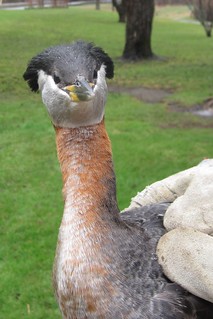
Crash Landing of a Grebe
When the phone rings at North Branch Nature Center, we never know quite what we'll hear when we pick up. Today, we were surprised when a caller told us about a duck that was stuck in a puddle on the sidewalk in downtown Montpelier! The bird turned out to be a Red-necked Grebe.
Grebes are similar in appearance to ducks, but come from a very different lineage. Like loons, grebes eat fish by diving underwater. They've evolved nicely to this lifestyle, with their legs attached towards the back of their bodies (like the motor on the back of a boat). They have lobed toes, which allow their feet to act as flippers and propel them through the water. As a consequence of their anatomy which is so well adapted to life in the water, they are unable to take off from a solid surface.
Red-necked Grebes spend the winter along the Atlantic and Pacific coasts, and each spring they migrate at night to central and western Canada to breed. From above, a wet parking lot can look a lot like a big lake. Street lights can cause further confusion for birds, causing them to crash-land and become stranded on asphalt. In December, more than 4,000 Eared Grebes were grounded in a Wal-Mart parking lot in Utah, a quarter of which didn’t survive.
The Red-necked Grebe that crash-landed in Montpelier has an injured leg and was transported to a waterfowl rehabilitator this afternoon. If the leg does not heal, the grebe will be unable to hunt for fish and will not be rereleased into the wild. We hope this will not be the case, and that the bird will heal quickly so it can continue its northward migration. Traveling hundreds of miles each year is an inherently dangerous task for birds and other migratory animals and this incident demonstrates the added hazards that are created in a human-altered landscape.
Thursday, April 5, 2012
One Teacher, One School, One Community
I love my job. I get to be outside wandering through streams and navigating forests with some of the most incredible human beings,..children. I can not tell you how much I learn from my young friends in a simple blog post. I have learned patience, compassion, self efficacy, resilency, and the process of healing. For the last 7 months I have been working with a teacher and her class of brilliant and loving kindergarteners at Moretown Elementary School. I thought I was just inspiring teachers and their students to learn outdoors. Instead, I have been taught one the most powerful lessons of my teaching career. Please read the story below, written by Pam Dow of Moretown Elementary. Our school year started like none other. Just two days before our scheduled opening, parts of our village and town were ravished by tropical storm Irene. The opening of school had to be delayed. Children and families spent the first days after the flooding wrapping their heads around the magnitude of the disaster that destroyed their homes and town. Quickly it became neighbors helping neighbors, strangers helping strangers, Moretown helping Moretown. Although many of our material possessions were destroyed by the flooding, our sense of community was just beginning to emerge.
Many children’s homes were flooded and their prized possessions were gone or covered in a thick, gooey muck that was left behind after the waters receded. The school suffered damage as well, and as staff went about helping families clean out their homes, a professional cleaning crew set to work on the school; ripping up all flooring, scrubbing and sanitizing anything salvageable that came into contact with the contaminated waters.
Although crews worked hard for many days, our school building was still not safe for students. Many of our school children were experiencing the most tragic event of their lives, watching their homes and town be destroyed. They saw the sides of the main street piled with debris-residents’ belongings and the guts of their homes, not salvageable due to the wrath of Irene.
Moretown children needed normalcy. They needed something they knew and loved, which was why the staff knew school must go on. We began our school year with a series of fieldtrips to destinations across Vermont. Destinations that welcomed us with open arms and kindness. After several days of fieldtrips, we began school in tents set up on our baseball field. With surprising ease, children and adults adapted to our tent school. Teacher’s taught, children learned. I think we all grasped at this sense of normalcy, this idea of routine…school. We were together as a class, a school, and a community and for a few hours we could focus on something other than the destruction of our homes and town. When the time came to return to our classrooms, it was a celebration. Kindergartners were excited to begin a new program, a Nature Adventure Program, which connected students with the forest behind our school. For three hours each week, we have had the distinct pleasure of working with Amy Butler from the North Branch Nature Center. It quickly became apparent that this program was vital to the health and well being of our children.
I have watched as children eagerly wait for Wednesday mornings to arrive so they can go out into the woods behind our school to explore, build, and connect with the natural world around them. The timing of this program was perfect; these children were living out the realities of a natural disaster but were able to escape into the woods for solace each week. This group of five and six year olds quickly took to building…building with sticks and stones, leaves and natural materials. They built and built, from small mouse houses to “sewers” (large holes at the base of trees) that they dug with sticks. The building continued all fall and winter and now into spring.
The sticks and stones and their actions represent much more than children exploring in the woods. These children have been putting actions behind their emotions. They are mimicking the actions of the adults around them, they are rebuilding. As these children watched their town slowly being rebuilt, they, too, rebuilt their sense of normalcy, rebuilt their sense of safety, while rebuilding their homes in the woods.
Five and six year old children love to build; building in the woods, however, took on a whole new meaning. This group of children used its time in the forest to heal, to make sense of the devastation that took over their lives. Through their experiences, these children are becoming leaders, eager to assist their friends up a steep hill or share their knowledge of the natural world with others. These children have been given the gift of the forest this year. It was just what they needed as they experienced the rebuilding of their town and so many lives.
This year it was the flood. Next year, however, it could be Mom and Dad’s divorce, a car accident, the death of a loved one. I have come to realize that our natural world is a place for healing. Time spent outside is time spent learning about life, about our sense of community. Children need to be given this gift each and every school year.
Friday, March 9, 2012
5 Ways to Make it Better
You've the read the statistics about children's disconnect from nature and community. What's the latest news now? 6.5 hours a day of screen time for the average American child? Or is it 8 hours? Diminishing unstructured play time for kids, less leisure time for adults, and more time on the job. National Park visitation has dropped and childhood obesity is booming. Children can identify more video games and commercialized plastic products than they can recall a common bird song or verbalize the difference between a sugar maple and a white pine. Access to wildpsaces is vanishing and "stranger danger" has crippled free roaming in our neighborhoods. 20 years ago when I began working with children outside none of these statistics were being talked about. Many of them hadn't even come to be. We were still trying to protect whales and save the rainforest. The fabric of our own New England landscape hadn't yet been inundated with HD TV, Xbox, cell phones, high speed Internet, ipods,and the list goes on with the support of a crumbling economy. Now, I feel like I am trying to save my own species, the human one, and the whole of childhood. Quick, let me teach you how to play and be outdoors! But, let's not continue to dive into the why and what might happen if we don't,...rather let's look at how we can make a change. I strongly believe change starts at home, in our schools and in our communities (yeah Vermont!). I'd like to share just 5 ways to make it happen on your doorstep. This is a top 5 list not to ignore.
#1 - Nature is contagious. If you want to instill a love of the outdoors in your children, you as a busy adult need to get outside as well. Be a model for your kids. They are watching you and listening to you. Get dirty, wear mud boots and rain pants. Jump in snowbanks and catch a frog. Make going for walks in the forest or near a pond a weekly family activity. Playing is contagious and an incredible stress reliever,...especially outside. Take the time, we have more than we realize.
#2 - Have a "Bag-of-tricks". Children love using tools. Hand lenses, a small hand trowel for digging, a flashlight for dark crevices, string, cups for filling and dumping, pencils and paper. All of these can make a morning walk turn into an all day exploration. Don't forget a beginner field guide as well. Keep your "bag-of tricks" at the back door. A snack and a water bottle brings the bag up to a new level. Don't leave home without it!
#4 - Look for Natural Play Spaces. Children love to create their own play spaces outdoors. Look for the nooks and crannies in a hedgerow, under the drooping boughs of a fir tree, or next to a large boulder. Nature provides it's own playground with a much bigger opportunity for making it your own. The kids will tell you where the best places are, it's part of their biology. Follow them!
![]() |
| A child's special place |
#5- Find your Local Nature Hot Spots. Most communities in Vermont have a public park or recreation field. Find out where they are and then follow the suggestions above! Did you know the city of Montpelier has miles of trails starting at Hubbard Park and going all the way to East Montpelier? Town forests are open to the public for exploring and taking care of. Know where your rivers are and what we've named them. Become a steward of a green space or a watershed in your town.
It's meant to be simple and straight forward. It's just 5 ways. Get out there and make it better for our children and for yourself. Nature is waiting,....
![]() |
| Waiting for nature to soak in |
Saturday, February 25, 2012
Deciphering Ducks
For anyone who has painstakingly searched for warblers as they dart around in treetops, watching waterfowl will be a nice reprieve from the aches and pains of warbler neck (the syndrome that comes about from craning your neck upwards in order to look vertically for warblers above). Waterfowl tend to be sedentary, sitting still in the open water allowing for prolonged observation. They tend to be large, and have distinctive patterns that help identify them. But with many species, distinguishing them can be difficult.
One of the first steps towards deciphering ducks is to have the proper equipment. Binoculars are a must, but they will only allow you to see waterfowl that are nearby. A spotting scope can be an invaluable aide in identifying ducks even at great distances. The next step is to learn the most common ducks. The best way to spot other rarer species is to know that what you are looking at is not a Mallard! Can you tell which of the ducks below is a female Mallard?
To learn more about ducks and how to tell them apart, join us for the Better Birding Series on Monday, March 5 (program details below)
Better Birding Series: Deciphering Ducks
Monday, March 5, 6:30 p.m.@ First Baptist Church of Montpelier
Fee: $10
In time for the spring waterfowl migration, you'll get ducky. Think of this lecture as a "Duckumentary." You'll learn a simple approach to watching waterfowl and how to distinguish species in flight or when they're just sitting there in front of you. Featuring guest lecturer Larry Clarfeld of NBNC.
Better Birding Series: Deciphering Ducks
Monday, March 5, 6:30 p.m.@ First Baptist Church of Montpelier
Fee: $10
In time for the spring waterfowl migration, you'll get ducky. Think of this lecture as a "Duckumentary." You'll learn a simple approach to watching waterfowl and how to distinguish species in flight or when they're just sitting there in front of you. Featuring guest lecturer Larry Clarfeld of NBNC.
Subscribe to:
Posts (Atom)