|  Home  |   About us  |   Programs & Projects  |   Calendar  |   Birding  |   Blog  |   Get Involved  |

Monday, October 31, 2011

An eBird Milestone for NBNC

In addition to costumes and candy, there is other cause for celebration this Halloween. The North Branch Nature Center now has data in eBird for all 52 week-periods of the year! eBird is a massive online bird sightings database, and the missing info from the third week in October was a gap as obvious as a missing front tooth, which has now been filled. Beyond personal interest, eBird has tons of practical implications for avian conservation, allowing scientists to use observations from thousands of bird watchers to study bird distribution and abundance.

While in reality this is not a major milestone, it represents an increased effort by bird watchers everywhere to record what they see and share those observations with scientists and the general public. The current year (2011) marked a particularly deliberate uptick in eBird activity. The Vermont County Quest enlisted birdwatchers from throughout the state in a competition to see which county had “the most birds”, using eBird as a platform for measuring success. The results have been self-evident. Here in Washington County, eBird users have submitted 1642 checklists, a 58% increase from last year at this time.

As an example of the tremendous power of eBird, check out the links below, and the animation of the annual Chestnut-sided Warbler migration, generated using advanced computer models and eBird data:

Vermont eBird homepage
eBird tutorial
eBird bar chart for the North Branch Nature Center
eBird bar chart for all of Washington County, VT
Washington County Birding Challenge


Click here for more info and an interpretation of this computer-generated animation based on eBird data.

Thursday, October 13, 2011

Discovering Rarity

Last week’s blog post featured the second Vermont record for caterpillars of the Giant Swallowtail caterpillars, and the northernmost sighting of this species in the state. Abby Colihan found them while working in the garden in her backyard. But how did Abby ever know to think they might be rare? How many rarities like this are overlooked? And how might you, too, discover a rare critter in your own backyard?

Whether it be bird, butterfly, or anything else, a few simple tricks can help reduce the chances that some scarce critter wanders across your gaze undetected.

1) Get outside and look! Pay attention to what’s around you. The more you are out observing nature, the better a feel you will get for what is common and what is not. It doesn’t take studying the names of critters to recognize them… or to recognize that they are unfamiliar.

2) Expect the unexpected. Rare creatures show up every year in Vermont, and chances are, most go unnoticed. David Sibley has blogged about this phenomenon, and has even put a percentage to the rare birds that go unseen. You can’t find what you’re not looking for!

3) Document what you see. If something looks unfamiliar, take a picture! Digital photography has revolutionized the way we can record the natural world, and as a result, many more rare critters are being not only seen, but confirmed.

4) Share your observation! So many times, a rare bird is discovered to the delight of some ecstatic birder, only for them to hear from a neighbor that “it’s been there for weeks!” Call or stop by your local Nature Center, seek out an email list or discussion forum, or swing by your local extension office. You’re likely to find plenty of amateur and professional naturalists who are happy to help you identify your discovery.

The above steps will certainly not guarantee that you find a rare critter. Most people don’t (that’s what makes them rare). But, chances are, when a vagrant bird shows up at your feeder, you'll be more likely to take note. So get outside, observe the wild things around you, pay attention, and you just might discover the next Giant Swallowtail.

As a final primer for your search for rarity, enjoy the following awareness test:

Tuesday, October 4, 2011

A “Giant” Backyard Discovery

It was a day just like any other. Except that when Abby Colihan glanced out the window of her home into her garden, she noticed something different. It looked like a very large pile of bird guano, but upon closer inspection, Abby discovered it to be a caterpillar like none she had ever seen before.


The caterpillar was that of a Giant Swallowtail, a species that before July 30, 2010 had never before been seen in Vermont! This distinctive butterfly is similar in size to our Tiger Swallowtail butterfly with a striking mixture of black and yellow, with dashes of blue and red. Larvae feed on plants in the citrus family (Rutaceae) and resemble bird droppings from above (see picture above). Get up close to one, and it will try to fool you into thinking it is a snake (see picture below). If you still dare mess with this caterpillar, it will reveal its large antennae-like osmeterium that can give off harsh-smelling chemicals.


For some time it was suspected that Giant Swallowtail may arrive in Vermont. This species is known to move north some summers, establishing itself where it finds suitable food plants. In 2008, butterfly expert Bryan Pfeiffer noted that the Giant Swallowtail had been seen near Lake George in late August... it was already on its way. This Montpelier record constitutes only the second documentation of larvae in Vermont, and the farthest north this species has been documented in the state. So why didn’t anybody see this Giant Swallowtail before it laid eggs in Abby’s garden as it flew down the streets of Montpelier? And how did Abby know these caterpillars were special?

Stay tuned to our next blog update to learn how you too can discover a rare creature in your own backyard.

Thursday, September 22, 2011

The rare "Buckeye" Flutters at NBNC


The Common Buckeye is a striking butterfly with bold eye spots that can be flaunted in an attempt to guise as an owl and intimidate potential predators. Just looking at the picture of this gorgeous insect, it isn't hard to believe that it would be exciting to see one at the North Branch Nature Center, but what makes this sighting special is that the Common Buckeye is amongst the rarest butterflies in Vermont.

The mostly tropical genus of Buckeyes are fairly common in the south, where they can be found year-round in some places. The Common Buckeye regularly wanders north in summers, colonizing new areas as it expands northwards, occasionally even penetrating into southern portions of New England, but is extremely rare as far north as Vermont. Colonization in New England is only temporary as this species cannot survive our harsh winters. In fact, no sightings were known in Vermont before 2004 and in the recently completed Vermont Butterfly Survey, it was one of the ten least frequently encountered butterfly species.

While it came as a surprise to find a Buckeye at the Nature Center, it wasn't totally unexpected. 2011 has been an unprecedented year for "southerners" in Vermont, with butterfly species such as Giant Swallowtails (extremely rare and only seen in southern Vermont), Harvesters, and also plenty of Common Buckeyes being reported from numerous locations around Vermont. In fact, on August 24, Bryan Pfeiffer found two Common Buckeyes near Wrightsville Reservoir, just down the road from NBNC.

As climate change progresses and our planet slowly warms, perhaps sightings like this will become more common. After all, while a warming planet will be detrimental to many species, for others, it will create new opportunities. As the graceful Buckeye suns itself on the trails at NBNC, it is somewhat bittersweet that we enjoy its vivid pattern as it flashes its "owl eyes" towards our gaze. While there are many ugly signs of our rapidly changing climate, some come with bright colors and wings.

Friday, September 16, 2011

Caterpillars of NBNC (part 2)

As we dig deep into our drawers, searching for sweatshirts forgotten months ago, it is hard not to wonder what caterpillars do to prepare as winter draws nearer. Some species of caterpillars are still active even into October. Here, we look at some more caterpillars found around the Nature Center and how they've adapted to make it through the long, cold winters:


Its a sure sign that fall is around the corner when you see a Wooly Bear walking across the lawn. Wooly Bears, the larval name for the Isabella Tiger Moth, overwinter as caterpillars and pupate after emerging the next spring.


You can barely turn a corner around NBNC without bumping into a Hickory Tussock Moth caterpillar. They will stick together in groups when they first hatch in the mid-summer, but tend to separate as they grow, and by September can be fairly spread out. As winter comes, they will crawl into the leaf litter, spin a cocoon, and endure the cold months as a pupa.


These gentle giants start showing up in the fields of NBNC in late summer. The Gallium Sphinx Moth caterpillar feeds on bedstraw (aka Gallium). Caterpillars pupate and overwinter in loose cocoons in shallow underground burrows.


This caterpillar in the genus Panthea was found near the NBNC building this summer. Although we're not sure exactly what species it is, all in the genus feed exclusively on the needles of conifers and overwinter as pupae.


Many caterpillars, such as this Banded Tussock Moth, have tufts of hair protruding from various places. In fact, a "tussock" typically refers to a tuft of grass on a hummock, describing the hairy tufts. The Banded Tussock Moth incorporates many of its hairs into the cocoon where it overwinters.

Tuesday, September 6, 2011

Caterpillars of NBNC (part 1)

Amongst the many creatures worth watching this fall, the caterpillars that creep and crawl around our fields and forests can be every bit as interesting as the moths and butterflies they become. Stunningly patterned and with fascinating behaviors, we've marveled at the variety of caterpillars we observe at NBNC every year. Here are a few that spent their larval-lives at the Center:


Monarch caterpillars feed on milkweed. The migratory Monarch butterfly makes a 2,000+ mile journey from Vermont to Mexico each fall. Join NBNC for Monarch tagging on Wednesday afternoons as we attempt to track their journey. More info about this program


Black Swallowtail caterpillar near the NBNC building at the edge of the field. Their host plants include those in the carrot family, such as Queen-Anne's-Lace, parsely, and dill.


White-marked Tussock Moth. Caterpillars feed on a wide range of hardwoods and contain hairs(setae) that can cause skin irritation if handled.


Milkweed Tussock Moth. To no surprise, caterpillars feed on milkweed. They can be gregarious, forming large groups.


Paddle Caterpillar (Funerary Dagger Moth). A striking caterpillar whose long, paddle-shaped setae give it the resemblance of a viking ship. The caterpillar is described as "scarce" in Caterpillars of Eastern North America, but this individual was found right in the front lawn of NBNC!

Tuesday, July 19, 2011

Fern Fanatics: Why You Should Love Ferns

They’re lush. They’re soft. They can carpet the forest floor. Whether you’re in swamp, field, or on rocky ledge, they are there. Ferns add a vibrant texture to our landscape, and when we begin to look more closely at them, there is a lot to discover.


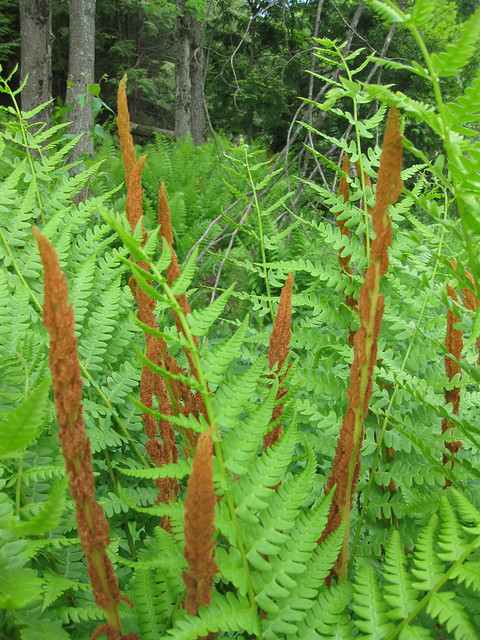
Ferns occupy a unique niche amongst the plants of our world. Unlike many of our plants that reproduce by flower and seed, ferns are derived from a more primitive lineage that, like mushrooms, use spores to spread and multiply (although like some flowering plants, they can also spread underground via rhizomes). Flip over the frond of a fern (the leaf-like blades that protrude from the ground) and you may discover the ferns’ sori, or “spore packets”.

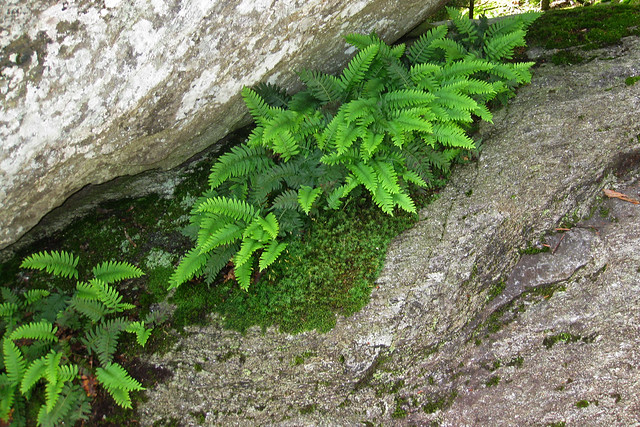
While we often think of ferns as occupants of dark, dank forests, many types can thrive in almost every crack and crevice of Vermont. Royal Fern may line the edges of lakes and ponds, while Common Polypody clings to the rocky surfaces of boulders and cliffs. While some are easy to identify, like the elegant Maidenhair Fern which grows in limestone soils of rich, moist forests, others can present quite a challenge to tell apart.

Flex your fern skills and join us for a woodland walk in Middlesex Notch with former botany professor Murray Evans. This will be a leisurely walk to explore some unusual species including Silvery Glade Fern and Maidenhair Spleenwort. No experience is necessary, and we hope you’ll take this opportunity to revisit some familiar ferns or explore a whole new facet of the natural world. This event takes place Please call 229-6206 with any questions and to register.

Bonus Question: Can you identify the fern photos in this blog post? Below are some resources to help get you started:

Winooski Valley Park District Fern Guide
Common Ferns of Vermont