|  Home  |   About us  |   Programs & Projects  |   Calendar  |   Birding  |   Blog  |   Get Involved  |

Saturday, June 25, 2011

Robin Rescued from Tangled Fishing Line

While out for a short visit to a local birding spot on the Winooski River this evening I got way more than I bargained for. As I descended the steep trail towards the river and a nearby marsh, I heard the distress calls of a Robin, and as I reached the sandy shore and rounded a corner, I saw a female Robin with its foot entangled in a big ball of fishing line.


Having experience working at bird banding stations, most recently at North Branch Nature Center, I felt confident that I could remedy the situation. Over the next 45 minutes, I worked to free her, first by restraining the bird using the “bander’s grip” and trying to tear the line. The line proved too tough to tear by hand; in fact, it tore my hand a bit! Without a way to break the line, I had to bring the line, bird, and all, back up to the parking area. There was line everywhere, wrapped up in trees, bushes, and sticks, and it was difficult to gather with one hand, and without putting tension on the line that could injure the bird. When I finally got all the line, I carried it (and the bird) back up the bank to the parking area.


I didn't have anything to cut the line in my car, so I knocked on the door of the nearest house. The homeowner came to the rescue with some small scissors, and I was eventually able to free the bird and release it unharmed. Her foot was wrapped tight, looking as if she had twisted and turned in the time after she became stuck and before I arrived. During the whole incident, a gang of Robins were crowded around us, squawking like mad. Upon her release, she flew a short distance and landed in the middle of the road. Shortly thereafter, a male landed next to her as if to console her. He stayed by her side, occasionally hopping, for several minutes while she sat still, and then they both flew off together.

Thankfully, this story had a happy ending, but the truth is that many animals get injured or killed by discarded fishing line, netting, plastic, and other litter. We should all not only take the responsibility to clean up after ourselves, but we should do our best to remove litter whenever we see it… if we do, we might just save a bird’s life.

Check back for pictures of the bird upon her release… they are being sent by the homeowner and will be posted to the blog shortly.

Sunday, June 12, 2011

Turtle Tutorial

Within central Vermont, our most common turtles, the Painted and Snapping Turtles, spend the majority of their time in close proximity to water, rarely more than a few feet from it. Much of their lives are hidden from view, below the surface of our rivers, lakes and ponds. It is during the most important and vulnerable time in their lives when they venture to our world on dry land.

During these late-spring/early-summer months, Painted and Snapping Turtles leave the water in search of a place to lay their eggs. They favor open, sunny areas with loose, sandy soils to dig their nests. This preference often proves to their detriment, as roadsides, trails, and gardens often meet the turtles’ needs and cause them to come into conflict with people. Most turtles typically don’t travel far, but a female snapper is willing to travel over a half-mile in order to find a suitable nesting site.


If you come across a turtle, it is not advisable to relocate it to your favorite neighborhood pond down the road. What you can do is search for evidence of whether or not she has laid eggs (is she walking towards the water? away? Is she digging a hole? filling one?). If you’ve found evidence that she has already laid eggs, you can try bringing her back to the nearby wetland where she came from. If you don’t find any evidence that she has laid eggs, moving her will do little good as her instincts will drive her back to land to nest.


Moving Painted Turtles is fairly straightforward. Most will recoil as far into their shell as they can squeeze, but occasionally one may struggle and scratch at you with its claws. Rarely is any real damage inflicted. Snapping Turtles, however, live up to their namesake. In water they are quite docile, but on land their aggression is unmatched. Their powerful beak can clamp down with great force and speed, and their long necks give them a surprisingly long reach. There is no easy way to move a large snapper.

Carefully moving the turtle with a shovel may save you having to touch it, but if such a tool is unavailable, here are some other tips. Immobilizing the turtle by covering its head with a towel or other cloth may restrict its ability to snap at you. Never carry a turtle by the tail as it can cause injury. Instead, grab her with a hand on each side of her carapace (top shell) just above her hind legs. Be careful, as her neck is long and can snap backwards a considerable distance. Also beware that her claws are long and sharp, and without protective handware, she can easily draw blood.

When the turtle you encounter on land lays her eggs, you might find the location she has picked is not conducive to a successful breeding season. For example, the pile of woodchips next to the street tree nursery at NBNC was not a wise place for a female snapper in 2009. Her eggs would have dried up quickly in the woodchips and the pile would not have remained in that place throughout the summer. Ultimately, we decided the only way to prevent her nest from failing was to relocate the eggs.


Under the extreme circumstance that a nest needs relocation, look for a spot with good sun exposure, similar soil moisture (not too dry, not saturated), and bury the eggs at a similar depth. Some people believe it is best to keep the eggs the same side up while others are not convinced that it matters. Bare soil or just grass cover is good, but anything that will grow deep roots and provide shade is a bad idea.

Once a female has successfully laid her eggs, her role in their lives has ended. The threats the hatchlings will face are numerous, and they will have no parental supervision… just instinct. When discovered by raccoons, nests are quickly exhumed and eaten. Nests near human habitation are especially susceptible to this predation, as raccoons occur in greater densities in highly human-populated areas. If they are lucky enough to make it through the summer, a clutch of tiny, quarter-sized hatchlings will emerge from the soil in late fall, or early the next spring. In their first days, their shells are soft and malleable, offering little protection from predators. Some of the many creatures that could consume a baby turtle include crows, bullfrogs, bass, raccoons, otters, snakes, and countless others.


Next time you are out driving the streets, hiking the trails, or tending to the garden, and a turtle comes into view, don’t panic! Instead, enjoy the miraculous feat of nature at hand. Assess the situation and take action if warranted. Take some pictures and submit your sighting to the Vermont Reptile & Amphibian Atlas. And share your story with us, we’d love to hear about your turtle experience!

Monday, June 6, 2011

Birding Quest: 6-month Update

As you may have heard, NBNC has been rallying both avid and beginning birdwatchers throughout Washington County to participate in a state-wide bird “quest”. All fourteen Vermont counties are striving to document as many types of birds as possible using the free, online database called eBird. Half way through the year, Washington County birders have a lot to be proud of. As of June 1, 167 species have been observed in the county (compared with 149 species last year). Of particular note so far in 2011 has been the abundance of shorebirds and waterfowl that passed through county, many of which are listed below in the “notable sightings”. With another six months left, there is no telling what surprises might be in store… Visit the Washington County Birding Challenge page for updates.


The Shoveler (left) and Wigeon (right) stood side-by-side on Berlin Pond this spring, not knowing how rare they are in Washington County!

Notable Sightings (based on current records in eBird)

1st Documented Sighting:
Semipalmated Plover

2nd Documented Sighting:
Surf Scoter (first sighting in over 30 years!)
Sora (first sighting in over 30 years!)
Lesser Yellowlegs
Great Black-backed Gull
Northern Hawk Owl

3rd Documented Sighting:
American Wigeon (also 4th sighting)
Northern Shoveler (also 4th sighting)
Great Egret

Monday, May 16, 2011

Binoculars + Caffeine + New Jersey = World Series of Birding


Another year; another great trip for New Jersey for the World Series… a 24-hour birding marathon in which 80 teams scoured the garden state for every bird species they could find. Although we didn’t see the bird/creature on the right, it was the emblem for our team “The Chocolate-headed Cowbirds (with sprinkles)” which celebrates the support we received from a grant made by Ben & Jerry’s. Whether we were scouring the 10,000+ shorebirds at Heislerville, peering through the canopy to see the Acadian Flycatcher at Belleplain, or whistling to Eastern Screech-Owls just before dawn, our mixed-aged team enjoyed every minute of the trip.


Weather has played a major role in what birds we see during the competition and this year was no different. Migrating warblers were wholly absent and raptors were sparse. We often needed to visit 2-3 locations to find particular birds species that were found easily the day before. While some birds proved very difficult to find, we had great luck with sea birds. Amongst the ocean-faring birds we saw were Common Loon, Northern Gannet, Black Scoter, Surf Scoter, and a total of 3 Parasitic Jaegers! Another highlight was the huge abundance of shorebirds at Heislerville. While we missed the rare Curlew Sandpiper that hid amongst the thousands of shorebirds, we did manage to find 18 species of shorebirds during the big day including a banded Semipalmated Sandpiper (pictured right).


(our group during the big day... about 13 hours into our birding adventure)

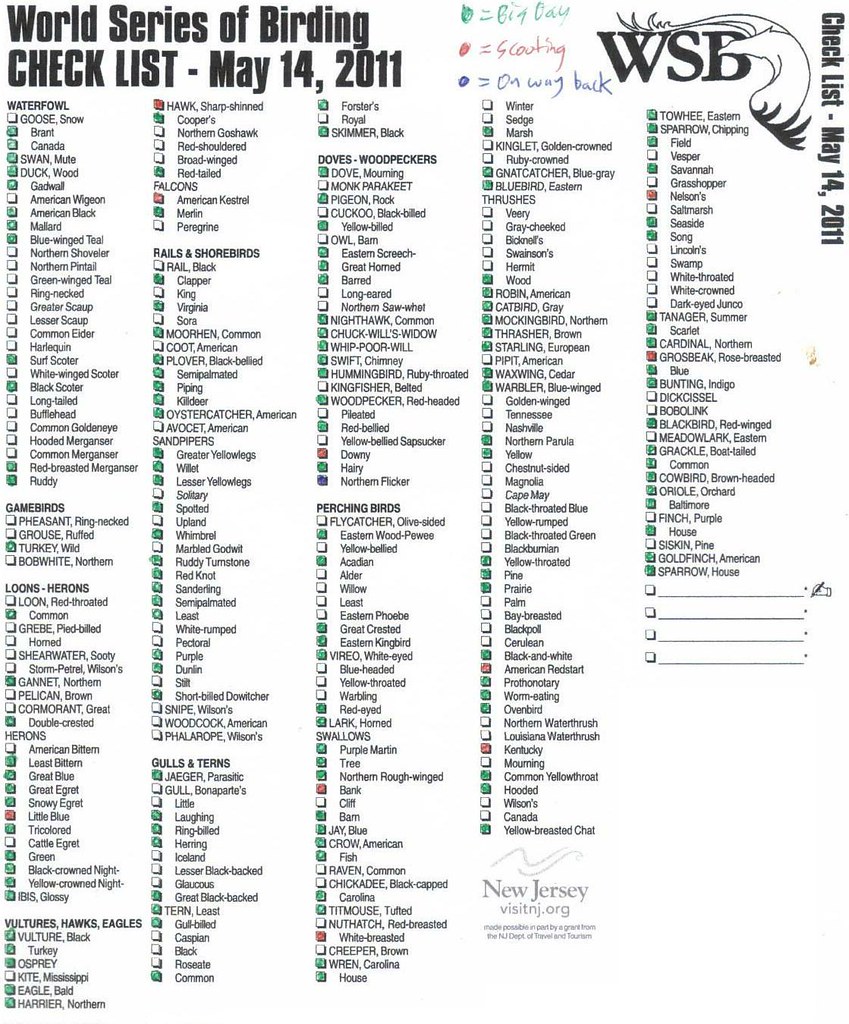
The Northern Flicker that flew over the van on our trip back raised our total species count for the trip to 150, with 139 species seen during the competition. A complete list of birds seen during our big day is shown below:

(click on the checklist to see a bigger version)

Friday, May 6, 2011

Day of the Nighthawk

The North Branch Nature Center’s Youth Birding Program has partnered with middle school students in central Vermont to revitalize the nesting habitat of the Common Nighthawk. Once a common sight to people in Vermont cities, nighthawks used to swoop and dive across the sky at dusk, collecting insects as they went. Their preference to nest in large, open spaces may once have precluded Vermont from possible breeding locations, but since at least the late 1800’s Common Nighthawks have made use of gravel rooftops to raise their young.


Unfortunately, the Common Nighthawk is in steep decline throughout its breeding range and has not been seen breeding in Montpelier in recent years. One cause of their decline is loss of habitat: both natural and artificial. Conversion of gravel rooftops to other substrates is believed to be one cause for their disappearance from urban areas. In 2007, New Hampshire Audubon began a research initiative to install gravel “nest patches” on rooftops in order to create the Nighthawk’s preferred gravel nesting sites. Students from U-32 Middle/High School (Montpelier) and Crossett Brook Middle School (Waterbury), in partnership with North Branch Nature Center, will replicate the efforts of NH Audubon by installing Vermont’s first nest patches.

Yesterday, U-32 students installed a nest patch on their school’s roof, and will monitor this patch over the next few weeks. As Nighthawks return from their winter in South America and establish nesting sites in New England, we’ll be watching to see if our nest patch is used by a lucky Nighthawk family. Photos from the installation will be coming soon...

Tuesday, April 26, 2011

Central Vermont's Big Night

After numerous photo-reports from around the state, Central Vermont has been very patient in waiting for our amphibians to finally awake and emerge. Last night they did just that, and in record numbers! Reports are still coming in, but widespread movements were reported from around central Vermont (and elsewhere). Weather looks good again tonight, so watch the roads if you must be out-and-about! Enjoy the following video and photos from crossing sites in Middlesex:


A "congress" of salamanders!


Spring Peeper


Spotted Salamander


Green Frog


Eastern Newt


American Toad

Monday, April 25, 2011

Woodland Wildflowers

For a narrow window of time each spring, our forests erupt in an explosion of color as the woodland wildflowers bloom. Many of these flowers are in a race to leaf out and blossom before the tree canopy above closes, blocking sunlight from reaching the forest floor. Our earliest wildflowers are just starting to pop up in Central Vermont (Blood Root is flowering along the river at NBNC) and many more are on the way! For all those who enjoy spring flowers and would like to take their interest a step further, researchers are recruiting citizen scientists to help study the pollinators of Spring Beauty, a lovely little wildflower found around Vermont.

Enjoy this assortment of photos from the Greater-Burlington area, all taken this past weekend (April 23/24):


Dutchman's Breeches


Coltsfoot


Marsh Marigold


Trout Lily


Blue Cohosh