|  Home  |   About us  |   Programs & Projects  |   Calendar  |   Birding  |   Blog  |   Get Involved  |

Monday, October 15, 2012

Insect Signs of Fall: Part III


To find insects this time of year, you need go no further than the outer wall of any building.  After a quick walk around the North Branch Nature Center’s building this morning, dozens of insects were found attempting to break in.  There were the usual house and cluster flies, two Western Conifer Seed Bugs, a Boxelder Bug, and several March Flies, but the clear winners were ladybugs with almost 20 clinging to the wall.

Ladybugs are not true “bugs” (they are actually beetles) and only about half are actually ladies.  There are many species of ladybugs, too, although all that we found today were the Multicolored Asian Ladybug (Harmonia axyridis).  This species, which we’ll call MAL for short, was introduced to the North American almost 100 years ago as a biological control for aphids.  

Multicolored Asian Ladybug's can vary greatly in
color and pattern, as seen in this mating pair.
 Today, MAL’s are well established across the continent and have become abundant in some areas.  A decline in native species of ladybugs has been documented in tandem with the establishment of the MAL and other exotic ladybugs.  MAL’s have also been well known for their tendency to enter houses and buildings at the onset of winter, so there’s a good chance that you’ll see one this fall, both outside and in!

By Larry Clarfeld

Monday, October 8, 2012

Insect Signs of Fall: Part II


After a hot winter and a mild start to autumn, the temperature is starting to dip and many insects are looking for a warm place to spend the winter.  One such insect is the Western Conifer Seed Bug.

Originally native to the western US (as its name would suggest), this insect has slowly been expanding its range eastward since the 1950’s.  By the early 1990’s, the Western Conifer Seed Bug had reached New York, and today,  it is well established throughout the northeast.  While the cause of this species’ spread is not certain, the interstate highway system may have played a role.

Western Conifer Seed Bugs spend the summer months of coniferous trees where they use their piercing mouth parts to feed on conifer needles and seeds.  As winter approaches, they are often seen on the sides of buildings as they try to find their way inside to spend the winter.  While they can be quite large (up to ¾ inch), they are harmless to humans.  Keep your eye out for the Western Conifer Seed Bug this fall, both outdoors and in!

Monday, October 1, 2012

Insect Signs of Fall: Part I


Signs of fall are all around us:  brilliantly colored leaves of crimson and gold; honking geese flying overhead in “V’s”; and sunsets that fall ever earlier.  But some signs of fall are a bit more subtle.  Insects are getting ready for winter, and their changes in behavior foreshadow the coming winter.  

A Wooly Bear found at NBNC in early October, 2010

In Part I of our “Insect Signs of Fall” series, we look at a very familiar insect: the Wooly Bear.  Wooly Bears are neither bears, nor can we shear them for wool.  They are the caterpillars of the Isabella Tiger Moth (Pyrrharctia isabella).  The adult moths are aloft during the summer months.  They are drab in color and not a moth that would naturally catch your eye.  The caterpillars, however, are fuzzy with black hairs at both ends, and a brown, hairy center.  

adult Isabella Tiger Moth
photo by Tom Murray
courtesy of bugugide
Wooly Bears feed on a variety of vegetation, including grasses, asters, clovers, birches, maples, and others.  This time of year, they are frequently seen wandering in lawns, roadways, and sidewalks as they search for a location to spend the winter.  In the spring, they will form a cocoon and transform into an adult moth.

The length of their brown stripe can vary by individual, and folklore suggests that the length of the brown band can be an indicator of how harsh the upcoming winter will be.  The Wooly Bear below is an good example of how variable their appearance can be.  This myth has no factual foundation, so don’t count on these caterpillars to tell you the seasonal forecast.


Text and photos by Larry Clarfeld, unless otherwise noted.

Thursday, September 20, 2012

Life, Death, Cooperation, & Coevolution... in a beetle


While out on a stroll yesterday afternoon, a group of parents and kids went across the fields of NBNC in search of Monarchs as part of our weekly Monarch Tagging Program.  A large insect flew across the trail.  For a moment, a dull-yellow glow made the creature appear as a bumblebee, but I quickly netted it and discovered it to be a very special beetle: the Sexton Beetle.

Burying Beetle (probably N. tomentosus) found at NBNC

Sexton Beetles (Nicrophorus sp.) are also known as burying beetles for a very important and unique ecological role they fill: burying dead things.  After finding a small carcass, the beetles begin to dig out a hole underneath it, allowing the body to sink into the hole and eventually be completely covered in soil.  The reason the burying beetle fulfills this ritual is to protect the carcass from other scavengers that could compete for the meat.  The beetle then strips the carcass of fur or feathers, lays eggs nearby, and nurtures its young as they feed on the rotting flesh, protecting them as they grow.  

Photo of mite by Tom Murray,
courtesy of bugguide
If this incredible life history wasn’t fascinating enough, the beetle we found was covered in mites.  While it would seem that mites could be harmful to the beetle, they actually have a symbiotic relationship.  These mites (Poecilochirus sp.) also feed on carcasses, but are unable to successfully travel from one carcass to another on their own.  Instead, they hitch a ride on the burying beetle!  In exchange for the transportation, the mites perform a cleaning service (a car wash, we could say) by removing any remaining meat on the beetle that could harbor bacteria.  (close-up picture of mite on the right)

Just in this one beetle that happened to fly across the trail, we can find death, birth, cooperation, and co-evolution.  Nature is always full of surprises and there is always more to learn, even from the tiniest of creatures.

Text and Burying Beetle photo by Larry Clarfeld

Thursday, September 6, 2012

"Giant" Backyard Discovery Returns!


one of the late-instar caterpillars

Before 2010, a Giant Swallowtail Butterfly had never been seen in Vermont.  Now, for the second consecutive autumn, this species has laid eggs in the Montpelier backyard of Abby Colihan.  A mild winter, sandwiched between two hot summers, has allowed the Giant Swallowtail to thrive in areas where it had been absent just a few years earlier.  

The range expansion of this species has limits, even in a warming climate.  The main host plants of caterpillars include those in the citrus family, and the only native host plant documented in Vermont so far has been Prickly Ash.  But Prickly Ash grows only in the Champlain Valley and southern parts of Vermont, so for Giant Swallowtail to lay eggs in Washington County, they need a little help.   Perhaps that is why the “gas plant” in Abby’s garden has been used two years in a row!

I counted a total of eight caterpillars on the small shrub; two were late-instar (older) caterpillars, and six were early-instar (young) caterpillars, which indicates that at least two female Giant Swallowtails laid their eggs there at different times.  At a glance, they look like bird droppings, but upon close inspection their intricate pattern is uniquely beautiful.  

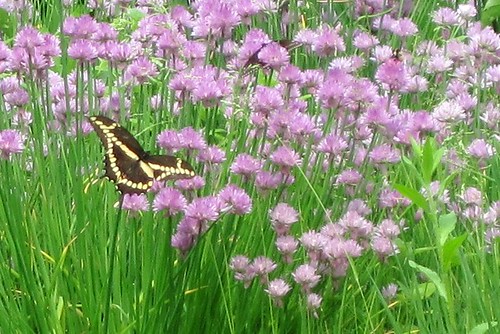
Keep your eye out for adult Giant Swallowtails this month, as they may still be on the wing.  And one cold winter could halt their northward expansion.  Here is a photo of an adult that visited the North Branch Nature Center this past May:

Giant Swallowtail in the NBNC butterfly garden


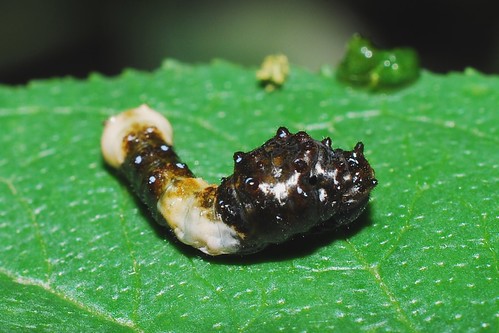
 And here is a picture of one of the early-instar caterpillars, which was around 1/2 inch long:

An early-instar caterpillar

Photos and text by Larry Clarfeld