Ask any Forest Preschooler what they think about being outside and getting dirty and it's quite likely you'll hear rave reviews. In fact, one child came up to me one day half covered in mud from the mud kitchen and exuberantly shared, "Look at my mud!"
As the landscape transforms, we at Forest Preschool will be experiencing a sensory feast this fall, mucking about immersed in nature, and joyfully learning along the way! Harvesting, sorting, excavating, cooking, climbing, constructing, crushing, and creating are some of the things we'll be inspired to do in our outdoor classroom when the fall session begins on August 30th.
Get inspired yourself and enjoy the following photo journal of Forest Preschool "dirt time" last fall!
It's autumn and seeds are everywhere! As an end cap to a morning exploring the world of seeds and how they disperse, we treated ourselves to a Staghorn sumac tea party beside the North Branch. After harvesting sumac nearby, discovering seeds inside the fuzzy fruit, we made tea using a Kelly Kettle and then enjoyed the fruits of our labor on a gorgeous October morning.
Excavating at Mud Kitchen before the rains came.
Exploration at Mud Kitchen after a rain. "It's a mud flood!" one Forest Preschooler declared!
It's a great apple year! Harvesting, snacking on, and grating apples to make apple salad at Deer Camp has been a highlight.
Hard to beat eating an apple while sitting in an apple tree!
Grinding wheat berries into flour to make bread dough for roasting later in the morning.
Roasting apples and bread on a stick over the fire at Deer Camp.
Discovering what's inside of an acorn and sorting nut "meat" from the shells.
The "children's house" or "beaver lodge" cooperatively built and played in for many days.
Fishing! We love rainy days and puddles at FPS!
Rain art using chalk on a wet block of wood.
Painting with natural ink made by crushing grapes that were harvested at Deer Camp.
The tightrope walker!
Paddling a "long canoe" to "an island" at Deer Camp and snacking on a wild harvested apple to refuel along the way!
And so, onward we paddle, towards an unfolding story at Forest Preschool that tells of vivid imagination, growth, child centered learning, a sense of agency, connection, and dirt.
Today, students look closely at medicinal herbs. They draw, describe and name a plant based on
its physical attributes. Students craft questions that begin with “I wonder”
or “I notice”. On this mid-autumn day we
release the assumption that knowing
facts is more important than noticing
qualities. We are scientific observers of our woodland ECO
camp.
Students explore and observe calendula flowers I brought from my garden. One student spends the better part of a half hour sketching the layers of the flower it with a pencil. She has discovered the serrated edges, the layering of ring after ring of petals. She draws what she sees in this moment with care and attention.
Another student stops at a stand of seeding sunflowers.
“Wait, does this sunflower actually create sunflower seeds?”
She proceeds to dissect it and find dark black sunflower seeds just like the ones she eats from a grocery store Planters' brand bag. The seeds are tucked below the waning composite flowers of the seed head.
“Wow! Can I, like, eat this? Can I take this back to share with my classmates?”
Excitedly, she returns to her classmates with this discovery at our closing circle.
Today began with “I wonder” and ended with “I discovered!” Making a discovery is often accompanied by excitement which triggers specific neurotransmitter chemicals in the brain. These chemicals create a memory that lasts longer and is filed differently than fact recall memories, such as those we absorb from a lecture or read in a textbook. It takes a bit longer to discover the world around us than it does to absorb it from a lecture. ECO gives us the opportunity to take the time to wonder and notice in tribute to long lasting memories.
Last Friday I ventured out with Twinfield kindergarten teacher, Sharyn Baum, and her eager students for our first ECO outing of the year. The focus of our first outing is to get to know each other and our outdoor classroom, all while practicing the ECO routines and rhythms.
It was a pretty chilly morning, so we were happy to venture out of the shady woods of our base camp into "Milkweed Meadow" to continue our scavenger hunt. The field was alive, with students finding daddy longleg spiders, grasshoppers, and crickets with every step. We even found a pair of mating grasshoppers like the ones pictured above! (Photo credit: Mary Holland) Don't worry--we gave them their privacy back after just a few minutes of checking them out in a jar. One child in particular found he had a real knack for catching grasshoppers. He caught three in about five minutes! He was beaming, having discovered a new-found talent and feeling a level of awe from his five year-old peers.
Moments like this, where children uncover parts of themselves that shine in the outdoor classroom, are why I love being an outdoor educator. During our inside circle time on the rug, this same child was 'wiggly' and had a hard time keeping hands to himself. Outside, these same attributes that were challenging inside, were assets that helped him excel in gaining a closer look at the natural world around him.
Now that it’s the end of September, I’ve started the ECO
program with the Waitsfield Kindergarten and East Montpelier 2nd/3rd grade joint class. Needless to say, the content of the lessons
and the social expectations between these two age groups is quite different.But in both of those classes, and in all of
the classrooms that the North Branch Nature Center staff teach the ECO program,
the “Three Cares” are shared and used.
The “Three Cares” are a set of expectations for ECO students
in the forest.Showing care is the overarching
theme.With ECO happening in seven schools around Central Vermont with different rules and
expectations for their students, it is helpful to have a unified way of
explaining how we ask students, teachers, and volunteers to be in the
woods.The "Cares" are simple, and profound,
and I often catch myself applying them to my relationships outside of the ECO realm.
1.Take care of yourself:
During the morning circle, I always ask the group what the
three cares are and an example of what it looks like.Here are some of the common replies:“Drink water,” or “Wear warm clothes and
boots.”Here is a picture of three
kindergarteners taking care of themselves by eating snack and putting on warm
mittens on this cool autumn morning.
2. Take care of
others:
When asked what taking care of others looks like, children
respond, “Help a friend up if they trip,” “Zip up their backpack when they
can’t reach it,” “Get a teacher if someone is hurt.”I never cease to be amazed at the empathy
elementary school students demonstrate.They understand how important it is to help their friends, and sometimes
need reminders.(Don’t we all need
reminders to be kind sometimes?)Here,
one student helps another collect materials to help her friend build her Red
Eft Hotel.
3.Take care of the Earth:
Children as young as kindergarten understand to pick up
trash on the side of a trail or not to pick all of the leaves off of one fern
plant. Every time we go outside,
children have an opportunity to show care for the earth and deepen their
feelings of belonging in the natural communities around their school.
These three expectations set a tone of caring for the whole
time we are outside.They are simple and
basic, and powerfully profound.They are wonderful reminders for everyone about living kindly and lightly on the Earth.What does your child remember about “The Three Cares?”
5th grade students at Main Street Middle School in Montpelier, have been participating in ECO longer than any other group of children. They were the first. Starting in Kindergarten, they have been using the green spaces of Montpelier as an extension of their classroom every other week, for going on 6 years. These kids are the ECO pros. So, this past Monday when I told them that they where going to do something that they have never done in ECO before, most were more than a little skeptical.
Unlike most other ECO schools, Union Elementary and Main Street Middle School don't have their own forest on school grounds. Instead, we have to walk a solid 25 minutes to access the woods of Hubbard Park. Since it is a public park, we must be considerate of other park users and follow the park's rules and guidelines. This means that creating permanent fire pits or building large firewood shelters that would stay up indefinitely (both hallmarks of your typical ECO base camp) would not be possible. Although these 5th grade students have been going out for ECO longer than anyone else, they have not had the experience of walking into a base camp that they have built themselves. So, not surprisingly, there was a wave of excitement when students learned that this year they will be selecting and building their own base camp.
Now, we did have to make accommodations and alterations to our typical idea of an ECO "base camp" in order for it to work in the public park setting. For instance, instead of a fire pit, we created a fire safety circle made of small logs that we can place a portable fire pit into, allowing us to have Leave No Trace fires. Also, to give our space a bit more of that camp feel, students decided to move large logs into a circle to serve as benches around our portable fire pit. This is where we would hold our morning meeting at the start of every ECO session, where we would eat our snacks and lunches, and where we would hold our debrief and closing circle at the end of every day. To the average passerby, this camp would be nothing more than a few logs laying on the ground in the forest. But to these students, it will be their ECO home.
5th grade students working together to lift a 20 foot log
I was amazed at the tremendous teamwork that these students displayed in not only the building of their camp, but also in the site selection process. We split into two scouting parties, each covering a different section of the forest. As a class, they had created a list of criteria for a quality base camp site. It had to be relatively flat, have little vegetation that would be in danger of getting trampled, be large enough to fit the entire class comfortably, and be free of dead falls and widow makers. Each scouting party located at least one solid potential site, presented it to the other group, listing pros and cons of each space, and then voted on it as a class. Majority ruled and the campsite had been chosen, without hard feelings or argument.
Once the site had been selected, students immediately went to work clearing sticks and logs out of the central meeting area, and moving in larger logs for the benches. On young lady found a log approximately 20 feet in length and enlisted her seven of her friends in transporting the log to our circle of benches. When they realized that the log was far too long for the space, again they worked together in problem solving. After some brief deliberation, we decided to safely break the log by wedging it between two strong, living trees that were growing close together and pulling on it like a lever, creating a simple machine to do the hard work for us.
.
1st and 2nd graders working together to pull down a hazardous tree in their base camp
Similar teamwork was also on display at the ECO base camp at Moretown Elementary School. This time it was 1st and 2nd graders who were working together to make their base camp a safer place. Moretown is lucky enough to have the town forest located directly behind their school and have had an established base camp on top of the forested hill for several years. However, over those years, more and more trees have been dying back, beginning the decomposition process while still standing upright. While this may make for excellent woodpecker habitat, it becomes a serious hazard when a 30 foot dead spruce tree is standing right in the middle of base camp! So, with a climbing rope over 100 feet in length, and using a pully to wrap around a strong living tree for added leverage and increased safety, these young ECO students set out to make their camp a safer place for all.
First, a teacher inspected the tree to ensure that it would be safe to pull down and not run the risk of being hung up in another tree, thus creating another hazard. Then, the teacher tied a loop around the tree while the students watched from a safe distance. Once the rope was secure and fed through the pully, students took their position. After a countdown from ten, students pulled all together. The tree moved... but didn't come down.
We counted down again. Pulled. A little more movement... no timber.
We counted down one last time, this time deciding to pull back and forth, building momentum.
Pull, relax, pull, relax, pull, relax.
The tree cracked.
PULL! relax, PULL! relax, PULLLL!!! TIMBER!!! The tree was down and base camp became a safer place to learn.
Elsewhere in the ECO universe, teachers at Hyde Park Elementary were gearing up for their ECO year. There were three veteran ECO teachers and three teacher new to the program. To help bring everyone up to speed and on the same page, we held an adult ECO session for just the teachers. We went through the same core routines that they would be leading their students through, beginning with a team building challenge called "River Crossing." The object of this challenge is to get your team from once side of the "river" to the other. The catch is that there are only one pair of hip waders, and everyone can only use them twice. If you try to cross without using the waders, you drown and your team starts over. Oh, and you only have 5 minutes to come up with and execute your strategy, starting... now! I usually give students more time, but these were teachers. They could handle it.
As a team, they quickly decided that the best strategy would be for one person to carry another across, hand over the waders and send the carried person back to pick up the next team member. Repeat until everyone has safely crossed. It was a fairly simple challenge, but it put the teachers in the role of the student, active and engaged in the activity. This will be important as they go through the ECO year, engaging and learning alongside their students.
After a few more activities in the forest, we were rewarded with a special visitor. Again, we were all placed back into the role of the student, working and learning together with nature as our teacher.
As we prepare to turn the calendar page to September, the persisting heat reminds us that summer isn't over yet! September turns out to be a fantastic month for finding caterpillars. Below are some caterpillars to keep an eye out for this time of year:
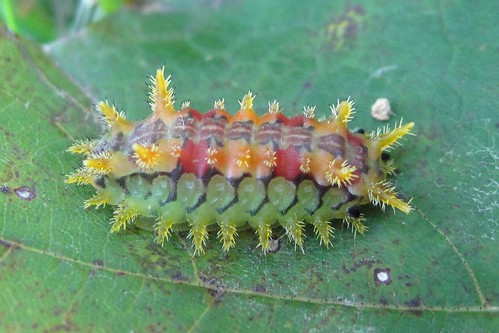
The Yellow-shouldered Slug caterpillar is so strange, it would be easy to confuse it for some other sort of insect. While this species can blend quite well, others, like the Spiny Oak Slug, are vibrantly colored. September is one of the best months to search for these fascinating creatures!
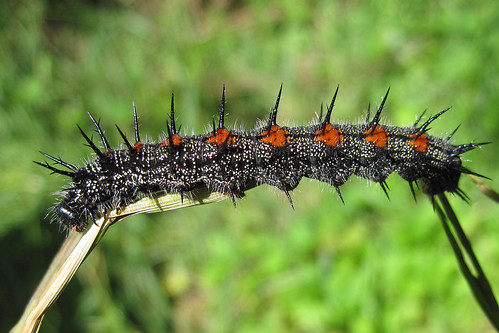
Any remaining Mourning Cloak caterpillars will soon be spinning a chrysalises. As we approach the end of the month, adults will be far more common than caterpillars as this species overwinters as an adult butterfly.
Spotted Tussock Moth caterpillars are often easier to find than many other caterpillar species. Their long hairs are distasteful to predators, and hence they often feed out in the open.
This Virginia Creeper Sphinx, found last August near the NBNC Community Garden, fell victim to parasitic wasps. The white ovals on the caterpillar's back are the cocoons, out of which the wasps will soon hatch.
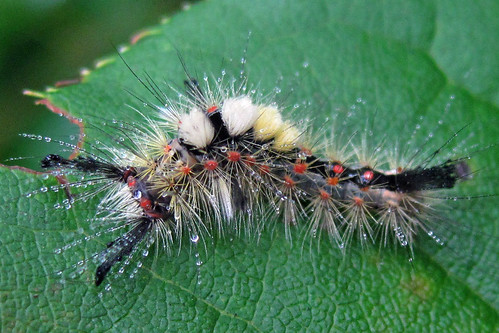
The Rusty Tussock Moth is native to Europe, but is now widespread in North America. Adult females are wingless.
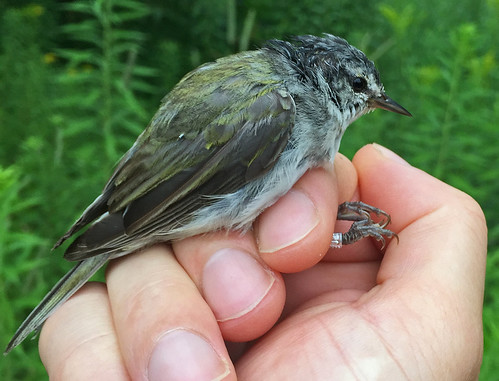
While this mid-season update comes more than 80% through the season, we had exciting news of a Tennessee Warbler banded this past Monday at the North Branch Nature Center that we couldn't wait to share. Tennessee Warblers breed in Vermont only in the Northeast Kingdom and are more common further north in the boreal forest. The individual we encountered was likely an early migrant, already on its way to central America. While our banding protocol is catered to study breeding birds at NBNC, it is not uncommon for us to encounter early migrants and other species that are dispersing from their breeding grounds towards the end of the banding season.
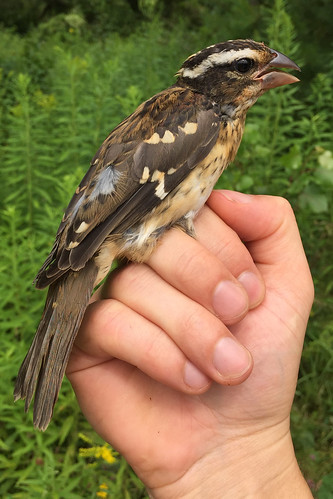
Also typical this time of year is an influx in hatch-year birds (those born during this current breeding season). Hatch-year birds drastically outnumbered adults during our most recent banding session. Another highlight of our morning on July 27th was our first Rose-breasted Grosbeak. We commonly hear this species during banding sessions but this first year male was still a big surprise.
This coming Saturday, August 1st, will be our final banding session of the year and we invite the public to come observe. Stop by anytime between 6:30 and 11:00 a.m. to get a behind the scenes glimpse of banding in action. We catch, measure and band a variety of songbirds to study their survivorship and reproductive success. A rare chance to see beautiful birds up close.
Full results from our July 27 banding session are below: