|  Home  |   About us  |   Programs & Projects  |   Calendar  |   Birding  |   Blog  |   Get Involved  |

Monday, August 31, 2015

Caterpillars of NBNC (part 5)

As we prepare to turn the calendar page to September, the persisting heat reminds us that summer isn't over yet! September turns out to be a fantastic month for finding caterpillars. Below are some caterpillars to keep an eye out for this time of year:


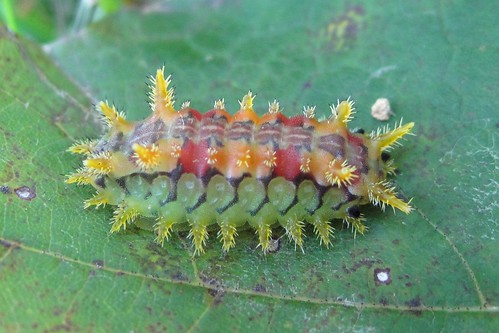
The Yellow-shouldered Slug caterpillar is so strange, it would be easy to confuse it for some other sort of insect. While this species can blend quite well, others, like the Spiny Oak Slug, are vibrantly colored. September is one of the best months to search for these fascinating creatures!


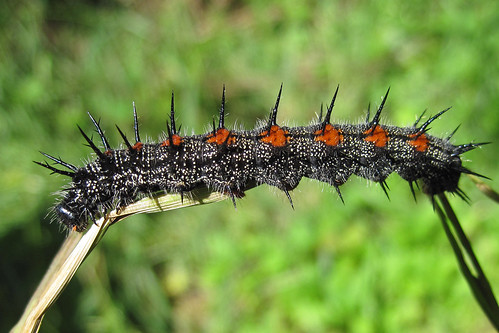
Any remaining Mourning Cloak caterpillars will soon be spinning a chrysalises. As we approach the end of the month, adults will be far more common than caterpillars as this species overwinters as an adult butterfly.


Spotted Tussock Moth caterpillars are often easier to find than many other caterpillar species. Their long hairs are distasteful to predators, and hence they often feed out in the open.


This Virginia Creeper Sphinx, found last August near the NBNC Community Garden, fell victim to parasitic wasps. The white ovals on the caterpillar's back are the cocoons, out of which the wasps will soon hatch.


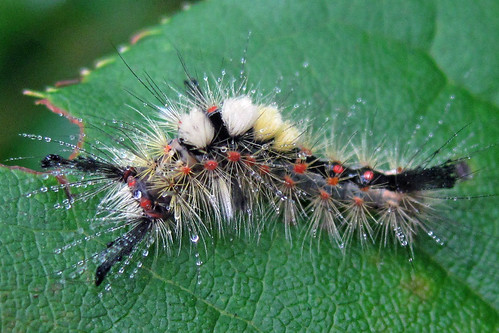
The Rusty Tussock Moth is native to Europe, but is now widespread in North America. Adult females are wingless.

See previous "Caterpillars of NBNC" posts:

Tuesday, July 28, 2015

Bird Banding: Mid-season Update

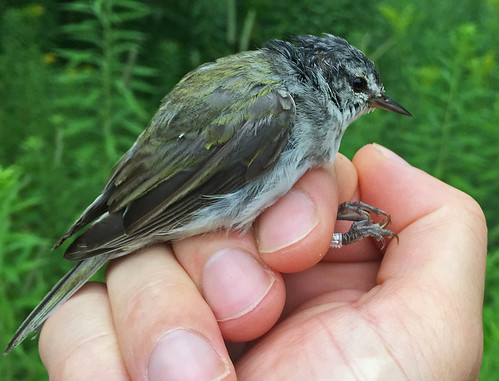
While this mid-season update comes more than 80% through the season, we had exciting news of a Tennessee Warbler banded this past Monday at the North Branch Nature Center that we couldn't wait to share. Tennessee Warblers breed in Vermont only in the Northeast Kingdom and are more common further north in the boreal forest. The individual we encountered was likely an early migrant, already on its way to central America. While our banding protocol is catered to study breeding birds at NBNC, it is not uncommon for us to encounter early migrants and other species that are dispersing from their breeding grounds towards the end of the banding season.


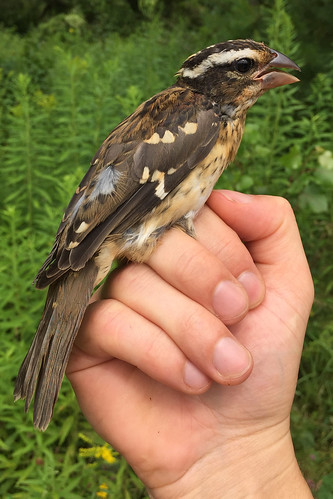
Also typical this time of year is an influx in hatch-year birds (those born during this current breeding season). Hatch-year birds drastically outnumbered adults during our most recent banding session. Another highlight of our morning on July 27th was our first Rose-breasted Grosbeak. We commonly hear this species during banding sessions but this first year male was still a big surprise.

This coming Saturday, August 1st, will be our final banding session of the year and we invite the public to come observe. Stop by anytime between 6:30 and 11:00 a.m. to get a behind the scenes glimpse of banding in action. We catch, measure and band a variety of songbirds to study their survivorship and reproductive success. A rare chance to see beautiful birds up close.

Full results from our July 27 banding session are below:

  • Downy Woodpecker - 1
  • Traill's Flycatcher (most likely Alder) - 3
  • Eastern Phoebe - 1
  • Red-eyed Vireo - 2
  • Veery - 1
  • Gray Catbird - 5
  • Ovenbird - 1
  • Tennessee Warbler - 1
  • Common Yellowthroat - 7
  • American Redstart - 2
  • Chestnut-sided Warbler - 3
  • Cedar Waxwing - 1
  • Song Sparrow - 6
  • White-throated Sparrow - 1
  • Rose-breasted Grosbeak - 1

Tuesday, June 30, 2015

Pursuit of Happiness


Hooray for puddles!
Earlier in the month, with the expanse of Lake Champlain and the blue, green rise of Adirondack Mountains as a backdrop, I sat among educators at the In Bloom Conference: Promising Practices in Nature-based Early Childhood Education. We joined together as a community passionate about young children learning and playing outside in preschool and kindergarten settings. 

It was inspiring and validating to gather with others who collectively feel that playing and learning outside is not only good for young children but vitally important, especially as the average amount of time children in the US spend outdoors engaging in unstructured play is shrinking to a shocking level. 

Cooking in the Mud Kitchen!
Although outdoor styled preschools and kindergartens in Europe (often called Waldkindergartens) have been thriving and receiving government support since the 90’s, the concept is just now taking root in a broader fashion here in the US. Research in Europe illustrates the developmental, health, and academic benefits of outdoor play and learning in the early years. But to a child, learning and playing outdoors is just plain old fun!

During the keynote address at the In Bloom Conference, Antioch professor David Sobel asked a poignant question; What happened to the joy of learning in school? He said he’d like to see US schools incorporate the following into their mission: Life, liberty, and the pursuit of happiness.

I see children thriving outside - joyful and curious about the wonders in nature and using nature as a source of rich, imaginary play. Vermont is in bloom and so too is our Waldkindergarten styled Forest Preschool program at the North Branch Nature Center. Please enjoy taking a look at some of the many wondrous, curious, joyful moments at Forest Preschool this May. 

Registration for the fall session of Forest Preschool is now open. Give the gift of nature and spread the word!


Weaving on the loom at Deer Camp.


Investigating slugs and snails.


Chalk painting in the rain.

Oh yeah, mud!

Making ink by crushing grass and clay brick.

Joy!

Tuesday, June 2, 2015

Nature Center Takes Flight

North Branch Nature Center Launches $1.5 Million
Capital Campaign

Among the great birding activities at this year’s annual BirdFest on May 30, was a special announcement and celebration of NBNC’s plans to raise $1.5 million to build a new education and visitor center and advance our mission to connect people of all ages with the natural world.

With $590,000 already raised during the quiet phase of the campaign over the past year, we are enthusiastic about the huge demand for the expansion and the strong desire on the part of Vermonters to make nature a bigger part of their lives.  


“A passion for wildlife and wild places is very much a part of the Vermont ethic,” said NBNC Executive Director Chip Darmstadt. “This expansion will help us bring our innovative blend of nature education and experience to many more people — here in central Vermont and across the state.”

After several years of planning and community input, we have developed a long-range plan to expand and enhance our educational programs.  Called “Our Future in Nature,” the expansion has three major components:


  • A new, inviting Community Nature Center will offer much-needed space for year-round children’s activities, a multi-purpose room capable of seating 75, and a teaching lab for naturalists and citizen scientists.
  • Eco-friendly landscaping and design will enhance the outdoor experiences for visitors who come to the preserve to walk, bike, ski, garden, learn, study or simply relax along our gentle bend in the North Branch of the Winooski River.
  • Renovations to the existing 1800s farmhouse will improve its energy efficiency and functionality.  Utilizing solar energy, the new Community Nature Center and farmhouse will become “net zero,” offsetting all fossil fuel use.
“In a world that more and more needs nature’s healing and restoration, North Branch Nature Center is a treasure for all Vermonters,” said Tom Slayton, author and Vermont Life magazine editor emeritus, who serves on NBNC’s Honorary Campaign Committee.

To learn more about the Our Future in Nature capital campaign, call (802) 229-6206, email Campaign@NorthBranchNatureCenter.org or stop by in person at 713 Elm Street in Montpelier.

Wednesday, May 27, 2015

A Lesson in Mud and Puddles

Mud Kitchen at Forest Preschool.
Squish, splat, plop! During mud season, I often grumble as I slog through thick, and sometimes greasy mud while driving along the back roads of central Vermont. My seven year old daughter, however, absolutely delights in squishing in the mud on our road and stomping in puddles with booted feet, creating mud dams, and redirecting the flow of snow melt. As soon as the snow disappears and the swollen brook subsides, she and all the neighborhood kids spend countless hours in the “mud pot” located on the side of the brook in our village. They step in it, stir it, add water and interesting natural ingredients, make pies, make pottery, and the list goes on and on. At Forest Preschool this spring, mud and puddles were a main attraction. 

Making "eggs" to put in a "nest."
A child to mud is much like a bear to honey. From a parental perspective, mud and puddles may be something to avoid but to a child, they are shear joy. The allure of playing in the mud, stomping in puddles, and getting covered in dirt is irresistible! Such play may seem like all fun and games but, actually, it’s much more than that.
Mud and puddle play offers rich learning opportunities, ignites imaginations, and builds healthy immune systems. Children are innately drawn  to explore the elements of the earth, learning how they behave and what can be done with them. Through mud and puddle play, children learn about cause and effect. They become scientists and artists as they explore and experiment with the chemistry of soil and water, the physics of pouring and the flow of water, and endless creative possibilities that mud and puddles offer.
Painting with mud!

On the land at North Branch Nature Center, beside a naturally wet and muddy spot at the edge of the forest, sits a Mud Kitchen. Pots, pans, a spice rack, whisks, shovels, spoons, are assembled for Forest Preschoolers to become scientists, chefs, and artists. Imaginations come alive in the Mud Kitchen and delicacies such as pizza soup, birthday cake, an assortment of pies, are concocted. Mud is at the heart of such domestic and scientific endeavors but a variety of other natural ingredients found in the forest are untilized. Pine needles, stones, cones, sticks, and leaves are often added to recipes and solutions or sprinkled on top to decorate or engage in further experimentation. Earth and water are poured, stirred, and mixed.

Cooking in the kitchen!
In the article, Making a Mud Kitchen, Jan White shares, "Making connections through discovering and investigating cause and effect is the stuff of brain development and scientific process. Curiosity, fascination and the pleasure of finding thing out are fundamentally important to the human state - being human.

The processes of making concoctions brings the worlds of science and art completely together through possibility thinking. The growth of imagination and creativity happens through building on concrete cause-and-effect experience to posing and predicting what if?  Good scientists do this all the time, as do artists and all other innovators."
Experimenting with the flow of water and fishing with a stick!
Mud not only capitalizes on natural curiosity as a tool for teaching and learning, it helps to support healthy immune systems. Jan White also share in the article, Making a Mud Kitchen, “Contact with soil is actually beneficial as the bacteria in it help to build healthy functioning immune systems in young children (See Why Dirt is Good in booklist below), and research also suggests that that this makes us feel happy! (Go play in the dirt). “

At North Branch Nature Center's Forest Preschool, it’s not uncommon to hear a child exclaim, "Mud is glorious.”  I had to chuckle one time as a child shared, “I love puddles - I want to sleep in one!" Alas, proof is in the (mud) pudding - earth mixed with water is irresistible! And so, if you have children or know a child, enjoy time outdoors this season and, as Jan White says, go play in the dirt! 

Mud glorious mud!
Mud Kitchens are easy to make at home. All you need is a little dirt (purchased topsoil or earth free of cat or dog feces), a little water (even one pot full will do), and some old pots and pans. Check out the link below to learn more!

Link to Making a Mud Kitchen by Jan White:
http://www.muddyfaces.co.uk/mud_kitchens.php/#Delving_Into

Thursday, April 16, 2015

Support The Kids Need Nature Scholarship Fund!


Kids Loving Nature! 

Please join us on May 2nd for an evening of music with singer-song writer Keith Greeninger to support North Branch Nature Center and the Kids Need Nature Scholarship Fund. 
As a singer-song writer, Keith paints intricate portraits of the human condition with powerful melodic images, deep engaging guitar rhythms and husky, heart wrenching vocals. His masterfully crafted tunes and powerful presence have earned him the top song writing awards at music festivals. Keith's records and personal appearances have garnered him a legion of devoted fans, and the respect, admiration and appreciation of music critics far and wide. Keith also whole heartily supports the work we do at North Branch Nature Center and is coming to Vermont to help raise awareness for The Kids Need Nature Scholarship Fund.  THANK YOU KEITH! 

Keith Greeninger

The North Branch Nature Center offers programming for children of all ages to connect with the wild wonders of our local natural environment and thrive outdoors. It is North Branch Nature Center’s goal that Forest Preschool, Trekkers Afterschool Program, and Summer Nature Camp be accessible to all children in our community.
Although Vermont is home to beautiful and accessible green spaces, children in our state are spending less and less time playing and learning outdoors. In order to maintain the health and vibrancy of our children, community and environment, kids need regular experiences immersed nature.  Our vision is to create awareness in the greater Montpelier area of the many benefits of children learning and playing outdoors. We know our children are our biggest investment in the future of Vermont and the health of our planet.

Our Kids Need Nature initiative is simple, to get more children outside engaging in nature play and discovery. Growing up without a sense of place and without loving where we come from, we are unable to protect what sustains us every day.  Join us in making a commitment to children and nature connection by donating to the Kids Need Nature Scholarship Fund.

WHEN
Saturday, May 2nd
Doors open at 5:30pm
Concert starts at 6:30

WHERE
Fresh Tracks Farm and Winery in Northfield, VT.

TICKETS
$20
Tickets can be purchased by calling North Branch Nature Center
(802) 229-6206
or at Onion River Sports on Langdon Street in Montpelier.

THANK YOU to our SPONSORS
Onion River Sports
Vermont Creamery
Red Hen Bakery
Fresh Tracks Farm and Winery


Monday, April 6, 2015

I Am a Scientist Because,....

Asking questions
Every Thursday afternoon, kindergarten students from Union Elementary school walk a few blocks to Harrison Field to have ECO. This team of teachers from UES have worked with our ECO staff at The North Branch Nature Center for over three years and have refined and expanded on their opportunities to learn outdoors with their students. This past Thursday the sun shone and warmed these 5 and 6 year olds into an exploratory group of scientists. Each kindergartner was prepared to collect and record data with a science journal, magnifying lens, pencils and a collection bag. The task for these children was to record things they thought were helpful to the forest and things that were not helpful.  This is an interesting task for a young child! I wondered what they write in their journals. Would they even find anything? Would they care?


It became immediately obvious that these children had knowledge about this little wooded lot amidst a busy neighborhood. These kindergartners have been visiting Harrison Field since September and have developed a strong sense of place. They know that deer sleep under the pines at the top of the hill. Pine trees are helpful. They have watched crows building a nest in a tree at the edge of the forest. Sticks are helpful. They have played in the mud and wet areas in the field. Water is helpful. On this spring day they picked up plastic wrappers. Garbage is not helpful.  The desire to search, question and record was intrinsic. These children wanted to help! They also knew what it looked and sounded like to be a scientist. Gathered around a pile of crow feathers, students huddled and wrote down their observations.  They looked closely with hand lenses. The teacher and I stepped back from the group and let them continue their investigations with no interruptions. This is science, this is learning in nature and this caring about the environment. 


Looking closely

Off to find more evidence


Thank you to Emily Wrigley and her class of amazing Kindergartners for sharing their love of the natural world with me! To learn more about why we become scientists, check out #IAmAScientistBecause on twitter!