|  Home  |   About us  |   Programs & Projects  |   Calendar  |   Birding  |   Blog  |   Get Involved  |

Friday, April 3, 2015

March Wind and Signs of Spring


Forest Preschoolers experimenting with salt 
and colored water on ice. 
Although winter is reluctant to let go, signs of spring abound and the second session of Forest Preschool is off to an exciting start! We are enjoying all that late winter weather and early spring have to offer, including a wondrous, changing landscape and the arrival of puddles and the first migratory birds. Engaged in all of our senses, mornings have been full of discovery, wonder, and play.

But that’s not all!

Over the last few weeks, children have been settling into the rhythm and routines at Forest Preschool and learning ways to care for one another and the natural world. Forest Preschoolers are also learning about self-care outdoors in all types of weather.

Cooperative building of a nest to shelter "eggs"
made from colored water frozen in balloons.
In addition to getting into the swing of things at Forest Preschool, we’ve had lots of fun exploring and experimenting with ice and snow and the concept of freezing and thawing. One child shared, “So, water turns into ice and ice turns into water!” Curiosity was ignited during experimentation with bubble blowing. On mornings when ambient air was below freezing, we discovered that bubbles freeze, sink, and shatter! “The bubble turned into dust!” shared a wide eyed Forest Preschooler. Playing hide-and-go-seek at Needle Tree Forest and climbing and exploring Igloo Land was a true highlight in March. “I’m climbing Mt. Everest!” exclaimed a child as he made his way to the top of the giant quinzhee. A quinzhee is a mound of snow that is hollowed out to create a shelter.
Look, dog tracks! I wonder where they go?

Snow provided ample opportunity for us to become nature detectives and look for clues that might tell us who had been visiting the North Branch Nature Center. Excitement abounded as we followed dog, deer, and skunk tracks! Upon discovering dog tracks, a teacher wondered aloud which way the animal was traveling. A child was quick to exclaim, “It’s going that way because it’s claws are going that way!”
Cattail fluffy seed heads blowing in the wind.

One morning we heard and saw a special sign of spring; a Red-winged Black Bird! Shortly thereafter, we became RWBBs and flew in search of cattails to call home. We discovered a stand of cattails and experimented with waving them in the air. In doing so, we learned about seed dispersal. By waving the cattail back and forth or pulling it apart and blowing, we sent fluff and seeds flying into the air. One child was eager to share, “...yeah, they are so soft - they plant more. But you can’t get too clumpy or else they won’t fly in the air. I wish I was a cattail - then I could fly!” A teacher then asked what it would be like to fly. “It would be beautiful” another child responded.

Cooperative mouse nest building with hay inside a giant quinzhee.
The wind blew strong on several days but children’s curiosity and imagination did not wane. We flew colored silks and let them go to observe how the wind moves light objects. One child stated, “The wind is blowing hard enough to blow the barn to outer space!” The quinzhee provided excellent shelter and play space out of the wind when needed. What could be better than building mouse nests inside a large snow cave on a windy day?

At the end of last week we tapped a sugar maple tree. Children took turns using a bit and brace to drill a hole and then tap the spile into the tree. We hung the bucket, watched, and listened to the sap drip, drip, drip, into the bucket. 


Drilling a hole in a sugar maple tree! As soon as the hole 
was drilled, the sap started running! Yum - maple sap tastes good!

Mountain climbers on top of quinzhee.
Exploration and play inside igloos. Where does that tunnel lead?
Puppet show at Deer Camp in Deer Hut.
Playing camouflage, a version of hide-and-go-seek, in Needle Tree Forest.
Nice hiding spot!

Fun on a windy day!

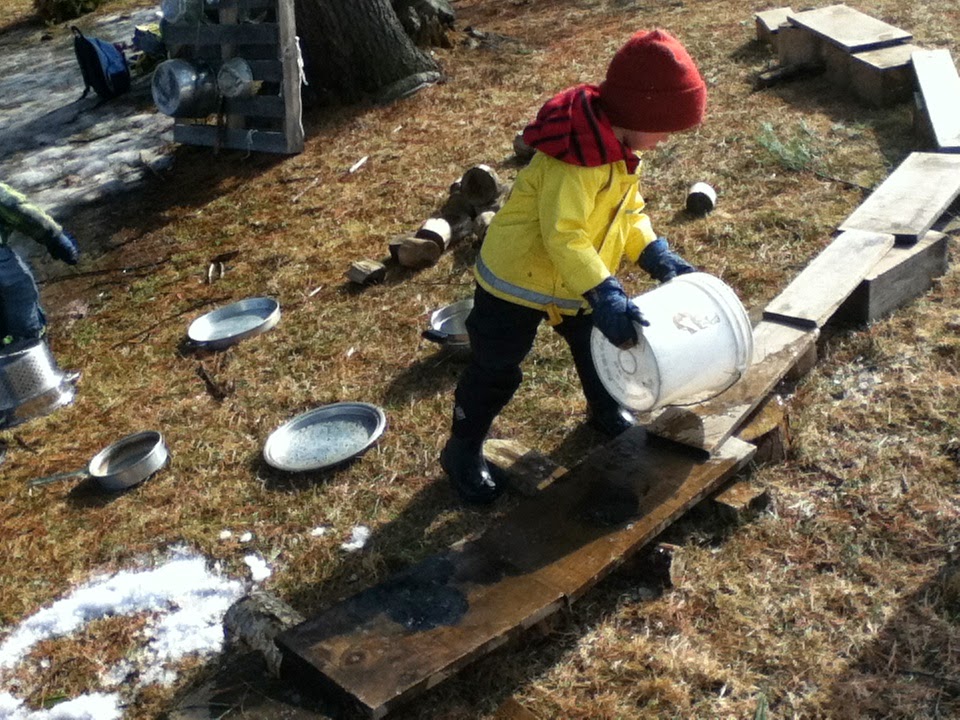
Experimenting with pouring and "washing dishes!"
We look forward to discovering more wondrous signs of spring with Forest Preschoolers in the coming weeks!

Monday, March 30, 2015

Gulls Being Gulls

The birds that most people often simply refer to as 'seagulls' are actually comprised of dozens of species spread across the globe. In Vermont, the most common gull is probably the Ring-billed Gull.

Ring-billed Gulls are opportunistic and have adapted well to the human-altered landscape. They make themselves at home in fast food parking lots, landfills, farm fields, and wherever else they can find an easy meal. But in Winooski, I was thrilled to watch a feeding frenzy of gulls in their 'natural habitat'. 

Their aerial acrobatics were astonishing. As they floated through the sky, they seemed equally able to spot tiny fish in the raging current as they were to spot a competitor's catch that they might be able to steal. I spent over an hour photographing these gulls as they fed. 


Can you spot the fish?

Thieves everywhere!
Attempting to go in for the steal...
...and a lucky fish gets away


Wednesday, February 25, 2015

Hands On History

4th grader burning a bowl into a birch log
As a part of Vermont’s Framework of standards, 4th graders learn about Vermont’s cultural history and how the way people live has changed over the years. With the onset of winter, we decided it was the perfect time for students at Union Elementary School to explore the cultural practices of some of the first Vermonters, the Abenaki and some of the techniques they employed to survive in our Green Mountain State.

Testing out the Christmas tree bed in the wigwam
We wanted to cover some of the most basic needs such as shelter, fire, water, and food. These four things combined make up what is known as the “Sacred Order.” Of the four, shelter is the most important, especially in a cold VT winter! So this is was we started with. We began by breaking into groups to build a fairly simple, A-frame style survival shelter with sticks and snow. There was a freshly fallen hemlock limb that we were able to tear the branches from and use as insulation from the ground. These survival shelters were only large enough to fit one student. On another day, we built a wigwam style shelter with freshly cut saplings and a tarp. As with the survival shelters, we lined the floor with evergreen boughs (this time from abandoned Christmas trees) to insulate us from the snow. This shelter was able to accommodate up to 9 students!

Using the bow drill with a partner eases the stress on your arm.
For the other three elements of the sacred order we spent a day going through station rotations, with each station focused on a different element/skill. At the first station we learned how to use a bow drill to produce a coal that could then be used to light a fire. Fire is often placed before water in the sacred order because of its use to purify water.  Forming a coal with a bow drill can be difficult so students broke into teams to work the bow back and forth, similar to cutting a log with a crosscut saw.  Since this was the first time ever attempting a bow drill for most students, we weren't concerned with forming an actual coal. Our primary goal was to work on our form and technique and to get the spindle spinning for several strokes, which everyone was able to do. One team actually produced smoke!

Taking turns blowing the coal
The next station covered our need for potable water by utilizing fire in the form of a burning ember to burn out a container in which we could boil and purify water. Teachers and parent volunteers tended the fire and helped students transport the hot coals from the fire to the log.  Once a coal was on the log, students took turns holding the coal down with a stick and blowing on it. We were sure to take turns because if we didn't we would get light headed from all of that blowing!

Food was the topic of our third and fourth stations. Unlike the first 3 elements in the order, we can survive weeks without food. Eventually though, we do need to eat.  One of the foods that the Abenaki relied upon were ducks, and to lure them in, they would weave and tie decoys out of cattails. So, armed with only a few pictures to serve as an example and a pile of cattail leaves, students attempted to make their own decoys.  Not only did our decoys look like ducks, but they also floated when we dropped them into the North Branch River on our way back to school. At our final station, we honed our skills with a throwing stick so that if our decoys worked, we would possess the accuracy to successfully harvest our food.

These are ancient skills that are no longer necessary in our everyday lives. However, we are inexplicably drawn to them, emboldened by the deep heartstrings they strike. To better understand and appreciate who we are, it is important to understand how we got here. Then maybe we can better choose where we are going. This is why we study history. Studying it outside during ECO takes the lesson out of the history book and puts it directly into the hands of the student.

Piling snow for a quinzee

Monday, February 16, 2015

It's Happening!


The sky is a shocking, cloudless shade of blue today, contrasting against a pure white blanket that spreads across the landscape. The Black-capped Chickadees and the American Tree Sparrows are flitting to and from the bird feeder. Even though Vermont is deep in winter, as I look out the window and take in the stunning colors and winter bird activity, the upcoming Forest Preschool  spring session is on my mind. I am thinking about the youngster’s eager hands and wide eyes as they explore the wonders of late winter and the dawning of spring in an outdoor classroom here at North Branch Nature Center. I am also thinking about the ever widening gap between children and the time they spend outdoors connecting to nature. I wonder about the potential implications of a shrinking population of future environmental stewards.


As a teacher in an outdoor classroom, I see first hand how young children grow and thrive when they play and learn outdoors. While using all of their senses, curiosity and imagination blossoms and children marvel at the wonders of their world. As budding naturalists at Forest Preschool spend time in natural spaces, they develop a love of mud, trees and big rocks for climbing, tall grass to hide in, weightless milkweed silk and seeds, crunchy leaves for making animal homes, being outside in all types of weather, the tickly feeling of a wooly bear crawling on tender skin, and countless other offerings and experiences in nature. They develop a sense of place and identity in relation to the natural world they are apart of. Inquisitiveness is ignited and followed. Wonder is fostered. But that’s not all that happens.

I recently ran into an acquaintance I hadn't seen in a couple of years. While catching up, I shared a bit about my job as a forest preschool teacher. A curious expression spread across her face. She asked if I teach preschoolers how to survive outdoors. Well, in a way. They develop resilience and learn self care skills in all types of weather, I replied. But really, some of the basic goals of our preschool program are similar to most any preschool; to develop social skills, imagination, and stimulate learning. One difference between the program we run and others is that our classroom does not have walls - the fields and forest are our classroom.


In a dynamic classroom without walls, lifelong foundational skills are laid and development of the whole child is supported. Each natural wonder the children are drawn to - the stickiness of mud, the dispersing of seeds - becomes a lesson. Although forest preschools or forest kindergartens, as they're called in many european countries, are popping up in different parts of the country, by and large, this old concept by european standards is a relatively new idea in the US.


Our Forest Preschool is modeled around German waldkindergartens where children ages 3 to 6 spend all of their time outdoors, except in extreme weather conditions. Teachers guide and support children’s interests and learning rather than compel. Forest Kindergartens are a norm in many european countries. In Germany for example, the government began funding forest kindergartens in 1993. Also, many German primary school teachers report that children who attended waldkindergartens show significant improvements in reading, writing, mathematics, social interactions and many other areas. The Prime Minister of Scotland supports forest kindergartens and outdoor learning because, as he sees it, they are an important factor in the development of “good citizens.”


Not long ago I read an article titled, Into the Woods: American kids don't know how to explore. Maybe what they need is forest kindergarten. In the article, the author, Emily Baslon, wonders about "the implications of constantly channeling kids in a predetermined direction.” Balson shares how she was "taken" by a new documentary called Schools Out: Lessons from a Forest Kindergarten. The documentary brings an intimate look at a forest kindergarten in Switzerland to the movie screen. At the close of the article, she laments that forest kindergartens in the US will not be a reality based upon the trend towards many public school eliminating recess in favor of more “academic” time. However, forest kindergartens are happening! Young children are exploring and empowered to be active in their own learning process right here in our fair capital!  


In my work as a teacher of an outdoor preschool, I support and witness curiosity being fed, imaginations ignited, minds and bodies moving and developing in healthy ways, contagious enthusiasm for learning coming alive, and personal gifts coming into view. The beauty of forest kindergartens, or Forest Preschool as our program is called, is that not only are young children exploring, thriving, developing readiness for kindergarten and future learning, they are connecting to abundant wild wonders on a regular basis. They are developing a sense of place; coming to know the plants and animals of Vermont and developing a caring relationship with the natural world. One day this fall, a forest preschool student shared, “I noticed most of the trees at Deer Camp are maple.” Another exclaimed, “The world is covered in leaves.”


Similar to today’s stunning blue in contrast to the purity of white, there are numerous moments when I find my jaw drop while taking in the sights and sounds of the Vermont landscape. Our children are precious and so too is the Vermont landscape and its wild inhabitants. I am pleased that, despite Emily Balson’s forecast, Forest Preschool and many other forest schools sprouting around the country are working towards closing the gap between children and a connection to nature and ensuring that within the next generation, we will have future caretakers of Vermont’s natural environment. It’s likely young jaws will drop over and over as local natural wonders are discovered. Perhaps youngsters will pause as they notice with recognition, the flit of a Black-capped Chickadee. What better gift to give our children and the future of the land we hold so dear.


Into the Woods: American kids don't know how to explore. Maybe what they need is forest kindergarten, Emily Baslon: http://www.slate.com/articles/double_x/doublex/2013/12/forest_kindergarten_watch_kids_in_switzerland_go_to_school_outside_in_school.html


Tuesday, February 3, 2015

Embracing Winter, Scandinavian Style!


It is zero degrees out and the snow is falling. As I write this blog, my seven year old daughter is outside standing perfectly still next to the bird feeder hanging from a tree branch. Her hand is outstretched and holding a small pile of black oiled sunflower seeds. The warmth of her bodied is sealed in many layers and a balaclava that is covering her chin, cheeks, and nose. A thick hat sits atop her head and the only part of her body that is uncovered is a narrow band around her eyes. She stands in a winter wonderland of soft flakes and is surrounded by Black-capped Chickadees. One of the little birds lands on her mittened hand and retrieves a seed - the moment she has been waiting weather for, despite the cold! Not long ago I read an article, about Nordic babies and young children in winter. The article shared the sentiment, "There is no bad weather, only bad clothing." I'm sure my daughter would agree and I imagine the children who attend Winter Whispers, a weekly drop-off program, and Forest Preschool would agree as well.


I was somewhat surprised when I read the article, The Babies Who Sleep in Sub-zero Temperatures by Helena Lee, that it is a tradition for babies in Norway, Sweden, and Finland, to nap in prams outside - even in winter. In the article, improved health and a theory that babies sleep better and longer outside are described as reasons for doing so. At a preschool outside Stockholm, children spend their entire day doing what they would inside and only go in for meals or unusually cold weather. The article is clear to state, although the weather may be cold, the child must be warm - "It is important to have wool next to the child's skin." Another article entitled, How to Survive Winter in Finland and Enjoy It by Salla Korpela, explains, "The secret to spending time outdoors in the winter is to make sure you are dressed properly." 


Last Thursday, I woke to pink light and clear skies, and knew the mercury in the thermometer would be low. Even though it was sub zero at the time, when I made my way outside into the sunlight, I was struck by how still the air was and how warm my face felt in the light. At the North Branch Nature Center that morning, a fire was made to warm young bodies upon their arrival at Winter Whispers and used for cooking over later in the morning. 


Children arrived all bundled up in just the right outerwear to keep their bodies warm. Eager exclamations of “Can I use a shovel too” started off our play and exploration time in the snow. Thermal under ware, bibbed snow pants, fleece or wool sweater, a warm winter jacket, thick wool socks in boots with room to wiggle toes, a snug neck warmer or balaclava, and fleece lined hat with ear flaps did the job keeping all body parts warm! The little ones used child sized snow shovels to move snow and make paths, became nature detectives and followed animal tracks, slid like otters on their bellies, and watched puffs of steam billow around their faces, all the while cultivating resilience and a love of winter. 

Once inside, to warm during circle and snack, our group was excited to learn they had the opportunity to grind wheat berries into flour, make dough, whittle roasting sticks with a peeling whittler, and bake bread on the stick over an open fire outside. Children used eager hands to grind and feel the soft, powdery texture of flour, stir the dough, and practice fine motor skills by whittling bark off their roasting sticks. 

With these tasks complete, and layers back on, our little community of youngsters made their way outside. They happily circled around the fire pit with their bread dough wrapped around a stick and contentedly began to roast the dough until it was a nice golden brown. They did so over coals of softwood with the scent of cedar filling the air. Golden honey was drizzled over the their freshly baked bread and together the group enjoyed the treat under a winter blue sky streaked by jet plane streams and wispy cirrus clouds. Afterwards, with bellies and bodies warmed and full, we made our way through a field to explore a large quinzee and several igloos on our land afforded to us by the Ice on Fire celebration.

Children were thrilled to explore inside the frozen abodes. They exuberantly scaled up the quinzee's mountainous pile of snow and slid down. A maze of Christmas trees made for exciting hide and seek and imaginary play.

The winter morning ended in song under a bright sun with smiles wide. The only long faces we saw belonged to those who were disappointed that it was time to go home. Now that snow is piling up outside, many more winter delights await Winter Whispers in the coming weeks. Perhaps, donning our winter layers, we will hold out mittened hands piled with black oiled sunflower seeds in hopes a chickadee will eat out of our hands. One thing is for sure, with warm toes and fingers, we will continue developing winter self-care skills, resilience, and a love of the great outdoors in Vermont during this frosty time of year. As a parting thought, I leave you with the ending of The Babies Who Sleep in Sub-zero Temperatures:  "Another saying sums up what Swedes are likely to think when toddlers in other countries are kept indoors in sub-zero (Celsius) temperatures: "A little fresh air never hurt anyone." 


Links to The Babies Who Sleep in Sub-zero Temperatures and How to Survive Winter in Finland and Enjoy It :
http://www.bbc.com/news/magazine-21537988
http://finland.fi/Public/default.aspx?contentid=160110


Wednesday, January 28, 2015

SHRIKE!!!


 "Shrike! Shrike!! SHRIKE!!!"  Chip hollered from his office, jolting us out of our e-mail writing, computer screen glow enhanced trances. After a quick scramble for binoculars and cameras, we all went stampeding into his office and crowded around to see a Northern Shrike no more than 10 feet from the window!


Just as I raised the camera to take a picture, the shrike flew to the left and so did we, stumbling over to the next office for a closer view.  It sat there, tail flicking, for no more than 10 seconds before flying down to the feeders in the lilacs.

Still unable to even attempt a photo, we raced downstairs and into the conference room just in time to see the bird flit past a second feeder and around the back of the building.  To the kitchen we migrated but the windows were too dirty for a clear photo so I raced back upstairs to my own office window where I saw the shrike perched atop the burr oak near the kiosk.  There it sat for a solid 60 seconds, turning its head every which way, presumably looking for the next feeder to surprise attack.  After finally being able to snap off a couple quick shots, my racing heart hit another gear as it left its perch and flew directly toward the house and alighted on a branch in the small sugar maple directly outside the office window.

 The stunning black and white patterning on the gray body caught me off guard at this close range as I zoomed out to fit it in the frame.  It looked down at the feeder, then to the barn and then to the right across the road... and off it flew, vanishing around the corner and across the road.


Gone.

It had only spent a total of 3 minutes zipping around the house but its energy continued to buzz throughout the office the rest of the morning.  I am always amazed at how birds can command our attention so completely and am grateful to work at a place where the staff will drop everything they are doing at the call of "SHRIKE!"


Friday, January 16, 2015

Winter Whispers Begins!

This Thursday was the first day of our new winter drop-off program for preschoolers, Winter Whispers. With the weather at a chilly -4° at 9 am, we started indoors: making natural sun catchers and experimenting with what happens when you bring snow inside and how it looks under magnifying glasses. There was also plenty of time during our morning free play (known as “loose parts play”) to pretend to be animals. We practiced our hopping from lily pad to lily pad as frogs, our flying as snowy owls, and using our sneaky feet as foxes.

After our morning circle, some songs, and a snack, everyone worked to figure out layers and zippers and what outdoor gear goes on first to get ready to go on a snowy adventure outside. It may seem mundane, or even a chore for us teachers, to help get several 3.5-5 year olds dressed adequately to be outside for an hour or more on a cold day, but, for me, this process is a total highlight. When we work with preschoolers at NBNC, one of our major aims is to help them learn to care for themselves and their belongings. This is so much spatial and sequential reasoning to be learned from the process of dressing in layers. As the session progresses, it is a total gift to watch the kids become more confident and need less coaching in this process as they work out these new skills.

Grandfather sun came out and warmed the world a bit so we ventured out into the wild world of winter. Once outside, we hunted for “jewels” (frozen ice cubes tinted with food coloring) in the snow and other treasures that Mother Nature had left us. Eventually the majority of our time was taken up by several children working cooperatively to open an imaginary candy store (where the jewels were re-imagined as colored chocolates!) and by lots of sliding on sleds on our new fluffy snow. It is safe to say that the preschoolers, Mary, and I all had an equally joyous and exciting day to begin this new program in beautiful winter. We can’t wait until next week when we turn our focus to birds and what winter is like for them.

Winter Whispers is a drop-off program for preschoolers 3.5-5 on Thursdays from 9am-noon until February 19th. There are still a few spots open in the program! For more information visit our website at: http://www.northbranchnaturecenter.org/programs.html#winterwhispers