|  Home  |   About us  |   Programs & Projects  |   Calendar  |   Birding  |   Blog  |   Get Involved  |

Wednesday, January 19, 2011

Varied Thrush in Bolton Becomes a Celebrity


For weeks, a Varied Thrush has resided in the backyard of Don and June Kenney of Bolton.  Last week, the bird was featured on WPTZ (news channel 5) and the video is now online, with some commentary from NBNC educator Larry Clarfeld.  View the video.

Thursday, January 13, 2011

Ice Circles on the North Branch


Meetings at the North Branch Nature Center frequently get interrupted by natural phenomena. Usually it’s a bird sighting or a butterfly, certainly something alive. But what had us pulling on boots and hats recently was something more geometrical in nature. Larry Clarfeld, environmental educator at NBNC, had found what’s called an ice circle/disc or “pizza ice”. When he first came upon the ice circle along a bend of the North Branch of the Winooski River, it was slowly revolving in place. This particular stretch of river has a sharp bend near a spot we call “otter rock”. The river here features a deep hole and an eddy that may have helped the circle to form.

Expert on ice formation, Faye Hicks, a professor at the department of civil and environmental engineering at the University of Alberta in Edmonton, says these rarely-seen discs form near the outside of a bend in the river. When flow enters a river bend, flow velocities increase due to the effects of centrifugal acceleration; also, the bulk of the flow is pushed towards the outer bank."

"This high-velocity flow curves around the outer bank of the bend and, if there is an ice cover in the bend, the curving flow creates a curved drag force on the underside of the ice," Hicks said.

The rotating ice scrapes along the bank or nearby ice, eventually smoothing off the rough edges and creating a nearly perfect circle.

By the time we all got down to the river the ice circle had frozen in place, but there were actually two frozen ice disks nearly in contact with each other. One wheel, the recently rotating one, measured an estimated 25 feet in diameter, while the smaller one was about 15 feet across. I imagine one wheel formed first, eventually floated a bit downstream and froze into place, while another formed in its place.

If you’d like to learn more about how ice circles form, you can visit the Burlington Free Press's coverage on ice circles last year and even watch a video of it rotating in place (somewhat akin to watching paint dry).

Thursday, January 6, 2011

Hawk Owl Returns

After not being seen since January 1st, the Northern Hawk Owl was seen this morning at around 9:30 am. Here is a digiscoped picture:


More details about this sighting are in the comment of the previous post

Monday, January 3, 2011

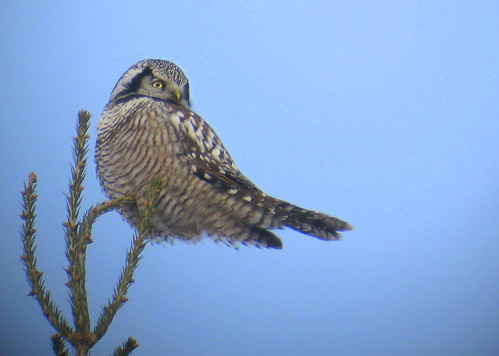
New Year's Northern Hawk Owl in Berlin, VT!

2010 ended with some excitement for Nat Shambaugh as he discovered a Northern Hawk Owl hanging out in the fields around Towne-Aire farm at the end of Jones Brook Rd in Berlin! “Go west on route 2 out of Montpelier, turn left at the fork past the Dairy Creme onto Three Mile Bridge Rd,” directed Nat, “go over the bridge and turn right onto the river road and start looking around in the tree tops and elec. poles…” After reporting the bird on the VTBIRD list on December 31, eager birders from around the state converged on Berlin to see the owl and over a dozen people saw the Hawk Owl in the 48-hours following Nat's original posting.


Northern Hawk Owls are indeed owls, not hawks, and are breeders of the boreal forest, only venturing to our southern reaches occasionally in winter. It gets its name because, as one would expect, it is said to resemble a hawk in appearance with a more slender, stream-lined body, smaller head, and overall more “hawk-like” posture and appearance than other North American owls. A treat for any birder (or non-birder, for that matter) to see, these owls are diurnal. When they do appear in our state, being active by day makes them much easier to observe. Furthermore, they have a tendency to choose the most prominent perch, be it the tippy-top of a tree, a telephone pole or wire, a fence post, or a street sign. Although their appearance in our state is rare, when they do appear, they tend to stick around and attract hordes of birders. The image above of a Hawk Owl in Eden, VT spent almost 2 months in the same location in the winter of 2009, being seen dozens of times by scores of birders. How long the Berlin owl will stick around is anybody’s guess.


Despite many search attempts since January 1st, the Berlin Hawk Owl hasn’t been relocated. Living only a few miles from the site where it was discovered, Chip Darmstadt was hot on the scene before its disappearance and got the picture shown above. “Eventually it flew over Jones Brook Road,” recounted Chip, “continuing to hunt from the powerline on the open hillside (technically in Moretown). There's a lot of open country along this stretch of the Winooski, so it would definitely be worth driving all of River Road between Montpelier and Middlesex [for those who want to look for it].” Another lucky observer, John Snell, managed to capture some thermal images of the owl as the sun set on New Year ’s Eve. Check out these amazing images below! (note that the right image shows the Hawk Owl on the ground after catching a rodent!)


We’ll keep trying to relocate this bird and will make updates on our blog, so check back for more details. Also, Bryan Pfeiffer, guru birder and friend of NBNC is keeping tabs on sightings on his blog, The Daily Wing. Whether the bird is rediscovered or not, it has already put on quite a show and given us a great start to the Washington County Birding Challenge!

Wednesday, December 29, 2010

The Birds of Washington County


Inspired by our friends at the Vermont Center for Ecostudies (VCE), NBNC invites you to participate in our first year-long Washington County Birding Challenge. For an entire year, we will be tracking how many bird species are seen in Washington County (WaCo). How many birds will we find? You can help us by reporting the birds you see!


Through the WaCo Birding Challenge we seek to learn more about where different birds live in our county, discover areas that might be important to rare species, raise awareness about the many amazing birds that visit our county, and hav fun while celebrating our local biodiversity. We'll even include a venue for those who want to compete to see if they can find the most birds in WaCo. To submit your observations (starting January 1, 2011) or see the latest tally, visit http://www.northbranchnaturecenter.org/waco/ and stay tuned for details.

Monday, December 20, 2010

Plainfield CBC Results


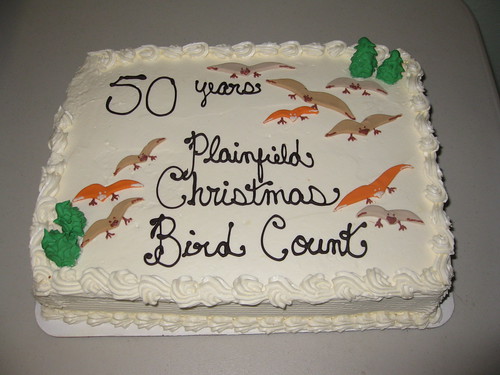
On Saturday, the 50th Plainfield Christmas Bird Count was held and the preliminary results are in. These results are not complete, but already we've recorded a 10-year high in our total species count of 40 (ten year average is 25 species). The most unusual sighting was a group of three Lapland Longspur that were seen eating grit by the side of a road, the first time this species has appeared for the Plainfield circle. Other highlights included a flock of 18 Pine Grosbeak (not many/any reports this season), a pair of Hooded Mergansers (rare on this count), good numbers of Bohemian Waxwing (98), and others. The preliminary tally is below:

Mallard 11
Hooded Merganser 2
Ruffed Grouse 2
Wild Turkey 311
Accipiter sp. 1
Red-tailed Hawk 1
Rock Pigeon 349
Mourning Dove 160
Barred Owl 1
Downy Woodpecker 39
Hairy Woodpecker 42
Pileated Woodpecker 7
Northern Shrike 1
Blue Jay 216
American Crow 247
Common Raven 46
Black-capped Chickadee 1263
Tufted Titmouse 13
Red-breasted Nuthatch 13
White-breasted Nuthatch 34
Brown Creeper 2
Golden-crowned Kinglet 13
American Robin 1
European Starling 752
Bohemian Waxwing 98
Cedar Waxwing 10
American Tree Sparrow 22
Dark-eyed Junco 22
Lapland Longspur 3
Snow Bunting 175
Northern Cardinal 27
Brown-headed Cowbird 6
Pine Grosbeak 18
Purple Finch 2
House Finch 7
Common Redpoll 40
Pine Siskin 2
American Goldfinch 188
Evening Grosbeak 12
House Sparrow 36

Thursday, December 16, 2010

Counting on You to Count the Birds

A group of 27 bird enthusiasts set out on Christmas Day, 1900 to count the birds they saw. This simple act was the creation of a century-long crusade that engaged over 60,000 people this past season. Creator Frank Chapman recognized the potential of the bird count from the beginning. In the announcement of the sixth bird count Chapman proclaimed “…we are gradually accumulating a mass of exact information… having, consequently, a real scientific value.” Now, 110 years later, the CBC has been cited in hundreds of papers and is now considered one of 24 major
indicators of climate impacts by the EPA.

Originally proposed by Frank Chapman, the CBC was proposed as an alternative to the ‘side hunt’, a tradition of the times that involved two teams of men competing in a kill-competition to see which team can accrue the most animal carcasses. In Enosburg Falls, VT, the participants of an 1896 side hunt collected a bevy of over 550 birds and mammals(see above). Not surprisingly, those numbers were drastically reduced in 1897. Through Bird Lore, the popular magazine Chapman published, he announced “a new kind of Christmas side hunt in the form of a Christmas bird-census”.

By 1902, the third year of the CBC, Vermonters were already participating. Gilbert H. Trafton spent six hours on Christmas Day scouring Randolph Center for birds and tallying a shrike, two White-breasted Nuthatches, and a chickadee. “The number of birds seen was very small,” remarked Trafton, “but it gives a fair indication of the winter bird-life here. I pass many days without seeing or hearing a single bird.” This statement held true to Chapman’s original intent to capture a census of observations both unusual and mundane, but thankfully, Vermont CBC’s since then have produced plenty of birds both common and rare.

The CBC in Vermont has come a long way since the first in 1902, which counted just four birds. In 2010, over 350 participants performed 17 counts tallying around 100,000 birds of over 100 species. The increase in popularity isn’t isolated to Vermont. Increasing numbers of CBC’s are being held in Latin America, the Caribbean Islands, and elsewhere. In 2009, a CBC was even held in Antarctica.

With its growth in size, the CBC has become a powerful tool in knowing and understanding the population trends of birds in winter. One can see the rise of Wild Turkey and the decline of Evening Grosbeak. We can even see the effects of climate change as species like Carolina Wren spread north. Only time will tell what other trends the CBC reveals, but for it to continue to be useful, we’re counting on you to count the birds.

This article originated from the Nature Center's Youth Birding Newsletter